

Fact checked by Rebecca Thornton, M.S., Food Science and Human Nutrition
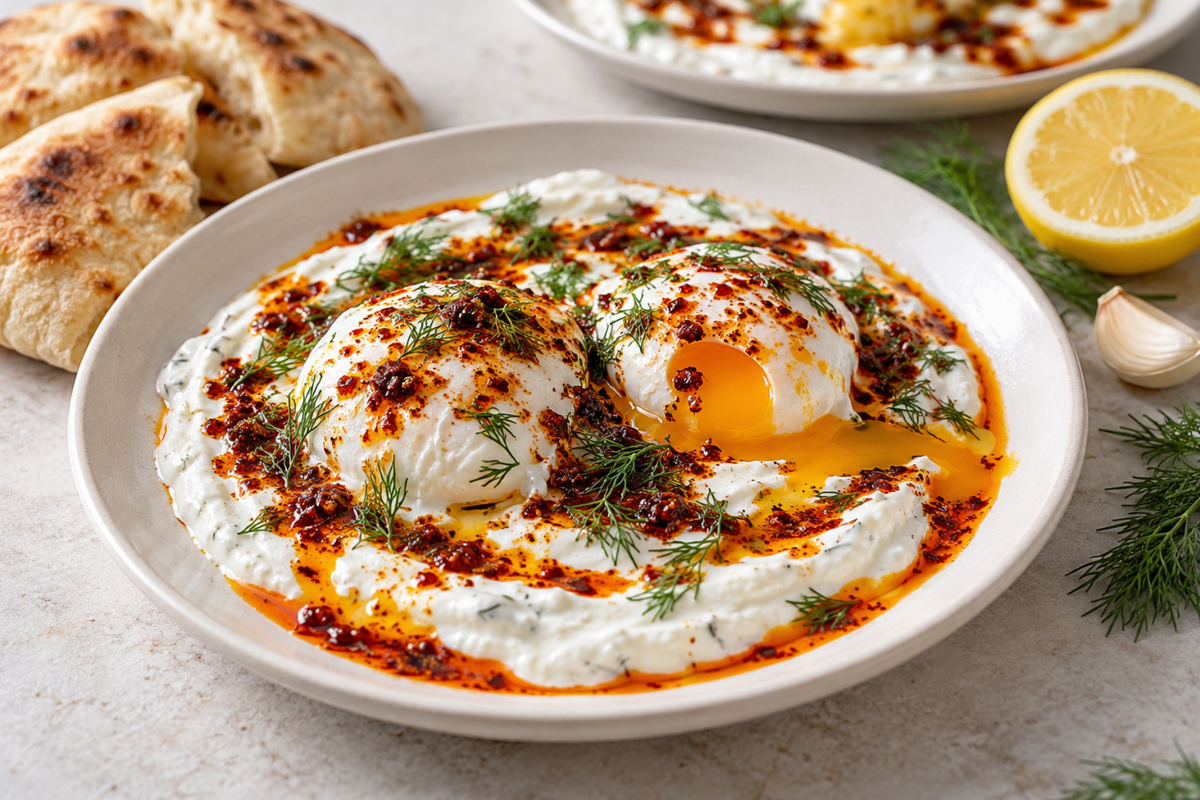
You have paid $16 for this at brunch. Garlicky yogurt, a poached egg broken over it, chili butter pooling at the edges, bread for scooping.
It is four ingredients and takes eight minutes.
It also quietly solves the problem everyone is trying to solve with a shaker bottle. The advice to get 30 grams of protein at breakfast is everywhere, and almost every recipe answering it involves powder. These Turkish eggs land at about 35 grams from yogurt and eggs alone.
There is one thing you have to get right or it turns into a watery mess. It is not the poaching.
What's in This Post
- Where the Protein Comes From
- Why This Works
- Ingredients
- The Yogurt Rule
- Step-by-Step
- Health Benefits
- Key Takeaways
- Tips and Variations
- FAQ
- Sources
Where the Protein Comes From
| Component | Amount | Protein |
|---|---|---|
| Plain nonfat Greek yogurt | 1 cup (227 g) | ~23 g |
| Large eggs | 2 | ~12.6 g |
| Total | ~35 g | |
| With whole-milk Greek yogurt instead | ~33 g |
Approximate, from USDA FoodData Central [5]. Brands vary by a gram or two.
For scale, here is what 30 grams looks like from a single food:
| To get 30 g from one food | You'd need |
|---|---|
| Large eggs | 5 |
| Cooked chicken breast | 3.5 oz |
| Peanut butter | 8 tablespoons |
| Cooked black beans | About 2 cups |
Eight tablespoons of peanut butter is the one that stops people. Combining two sources is far easier than leaning on one.
Why This Works
- About 35 grams of protein, no powder and nothing that tastes like a supplement
- Eight minutes, four core ingredients
- Genuinely a restaurant dish: this is çılbır, served in Turkey for centuries
- Savory, so it doesn't taste like dessert at 7 a.m.
- The chili butter takes 90 seconds and makes it look like you tried
- Naturally gluten-free if you skip the bread or use a gluten-free one
Ingredients You'll Need
Serves 1.
The yogurt base
- 1 cup plain Greek yogurt (full-fat, 2%, or nonfat), at room temperature (see below)
- 1 small garlic clove, grated on a microplane
- 1/4 teaspoon fine sea salt
- Squeeze of lemon
The eggs
- 2 large eggs, as fresh as you can get
- 1 teaspoon white vinegar for the poaching water
The chili butter
- 1 1/2 tablespoons butter (or olive oil)
- 1/2 teaspoon Aleppo pepper, or 1/4 teaspoon red pepper flakes plus a pinch of paprika
- Small pinch of salt
To finish
- Fresh dill or mint, torn
- Warm pita, sourdough, or toasted flatbread (choose a high-fiber version for extra satiety)
- Optional: 2 tablespoons hemp hearts over the top, about +6 g protein
The Yogurt Rule
This is the step that decides whether you get silky or grainy, and it is the one every home version skips.
Cold yogurt splits when a hot egg lands on it. The proteins tighten, the whey squeezes out, and you get a pool of watery liquid under a curdled base. It still tastes fine. It looks terrible and it feels wrong in the mouth.
Two rules fix it:
- Bring the yogurt to room temperature. Take it out of the fridge when you start heating the poaching water. Fifteen to 20 minutes is enough. Room-temperature yogurt meets a hot egg without shocking.
- Never microwave it. Direct fast heat is exactly what makes it break. If you are in a hurry, set the bowl of yogurt over the poaching pan for a minute while the water comes up. Gentle and indirect.
Use strained yogurt: Greek, skyr, or labneh. Regular yogurt is too loose and will weep no matter what you do.
Bonus, for better poached eggs: crack each egg into a fine mesh sieve and let it sit for ten seconds before it goes in the water. The loose, watery part of the white drains away, and that is the part that turns into those wispy strands. What is left holds together in a neat oval. This works better than swirling the water.
Step-by-Step Instructions
- Take the yogurt out. Stir in the grated garlic, salt, and lemon. Leave it on the counter while you do everything else.
- Heat the water. Fill a wide pan about 3 inches deep. Bring to a bare simmer, with small bubbles on the bottom and nothing breaking the surface. Add the vinegar.
- Sieve the eggs. Crack each into a fine mesh sieve over a bowl, wait ten seconds, then tip into a small cup. Discard the watery white that drained through.
- Poach. Slide the eggs in gently. Cook 3 minutes for a fully runny yolk, 3 1/2 for jammy. Do not let the water boil. A rolling boil tears the whites apart.
- Make the chili butter. While the eggs cook, melt the butter in a small pan over medium-low. When it foams and starts to smell nutty, take it off the heat and stir in the Aleppo pepper and salt. It should be warm and red, not smoking.
- Build it. Spread the yogurt across a shallow plate, pushing a slight well into the middle with the back of a spoon.
- Lift and drain. Take the eggs out with a slotted spoon and rest them on a paper towel for five seconds. Wet eggs water down the yogurt.
- Finish. Settle the eggs into the well, spoon the chili butter over, and scatter the herbs. Serve with warm bread immediately.
Total time: about 8 minutes.
Health Benefits
Spreading protein across the day is the actual point. In healthy adults, eating protein evenly across three meals, roughly 30 grams each, produced greater 24-hour muscle protein synthesis than the common pattern of a light breakfast and a protein-heavy dinner, even when the daily total was identical [1]. Breakfast is where most people's distribution falls apart.
There is a per-meal threshold. Research on protein dosing suggests the body responds better to a meaningful amount at once than to a trickle, and that the amount needed per meal rises with age [2].
Protein supports fullness. A systematic review and meta-analysis of randomized trials found higher protein intake influences appetite and the gut hormones involved in signaling fullness [3]. If hunger has been running your day, our guide on why your appetite feels out of control even when you eat healthy goes deeper.
Protein supports muscle maintenance. A meta-analysis in healthy adults found higher protein intakes support muscle mass and function, particularly alongside resistance training [4]. For the bigger picture, read why strength changes after 35 and how to support your muscles naturally.
Key Takeaways
- Yogurt plus eggs reaches about 35 grams of protein with no powder and no shake.
- Even protein distribution across meals beat back-loading it at dinner in healthy adults [1].
- Room-temperature strained yogurt is non-negotiable. Cold yogurt splits, microwaved yogurt breaks.
- Sieving the egg before poaching removes the loose white and gives you a clean oval.
- Four ingredients, eight minutes, and it is a real restaurant dish rather than a health-food invention.
Tips & Variations
- Dairy-free: this one does not translate well, because the yogurt is the protein. A thick unsweetened coconut or soy yogurt works for flavor but drops you to roughly 15 g.
- No poaching: two soft-boiled eggs, peeled and halved, sit on the yogurt just as happily. Six and a half minutes from boiling.
- Push past 40 g: add 2 oz of smoked salmon or a spoonful of cottage cheese folded into the yogurt.
- Make it a full plate: wilted spinach under the yogurt, or roasted tomatoes alongside.
- Meal prep: mix the garlic yogurt up to 3 days ahead and keep it covered in the fridge. The eggs and butter have to be fresh. Take the yogurt out 20 minutes before you eat.
- Allergies: nut-free and seed-free as written.
- Kids: skip the chili and use plain melted butter with a little paprika for color.
Frequently Asked Questions
What does 30 grams of protein look like at breakfast?
Roughly 5 large eggs, 1 1/4 cups of Greek yogurt, or 3.5 ounces of cooked chicken. Most people find it easier to combine two sources. This recipe uses yogurt plus eggs to reach about 35 grams.
How do I get 30 grams of protein without protein powder?
Combine two whole-food sources at the same meal. Greek yogurt with eggs, cottage cheese with eggs, or eggs with smoked salmon all clear 30 grams. Single foods rarely do at normal portion sizes. For a sweet, no-cook option, try our High Protein, Omega-3 Chia Yogurt.
Why did my yogurt go watery?
It was cold, or it was microwaved, or it was not strained yogurt. Bring Greek yogurt to room temperature for 15 to 20 minutes before serving, warm it only gently and indirectly, and drain the poached eggs before they land.
How many eggs is 30 grams of protein?
About 5 large eggs, since each has roughly 6.3 grams [5]. That is why egg-only breakfasts rarely get there.
Can I use regular yogurt instead of Greek?
Not really. Regular yogurt has about half the protein per cup and is loose enough to run across the plate. Greek, skyr, or labneh all work.
Is this good for meal prep?
The garlic yogurt keeps 3 days. The eggs and chili butter need to be made fresh, which takes about 5 minutes.
What is çılbır?
The Turkish name for this dish: poached eggs on garlicky yogurt with spiced butter. It has been eaten in Turkey since Ottoman times, long before anyone was counting grams of protein.
What supplement pairs with a higher-protein routine?
Eggs and yogurt cover protein well but give you almost no EPA or DHA. Nourishing Nutrients Wild Caught Fish Eggs delivers those directly, so your breakfast has backup where whole foods fall short.
Make It This Weekend
Take the yogurt out of the fridge first. Everything else follows.
Sources
- Mamerow, M. M., Mettler, J. A., English, K. L., et al. (2014). Dietary protein distribution positively influences 24-h muscle protein synthesis in healthy adults. The Journal of Nutrition, 144(6), 876-880. PubMed
- Moore, D. R., Churchward-Venne, T. A., Witard, O., et al. (2015). Protein ingestion to stimulate myofibrillar protein synthesis requires greater relative protein intakes in healthy older versus younger men. The Journals of Gerontology: Series A, 70(1), 57-62. PubMed
- Kohanmoo, A., Faghih, S., & Akhlaghi, M. (2020). Effect of short- and long-term protein consumption on appetite and appetite-regulating gastrointestinal hormones, a systematic review and meta-analysis of randomized controlled trials. Physiology & Behavior, 226, 113123. PubMed
- Nunes, E. A., Colenso-Semple, L., McKellar, S. R., et al. (2022). Systematic review and meta-analysis of protein intake to support muscle mass and function in healthy adults. Journal of Cachexia, Sarcopenia and Muscle, 13(2), 795-810. PubMed
- U.S. Department of Agriculture, Agricultural Research Service. FoodData Central. FoodData Central
These statements have not been evaluated by the Food and Drug Administration. This product is not intended to diagnose, treat, cure, or prevent any disease.
This content is for informational purposes only and is not medical advice. Talk with your healthcare provider before starting any new supplement, especially if you are pregnant, nursing, taking medication, or managing a health condition.


