

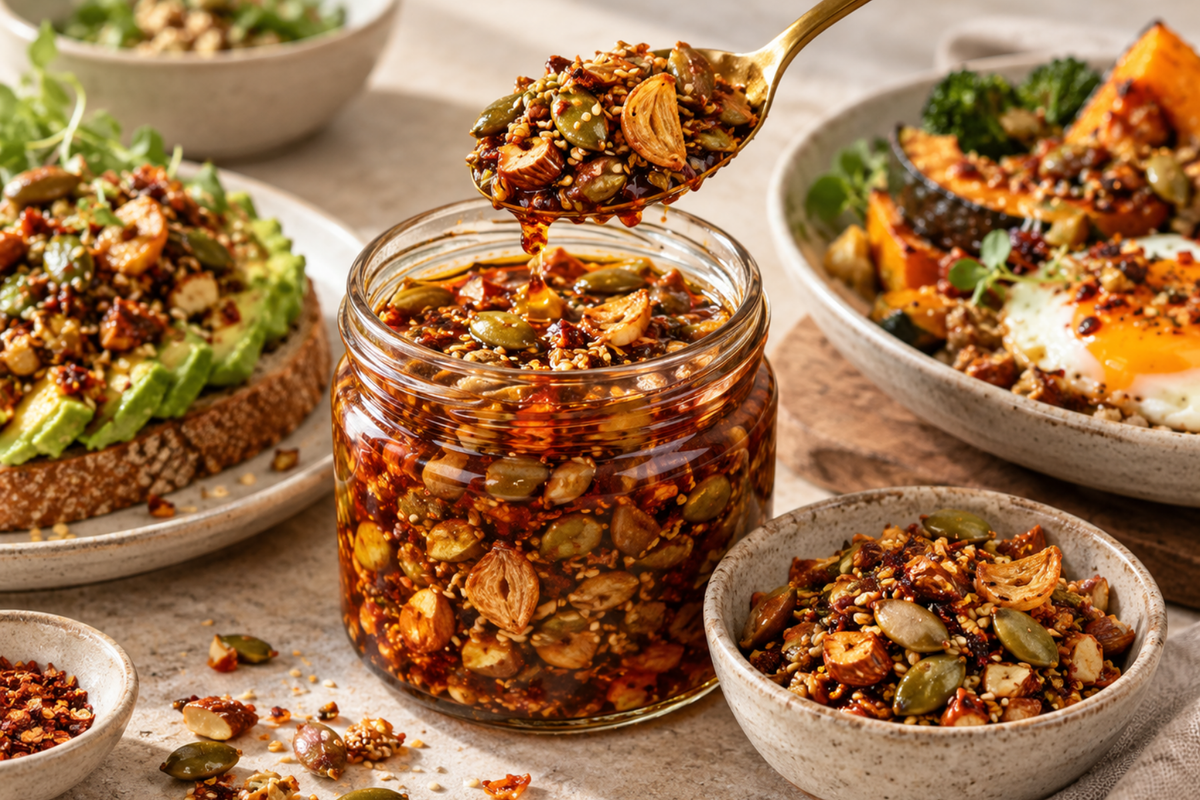
You know the 3 p.m. slump. You reach for something crunchy and salty, and ten minutes later you want another handful.
This chili crisp pumpkin seed crunch fixes the craving and does something useful at the same time. Pumpkin seeds full of magnesium, and magnesium is a mineral your body uses to make energy and keep muscles and nerves working normally [1]. Almost half of Americans consume less magnesium than recommended [1].
Make one jar on Sunday. Spoon it on eggs, soup, rice, roasted vegetables, or avocado toast all week.
Table of Contents
- Why You'll Love It
- Ingredients
- Ingredient Spotlights
- Step-by-Step
- How Magnesium Works in the Body
- Key Takeaways
- Variations & Tips
- FAQ
- References
- Disclaimer
Why You'll Love It
- Real magnesium, not a token sprinkle. 156 mg per ounce [1].
- 15 minutes, one pan. No baking, no special gear.
- Keeps for a month. Store it in the fridge in a jar.
- Savory, not sweet. Fills a gap most healthy recipes ignore.
- Goes on everything. Eggs, grain bowls, soup, roasted squash, yogurt, and salads.
Ingredients
Makes about 2¼ cups (18 servings of 2 tablespoons)
The crunch
- 1 cup raw pumpkin seeds (pepitas)
- ½ cup raw almonds, roughly chopped
- 2 tablespoons white sesame seeds
- ½ cup neutral oil (avocado, grapeseed, or light olive)
The chili crisp base
- 3 tablespoons crushed red pepper flakes (or 2 tablespoons gochugaru for milder, redder color)
- 4 cloves garlic, thinly sliced
- 1 small shallot, thinly sliced
- 1 tablespoon soy sauce or tamari
- 1 teaspoon fine sea salt
- 1 teaspoon smoked paprika
- ½ teaspoon ground cumin
- 1 tablespoon nutritional yeast (optional, adds savory depth)
Ingredient Spotlights
Pumpkin seeds
Roasted pepitas provide 156 mg of magnesium per ounce, or 37% of the Daily Value [1]. They also bring plant protein, zinc, and healthy fats.
Almonds
Almonds provide 80 mg of magnesium per ounce, or 19% DV [1]. They stay crisp in oil longer than most nuts, so the texture holds up all week.
Garlic and shallot
Fried slowly in oil until golden, they turn sweet and shatter-crisp. This is what makes chili crisp taste like chili crisp.
Step-by-Step
- Cold-start the aromatics. Put the sliced garlic and shallot in a cold saucepan with the oil. Turn the heat to medium-low. Starting cold keeps them from burning.
- Fry until golden. Cook for 8–10 minutes, stirring often. Pull them out with a slotted spoon as soon as they turn light gold. They will continue to darken afterward. Drain on a paper towel.
- Toast the seeds and nuts. Add the pumpkin seeds and almonds to the same oil. Cook for 3–4 minutes, until the pepitas puff and pop. Add the sesame seeds for the last 30 seconds.
- Kill the heat. Turn off the burner. Stir in the pepper flakes, salt, smoked paprika, and cumin. The residual heat blooms the spices without scorching them.
- Finish. Stir in the soy sauce, nutritional yeast, and reserved garlic and shallot. It will sizzle. That is normal.
- Cool completely before jarring. Warm crunch turns into soggy crunch.
How Magnesium Works in the Body
Magnesium is a cofactor in more than 300 enzyme systems [1]. In plain terms, it is a helper mineral your body needs for chemical reactions to run.
Two roles matter most here:
- Energy production. Your body requires magnesium to make usable energy from food [1]. One review counts magnesium's involvement in more than 600 enzymatic reactions, including energy metabolism [2].
- Muscle and nerve function. Magnesium helps move calcium and potassium across cell membranes, which supports normal muscle contraction and nerve signaling [1].
Eating magnesium-rich foods supports these normal processes. It does not treat, cure, or prevent any condition.
Key Takeaways
- Pumpkin seeds have 37% DV of magnesium per ounce [1].
- Avocado, by comparison, provides 5% DV per ½ cup [1]. It is good food, but a weaker magnesium source.
- 48% of Americans take in less magnesium from food and beverages than the estimated average requirement [1].
- Magnesium supports normal energy production and muscle and nerve function [1][2].
- A 2-tablespoon serving of this crunch supplies an estimated 50 mg of magnesium, about 12% DV, based on USDA values for the ingredients.
Variations & Tips
- Nut-free: Swap almonds for sunflower seeds.
- Low-sodium: Cut the salt to ½ teaspoon and use low-sodium tamari.
- Milder: Use gochugaru instead of red pepper flakes. You get the same color with far less heat.
- Sesame-free: Leave the sesame out and add 2 more tablespoons of pepitas.
- Storage: Keep in an airtight jar in the fridge for up to 1 month. Keep the seeds submerged in oil.
- Don't skip cooling: Jarring warm crunch creates steam and softens everything.
FAQ
Are pumpkin seeds really higher in magnesium than leafy greens?
Yes. One ounce of roasted pumpkin seeds has 156 mg. A half cup of boiled spinach has 78 mg [1]. Both are good sources, but pepitas are denser.
Can I use pre-made chili crisp?
You can, but you will lose most of the magnesium. Store-bought versions are mostly oil and chili with few seeds. The pepitas are the point here.
Why cold-start the oil?
Garlic burns fast in hot oil and turns bitter. Starting cold lets it cook evenly and stay sweet.
How spicy is it?
Medium as written. Start with 1½ tablespoons of pepper flakes if you are heat-sensitive. You can always stir in more.
Can I make it oil-free?
Not really. The oil fries the aromatics and helps preserve the jar. You can reduce it to ⅓ cup, but the crunch will not keep as long.
References
- Office of Dietary Supplements, National Institutes of Health. Magnesium: Fact Sheet for Health Professionals.
- de Baaij JH, Hoenderop JG, Bindels RJ. Magnesium in man: implications for health and disease. Physiol Rev. 2015;95(1):1–46.
Disclaimer
These statements have not been evaluated by the Food and Drug Administration. This product is not intended to diagnose, treat, cure, or prevent any disease. Talk with your healthcare provider before making changes to your diet or supplement routine, especially if you are pregnant, nursing, or taking medication.


