

You have probably seen fiber maxxing all over your feed. The advice is usually the same: eat more beans, eat more vegetables, eat more whole grains.
Good advice. Also exhausting.
Here is the part nobody says out loud. The average American adult eats about 16 grams of fiber a day, and only around 5 percent hit the recommended amount [1]. That is a gap of roughly 10 to 15 grams. But you are not going to close it by cooking three completely different meals from scratch.
You close it 5 grams at a time.
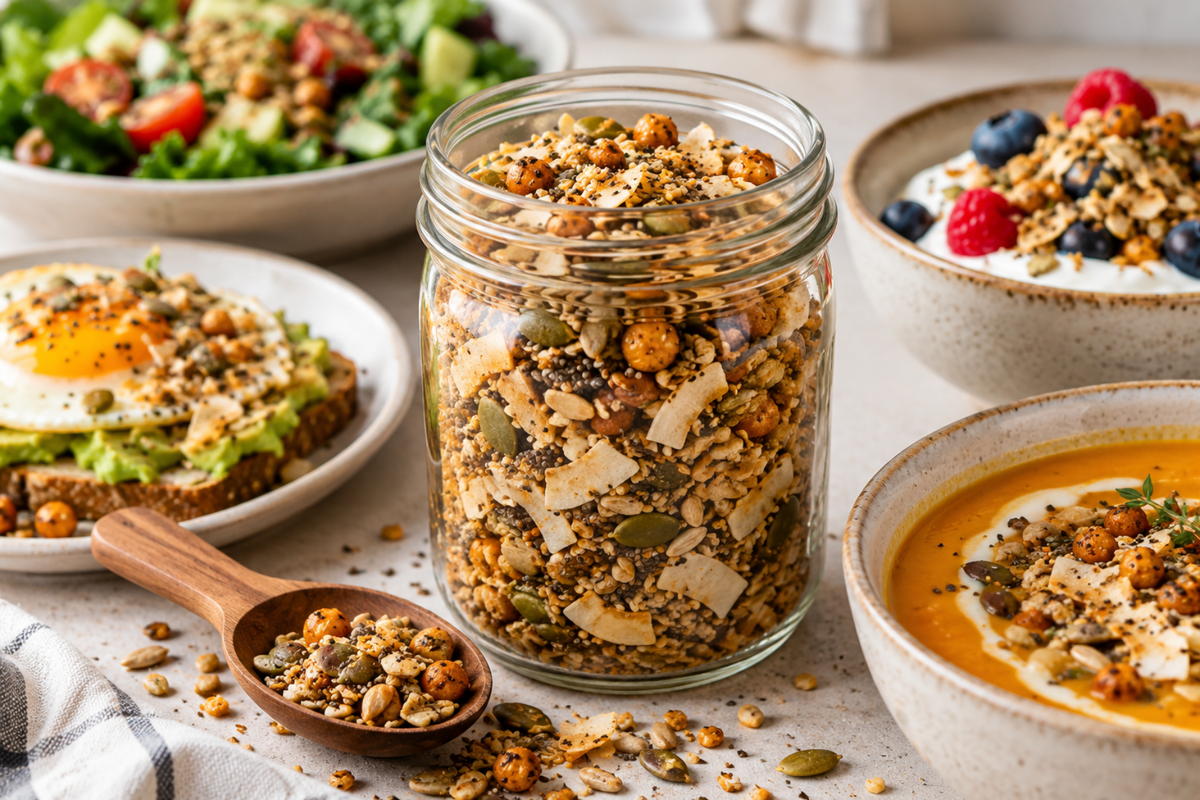
This high fiber topping — we call it fiber confetti — is one jar you make on Sunday in about 20 minutes. Then you spoon it over whatever you were already going to eat. Eggs. Soup. Salad. Yogurt. Avocado toast. Leftover rice. Three scoops across a normal day adds roughly 15 grams of fiber, and you never planned a single "high fiber meal."
That is fiber stacking, and it is the whole trick.
What's in This Post
- Why You'll Love This
- The Fiber Math
- Ingredients
- Ingredient Spotlights
- Step-by-Step Instructions
- Two Flavors From One Base
- How to Use It All Week
- Health Benefits
- Key Takeaways
- Tips & Variations
- FAQ
- References
Why You'll Love This
- One jar, twenty minutes, ten servings. Make it once, use it for a week and a half.
- About 5 grams of fiber per scoop. No measuring at mealtime, no thinking.
- Two flavors from one base. Savory for eggs and soup. Cocoa-cinnamon for yogurt and oats.
- It stays crunchy. The crushed crispy chickpeas are the secret. They do not go soft the way granola does.
- Nothing weird. Six ingredients you can find at any grocery store.
- Naturally gluten-free and plant-based.
The Fiber Math (So You Can See Where It Comes From)
Most "high fiber" recipes tell you the number and hope you believe them. Here is the actual breakdown for one batch.
| Ingredient | Amount | Approx. fiber |
|---|---|---|
| Chia seeds | 1/3 cup | 20 g |
| Ground flaxseed | 1/3 cup | 12 g |
| Pumpkin seeds (pepitas) | 3/4 cup | 6 g |
| Crispy chickpeas, crushed | 1/2 cup | 5 g |
| Sunflower seeds | 1/3 cup | 4 g |
| Unsweetened coconut flakes | 1/4 cup | 3 g |
| Total batch (~2 1/2 cups) | ~50 g | |
| Per 1/4 cup scoop (10 scoops) | ~5 g |
Fiber values are approximate and come from USDA FoodData Central [6]. Exact numbers shift a little by brand and by how finely everything is chopped.
The daily stack, for reference:
- Scoop on breakfast: +5 g
- Scoop on lunch: +5 g
- Scoop on dinner: +5 g
- Total added: about 15 grams
Most adults do well aiming for somewhere around 25 to 29 grams a day [2]. If you are starting near the 16-gram average, this jar alone gets you into range.
Ingredients You'll Need
Makes about 2 1/2 cups (10 scoops)
The Base
- 3/4 cup raw pumpkin seeds (pepitas), unsalted
- 1/3 cup raw sunflower seeds, unsalted
- 1/4 cup unsweetened coconut flakes (the wide flakes, not shredded)
- 1/2 cup crispy roasted chickpeas, lightly crushed
- 1/3 cup chia seeds, cracked (see Step 5 — do not grind to powder)
- 1/3 cup ground flaxseed (the "ground" part matters — see below)
- 1 tablespoon extra-virgin olive oil or avocado oil
For Savory Confetti
- 2 tablespoons nutritional yeast
- 1 teaspoon garlic powder
- 1 teaspoon smoked paprika
- 1/2 teaspoon onion powder
- 1/2 teaspoon fine sea salt
- 1/4 teaspoon black pepper
- Optional: 1/4 teaspoon red pepper flakes
For Cocoa-Cinnamon Confetti
- 1 tablespoon unsweetened cocoa powder
- 1 1/2 teaspoons ground cinnamon
- 1 tablespoon maple syrup
- 1/4 teaspoon fine sea salt
- Optional: 1/4 teaspoon ground cardamom
Ingredient Spotlights
Chia seeds are the workhorse here. They carry the most fiber by volume of anything in the jar, and much of it is the soluble, gel-forming type — the kind that absorbs water and thickens as it moves through you [3]. That is why chia turns a glass of water into pudding, and it is why this jar wants a glass of water alongside it.
The fiber works whether the seed is whole or cracked. The plant-based omega-3 fat tucked inside is a different question, and it is the reason we crack the seeds instead of leaving them whole. There is more on this in the FAQ.
Ground flaxseed is non-negotiable on the "ground" part. When researchers compared whole flaxseed, milled flaxseed, and flaxseed oil head to head in people, only the milled seed and the oil raised blood levels of ALA. Whole flaxseed did not [8]. So grind them, or buy them pre-ground. Store flax in the freezer, since it is the first thing in this jar to go stale.
Crispy chickpeas do a job no seed can do. They bring the loud, chip-like crunch that makes this feel like a treat instead of a health chore, and they hold that crunch on top of hot soup for a good ten minutes. Buy them roasted, or make your own from a drained, very-dry can.
Pumpkin seeds add magnesium and a green, nutty flavor that works in both the savory and sweet versions.
Step-by-Step Instructions
- Heat the oven. Set it to 300°F and line a sheet pan with parchment. Low and slow — seeds scorch fast.
- Toast the sturdy stuff. Toss the pumpkin seeds, sunflower seeds, and coconut flakes with the oil on the pan. Spread them in one layer. Bake 8 to 10 minutes, stirring once, until the coconut is golden at the edges and the pumpkin seeds start to pop. Watch the last two minutes closely.
- Cool completely. Slide the parchment off the hot pan onto the counter. Let everything come to room temperature, about 15 minutes. Do not skip this. Warm seeds will steam the chia and flax and you will lose your crunch.
- Crush the chickpeas. Put them in a zip bag and press with the bottom of a glass, or pulse two or three times in a food processor. You want rough pieces, not dust.
- Crack the chia. Pulse the chia seeds two or three times in a clean spice grinder or coffee grinder. You want them cracked, not powdered — you should still see individual broken seeds. Cracking opens the seed so your body can reach what is inside. Powdering it turns your confetti into damp dust within a week. Skip this step if you have no grinder; you will still get all the fiber.
- Add the delicate stuff off the heat. In a large bowl, combine the cooled toasted mix, crushed chickpeas, cracked chia, and ground flaxseed. Chia and flax carry fragile fats — they go in cold, never in the oven.
- Season. Add all the ingredients for whichever flavor you are making and toss until evenly coated. For the cocoa version, drizzle the maple syrup in slowly while stirring so it does not clump.
- Jar it. Transfer to a clean, dry glass jar with a tight lid. Store at room temperature for up to 3 weeks, or in the freezer for 3 months.
Total time: about 20 minutes, most of it hands-off.
Two Flavors From One Base
Make a half batch of each and you cover every meal.
Savory Confetti goes on: scrambled or fried eggs, tomato soup, roasted vegetables, avocado toast, green salads, baked sweet potato, cottage cheese, rice bowls, hummus.
Cocoa-Cinnamon Confetti goes on: Greek yogurt, oatmeal, smoothie bowls, sliced banana or pear, nut butter toast, baked apples, a bowl of berries.
How to Use It All Week
- Monday breakfast: yogurt + cocoa confetti
- Monday lunch: any soup + savory confetti on top
- Tuesday breakfast: eggs + savory confetti
- Tuesday snack: apple slices + nut butter + cocoa confetti
- Wednesday lunch: salad + savory confetti instead of croutons
- Wednesday dinner: roasted vegetables + savory confetti
Keep the jar on the counter, not in a cabinet. This is the entire behavioral trick — you use what you can see.
Health Benefits
Fiber supports healthy digestion and regularity. Soluble fiber holds onto water and forms a gel, which helps keep things soft and moving comfortably. Insoluble fiber adds bulk. Most whole plant foods carry a mix of both, and this jar is no exception [3].
Fiber feeds the bacteria in your gut. Your body cannot break down most fiber, but the bacteria in your large intestine can. When they ferment it, they produce short-chain fatty acids that help nourish the cells lining your colon. This is why fiber is often described as a prebiotic [4].
Fiber helps you feel full and satisfied. Foods that are high in fiber take longer to eat and slow the pace of digestion, which supports a steadier, more comfortable feeling of fullness after meals [5].
Chia and flax provide ALA. These seeds are among the richest plant sources of alpha-linolenic acid, an omega-3 fat your body cannot make on its own [6]. In one study, women who ate 25 grams of milled chia daily for seven weeks saw blood levels of ALA rise significantly [7].
A note on the ALA in this recipe: your body converts ALA into EPA and DHA — the omega-3s found in fish — but it does that conversion poorly and inefficiently. If EPA and DHA are what you are after, plant seeds alone will not get you there. For a direct source of EPA and DHA, you can also explore our Wild Caught Fish Eggs here.
Key Takeaways
- Most adults fall roughly 10 to 15 grams short of daily fiber targets [1][2].
- Fiber stacking — adding small amounts to meals you already eat — is easier to sustain than redesigning your meals.
- One 1/4 cup scoop of fiber confetti adds about 5 grams. Three scoops a day adds about 15.
- Grind your flaxseed. Whole flaxseed did not raise blood ALA levels in a human comparison study [8].
- Crack your chia rather than powdering it. You keep the crunch and still open the seed.
- Increase fiber gradually and drink water with it.
Tips & Variations
- Go slow. If you are currently eating very little fiber, start with one scoop a day for a week before adding more. Jumping straight to three can leave you gassy and uncomfortable.
- Drink water with it. Fiber that gels needs water to work the way it should. A glass with each scoop.
- Nut-free is the default. No nuts in the base recipe. Just check your crispy chickpea brand for shared equipment.
- No grinder? No problem. Whole chia delivers the same fiber. You only give up some access to the fat inside the seed.
- Seed-free version: swap the chia and flax for 1/2 cup bran flakes, crushed. You will lose some fiber, so expect about 3 grams per scoop.
- Make it hotter: add 1 teaspoon of chili crisp to the savory version, off the heat.
- Make your own crispy chickpeas: drain a 15-oz can, dry them very well with a towel, toss with 1 teaspoon oil, and roast at 400°F for 25 to 30 minutes until they rattle.
- Kid-friendly: the cocoa version on plain yogurt reads like dessert.
Frequently Asked Questions
How much fiber is in one scoop of fiber confetti?
About 5 grams per 1/4 cup scoop, based on USDA composition data for the ingredients [6]. Your exact number will vary a little by brand.
What is fiber maxxing?
It is the popular term for deliberately increasing your daily fiber to hit or exceed recommended amounts, usually somewhere in the 25 to 30+ gram range for adults. It is a trend name, not a medical protocol.
Should I grind the chia seeds?
It depends on what you want from them.
For fiber, no. Whole chia delivers the same fiber as ground chia, and the gel-forming mucilage works either way. The fiber count in this recipe does not change.
For the omega-3 fat inside the seed, milling probably helps. The clearest human study on chia used milled seed, and blood levels of ALA rose 138 percent over seven weeks [7]. Nobody has run a direct whole-versus-milled comparison in people, so we cannot say exactly how much whole chia gives up.
Here is the honest middle ground: chia is not flax. Flax has a hard hull, and whole flaxseed measurably failed to raise blood ALA in a head-to-head study [8]. Chia's seed coat is soft and gels on contact with water, so the same problem may not apply.
What we do in practice: pulse the chia two or three times so it cracks but stays visible. You keep the crunch and open the seed. Grind it to powder and the whole jar goes gummy within a week, because powdered chia and flax both pull moisture from the air.
Can I use whole flaxseed instead of ground?
Not if you want what is inside it. When whole flaxseed, milled flaxseed, and flaxseed oil were compared in people, only the milled seed and the oil raised blood ALA levels. Whole flaxseed did not [8]. Grind it or buy it pre-ground.
Will this make me bloated?
It can if you add too much too fast. Fiber is fermented by gut bacteria, and a sudden jump gives them a lot more to work with at once. Start with one scoop a day, drink water, and give yourself a week or two before increasing. Most people adjust.
How long does it keep?
Three weeks at room temperature in a sealed jar, or three months in the freezer. Ground flaxseed is the ingredient that goes stale first, so if you make big batches, freeze them.
Does this replace eating vegetables and beans?
No. Think of it as a topper that stacks on top of what you are already eating. Whole vegetables, fruits, beans, and grains bring fiber plus water, volume, and a range of nutrients this jar does not have.
Can I put it in a smoothie?
You can, but you will lose the crunch, which is most of the appeal. Sprinkle it on top of a smoothie bowl instead.
References
- Quagliani D, Felt-Gunderson P. Closing America's Fiber Intake Gap: Communication Strategies From a Food and Fiber Summit. American Journal of Lifestyle Medicine. 2017;11(1):80–85. https://pmc.ncbi.nlm.nih.gov/articles/PMC6124841/
- Reynolds A, Mann J, Cummings J, Winter N, Mete E, Te Morenga L. Carbohydrate quality and human health: a series of systematic reviews and meta-analyses. The Lancet. 2019;393(10170):434–445. https://pubmed.ncbi.nlm.nih.gov/30638909/
- McRorie JW, McKeown NM. Understanding the Physics of Functional Fibers in the Gastrointestinal Tract: An Evidence-Based Approach to Resolving Enduring Misconceptions about Insoluble and Soluble Fiber. Journal of the Academy of Nutrition and Dietetics. 2017;117(2):251–264. https://pubmed.ncbi.nlm.nih.gov/27863994/
- Slavin J. Fiber and prebiotics: mechanisms and health benefits. Nutrients. 2013;5(4):1417–1435. https://pubmed.ncbi.nlm.nih.gov/23609775/
- Dahl WJ, Stewart ML. Position of the Academy of Nutrition and Dietetics: Health Implications of Dietary Fiber. Journal of the Academy of Nutrition and Dietetics. 2015;115(11):1861–1870. https://pubmed.ncbi.nlm.nih.gov/26514720/
- U.S. Department of Agriculture, Agricultural Research Service. FoodData Central. fdc.nal.usda.gov
- Jin F, Nieman DC, Sha W, Xie G, Qiu Y, Jia W. Supplementation of milled chia seeds increases plasma ALA and EPA in postmenopausal women. Plant Foods for Human Nutrition. 2012;67(2):105–110. https://pubmed.ncbi.nlm.nih.gov/22538527/
- Austria JA, Richard MN, Chahine MN, Edel AL, Malcolmson LJ, Dupasquier CMC, Pierce GN. Bioavailability of alpha-linolenic acid in subjects after ingestion of three different forms of flaxseed. Journal of the American College of Nutrition. 2008;27(2):214–221. PubMed 18689552
Make One Jar This Week
Make one jar this Sunday and leave it on the counter where you can see it. That is the whole assignment.
And if you want to round out what the seeds in this jar start: cracked chia and ground flax give you plant-based ALA, but your body converts very little of it into the EPA and DHA found in fish. Nourishing Nutrients Wild Caught Fish Eggs delivers those directly, so your food-first routine has backup where plants fall short.
Coming next in the Fiber Maxxing series: what "fiber maxxing" actually means, and how to add 15 grams a day without feeling like a balloon.
Disclaimer: These statements have not been evaluated by the Food and Drug Administration. This product is not intended to diagnose, treat, cure, or prevent any disease. This article is for general educational purposes and is not medical advice. Talk with your healthcare provider before making changes to your diet or supplement routine, especially if you take medication or have an existing health condition.


