

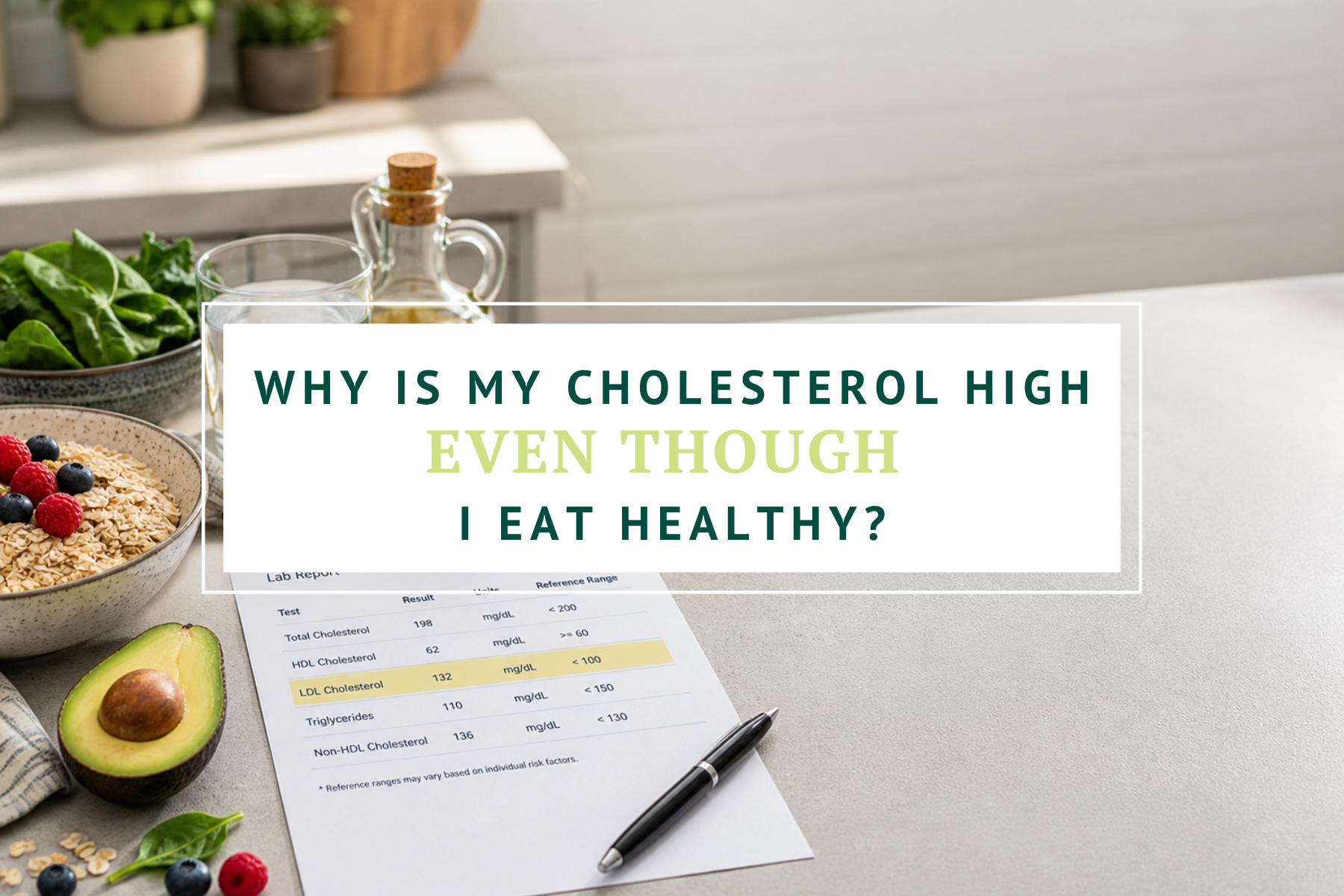
You cleaned up your diet.
More whole foods. Less fried food. Maybe less sugar.
So when your labs come back and your cholesterol is still high, it doesn't make sense.
It's frustrating—and confusing.
But here's the key point most people aren't told:
"Eating healthy" doesn't always match how your body handles cholesterol.
Cholesterol levels are not just a reflection of your food choices. They are shaped by:
- How your liver produces cholesterol
- How efficiently your body clears it
- Hormones, metabolism, and genetics
This is why two people can eat similarly—and have completely different lab results.
What "Eating Healthy" Often Misses
"Healthy eating" is a broad term.
For some people, it means:
- Cutting processed foods
- Choosing whole grains
- Eating more fruits and vegetables
All of those can support overall health. But cholesterol is more specific.
Some patterns that look healthy—but may still influence cholesterol levels:
- Diets high in saturated fats (butter, coconut oil, fatty meats)
- Low intake of fiber-rich foods
- Frequent "natural sugars" (smoothies, dried fruit, granola)
- Inconsistent meal timing
- Poor sleep or high stress
The issue isn't effort. It's alignment.
Your diet has to match how your body processes fats, carbohydrates, and energy—not just follow general advice.
What Your Cholesterol Test Is Actually Measuring
To understand why cholesterol stays high, it helps to understand what's being measured.
Most standard lipid panels include:
- Total cholesterol
- LDL cholesterol (LDL-C)
- HDL cholesterol (HDL-C)
- Triglycerides
But there's an important distinction:
- LDL-C measures how much cholesterol is inside LDL particles
- ApoB reflects how many cholesterol-carrying particles are in circulation
Think of it like this:
- LDL-C = how much cargo is being transported
- ApoB = how many vehicles are on the road
Why this matters: Over time, a higher number of circulating particles increases overall exposure within the body, which is why particle-based measures like apoB are often used alongside traditional cholesterol markers [1], [2].
Why Cholesterol Can Stay High—Even With a Healthy Diet
When cholesterol remains elevated, it usually comes down to two core processes:
- Your body is producing more cholesterol-carrying particles
- Or it's not clearing them efficiently
Several underlying factors influence these processes.
1. Genetics and Lipoprotein(a)
Some cholesterol patterns are largely inherited.
Genetic differences can affect:
- LDL receptor activity
- Cholesterol production
- Lipoprotein(a), or Lp(a)
Lp(a) is a cholesterol-carrying particle that is largely determined by genetics and minimally influenced by diet or lifestyle. This is one reason cholesterol may remain elevated despite consistent healthy habits [3].
2. Saturated Fat Sensitivity
Not everyone responds to dietary fat the same way. Some individuals are more sensitive to saturated fats, meaning foods like butter, coconut oil, and fatty meats may raise LDL levels more noticeably. Research shows that replacing saturated fats with unsaturated fats can support healthier cholesterol patterns, though individual responses vary [4].
3. Thyroid Function
Thyroid hormones help regulate metabolism, including cholesterol balance. When thyroid signaling is lower, LDL receptors may be less active and cholesterol clearance can slow down. This can contribute to higher LDL levels over time, even without major dietary changes [5].
4. Insulin Resistance
Insulin resistance can influence cholesterol production—even when it's not obvious. In this state, the liver produces more very-low-density lipoproteins (VLDL), which can later be converted into LDL. This process can increase the number of cholesterol-carrying particles in circulation [6].
5. Hormonal Changes
Hormones influence how the body processes fats and cholesterol. During periods of hormonal transition, lipid metabolism can shift and LDL levels may gradually rise. Changes in estrogen levels, for example, are associated with changes in lipid patterns over time [7].
6. Sleep and Stress
Sleep and stress affect metabolic health more than most people realize. Short or poor-quality sleep is associated with changes in metabolic regulation and shifts in lipid patterns. Over time, this can influence how the body produces and processes cholesterol [8].
Why "Healthy Eating" Isn't Always Enough
Most nutrition advice focuses on what to eat and what to avoid. But cholesterol is influenced by how your body responds to those foods, processes nutrients, and regulates internal signals.
Two people can follow the same diet and see very different results. That's because cholesterol is not just a food issue—it's a metabolic and regulatory process.
The Bigger Picture: Your Liver Sets the Tone
Your liver plays a central role in cholesterol balance. It produces cholesterol, packages fats into particles, and clears LDL from circulation.
Signals that influence the liver include:
- Insulin
- Thyroid hormones
- Hormonal balance
- Genetic factors
When these signals shift, cholesterol levels can change—even when diet stays consistent.
What This Means for You
If your cholesterol is still high after improving your diet, it doesn't mean your efforts aren't working. It means there may be another factor influencing your numbers.
Instead of continuing to make broad changes, the next step is to get more specific.
For the next steps and more information, check out the article "Why Your Cholesterol Stays High After "Doing Everything Right" - And What to Check Next."
What Most People Get Wrong
A common pattern:
- Try a new diet
- Wait for results
- See little change
- Try something else
This cycle continues because the underlying driver isn't being addressed. Cholesterol doesn't respond best to random changes. It responds to targeted adjustments based on your biology.
How to Start Thinking Differently About Cholesterol
Instead of asking: "Am I eating healthy enough?"
A better question is: "What is influencing how my body produces and clears cholesterol?"
That shift leads to more useful answers—and better decisions.
Key Takeaways
- Cholesterol is not just about diet. It reflects metabolism, hormones, liver function, and genetics.
- "Healthy eating" is not one-size-fits-all. Individual responses vary.
- Particle number matters. ApoB provides additional insight beyond LDL-C [2].
- Multiple factors influence cholesterol, including fat type, thyroid function, insulin sensitivity, and sleep.
- If cholesterol stays high, a specific driver is likely involved—not a lack of effort.
FAQ
Can cholesterol be high even if I eat clean?
Yes. Cholesterol is influenced by genetics, hormones, and metabolism—not just diet.
Does eating less fat always lower cholesterol?
Not necessarily. Fat type matters more than total fat. Replacing saturated fats with unsaturated fats may support healthier levels for some individuals [4].
What is apoB and why does it matter?
ApoB reflects the number of cholesterol-carrying particles and provides additional context beyond LDL-C [2].
Can stress affect cholesterol levels?
Chronic stress may influence metabolic and hormonal signals involved in cholesterol regulation [8].
How long does it take for cholesterol to change?
Changes can occur within weeks, but underlying factors may take longer to influence results.
References
- Sniderman, A. D., et al. Apolipoprotein B and cardiovascular risk. Journal of the American College of Cardiology. https://pubmed.ncbi.nlm.nih.gov/31642874/
- Ference, B. A., et al. Low-density lipoproteins cause atherosclerotic cardiovascular disease. European Heart Journal, 2017. https://pubmed.ncbi.nlm.nih.gov/28444290/
- Tsimikas, S. A Test in Context: Lipoprotein(a). Journal of the American College of Cardiology, 2017. https://pubmed.ncbi.nlm.nih.gov/28183512/
- Sacks, F. M., et al. Dietary fats and cardiovascular disease: A presidential advisory. Circulation, 2017. https://pubmed.ncbi.nlm.nih.gov/28620111/
- Duntas, L. H. Thyroid disease and lipids. Thyroid, 2002. https://pubmed.ncbi.nlm.nih.gov/12034052/
- Adiels, M., et al. Overproduction of very low-density lipoproteins is the hallmark of the dyslipidemia in insulin resistance. Arteriosclerosis, Thrombosis, and Vascular Biology, 2008. https://pubmed.ncbi.nlm.nih.gov/18565848/
- Matthews, K. A., et al. Changes in cardiovascular risk factors during the menopausal transition. Journal of the American College of Cardiology, 2009. https://pubmed.ncbi.nlm.nih.gov/20082925/
- Spiegel, K., et al. Sleep loss: a novel risk factor for insulin resistance and Type 2 diabetes. Journal of Applied Physiology, 2005. https://pubmed.ncbi.nlm.nih.gov/16227462/
Disclaimer: This article is for educational purposes only and is not a substitute for professional medical advice. Always consult your healthcare provider before making changes to your diet, lifestyle, or health routine.


