

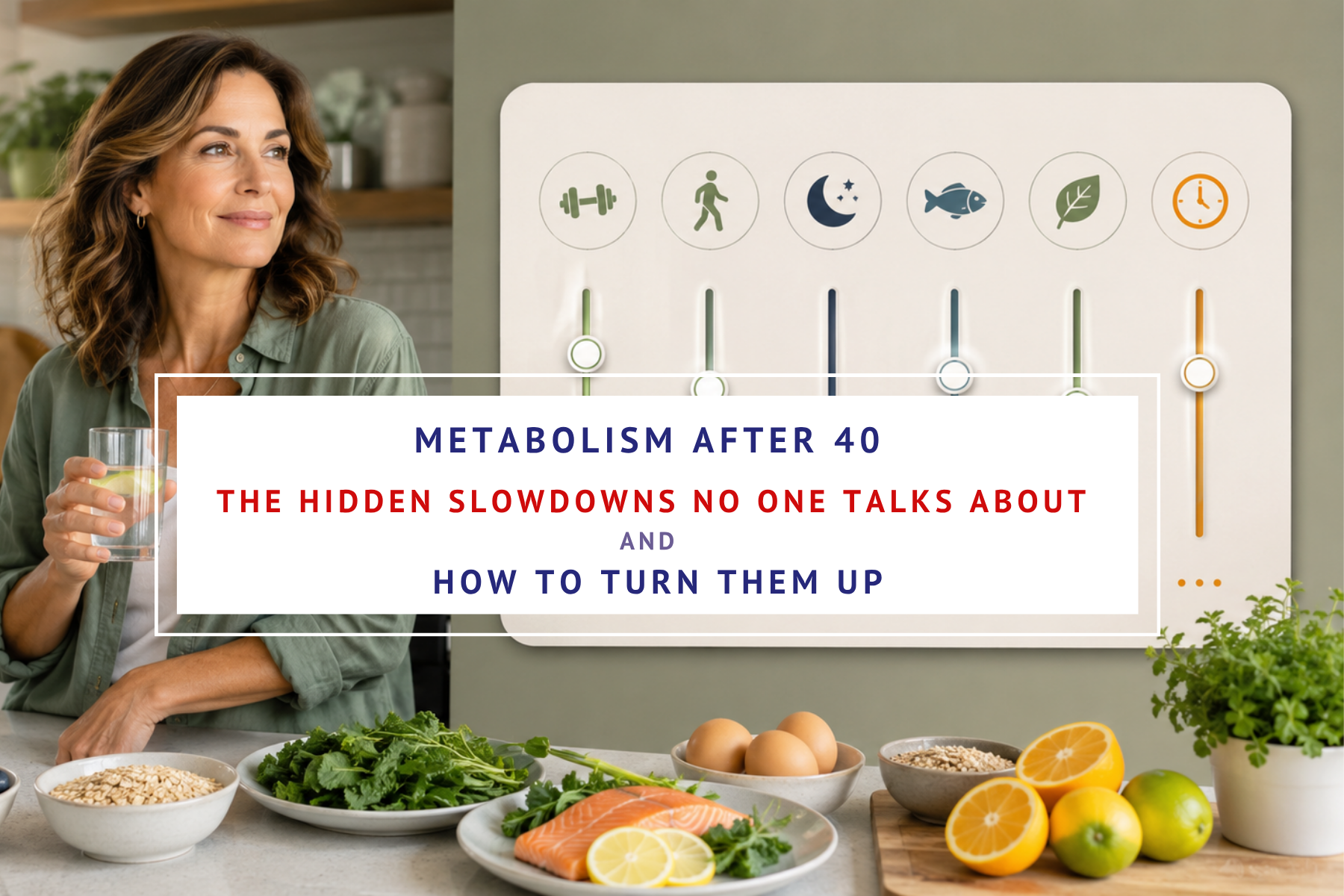
Why Did My Metabolism Change After 40—and What Am I Missing?
You didn't change that much. But your body did.
The frustrating part is that most advice still says "eat less, move more," as if your engine at 45 is the same as at 25. It isn't.
The big shift after 40 isn't just about calories. It's:
- muscle quality
- daily movement outside the gym
- sleep timing
- hormones
- and even how much brown fat you still recruit
This guide breaks down those hidden levers, why they change with age, and how to flip them in your favor without going extreme.
Key Takeaways
After 40, most "slowdowns" come from:
- lower muscle quality
- less NEAT (non-exercise movement)
- off-kilter sleep and meal timing
- and a quieter cold-response system
The fix:
- lift 2–3x/week
- eat more protein (especially at breakfast) and fiber
- walk more across the day
- shift meals earlier
- add gentle cold variation
First, a Reality Check: Your Baseline Metabolism Doesn't Fall Off a Cliff at 40
Adjusted for body size and fat-free mass, total and resting energy expenditure are surprisingly stable from about age 20 to 60, then slowly decline.[1]
That means a "sudden slowdown" in your 40s is usually not a built-in metabolic crash. It's a stack of small shifts: less muscle, less movement, patchier sleep, later meals, hormone changes, and years of accumulated lifestyle patterns.
Why that matters: aiming only at calories misses the real levers you can actually control.
Why Your Metabolism Changes After 40
Here's the short list most people overlook:
- muscle quality and anabolic resistance
- lower NEAT
- circadian misalignment
- declining brown fat activity
- hormone shifts
- adaptive thermogenesis from past dieting
None of these alone "break" metabolism. Together, though, they change how efficiently your body uses energy.
The Hidden Levers That Quietly Slow Metabolism
Muscle Mass and Muscle Quality Quietly Drive Resting Burn
Muscle and its mitochondria influence much of your baseline energy use. After 40, muscle quality declines, anabolic resistance increases, and mitochondrial efficiency may drop.[3][4] That means the same amount of muscle can burn less energy than it once did.
What to Do
- Resistance train consistently
- Focus on progressive overload
- Prioritize protein intake—especially earlier in the day
Research consistently shows that resistance training plus adequate protein supports muscle preservation and strength gains with aging.[4][9]
NEAT: The Silent 200–500 Calories Most People Lose
NEAT stands for Non-Exercise Activity Thermogenesis—the energy you burn walking, standing, pacing, cleaning, carrying groceries, and moving through life.
Studies suggest NEAT differences can account for hundreds of calories burned daily between individuals.[2] Midlife tends to reduce movement naturally: desk jobs, caregiving, stress, convenience, more sitting.
What to Do
Build movement into daily life: walking calls, stairs, standing breaks, short movement "snacks." Think: Always a little in motion.
Brown Fat and Cold Response Quiet Down
Brown adipose tissue (brown fat) burns calories to generate heat. Its activity tends to decline with age.[5] Small studies suggest repeated mild cold exposure may help support brown fat activation and non-shivering thermogenesis.[13]
What to Do
- Cooler bedrooms
- Brisk outdoor walks
- Cooler shower finishes
Nothing extreme. Just gentle temperature variation.
Sleep and Circadian Timing Matter More Than Most People Realize
Your metabolism runs on a 24-hour biological clock. Short sleep and late eating impair glucose handling, appetite regulation, and energy use.[6][7] Midlife often brings fragmented sleep, later meals, stress, and inconsistent routines.
What to Do
- Keep a regular sleep window
- Finish dinner earlier when possible
- Front-load more calories into daylight hours
Hormone Shifts Change the Metabolic Context
Menopause and aging thyroid signaling can influence visceral fat, resting energy expenditure, appetite, and energy levels.[8][11] This doesn't mean hormones "ruin" metabolism—it means your baseline physiology changes.
What to Do
- Prioritize resistance training
- Maintain protein intake
- Protect sleep quality
- Discuss symptoms with your clinician when appropriate
Chronic Dieting Can Train the Body to Burn Less
Aggressive dieting can trigger Adaptive Thermogenesis—meaning the body burns fewer calories than expected after weight loss.[14] This can persist for years.
What to Do
- Use smaller deficits
- Preserve muscle
- Avoid crash dieting
- Incorporate maintenance phases
Plateaus are often physiology—not failure.
The Practical Playbook: How to Turn These Levers Back Up
Lift Heavy Things, on Purpose
Resistance training rebuilds metabolically active tissue and improves glucose handling. Focus on squats, hinges, rows, presses, and carries. Aim for 2–3 sessions weekly and progress gradually.
Eat Enough Protein—and Spread It Across the Day
Protein supports muscle maintenance, has the highest thermic effect of food, and improves satiety.[10] Older adults often need a stronger protein signal per meal due to anabolic resistance.[4]
General Target: 1.2–1.6 g protein/kg/day, spread across 3–4 meals, with 25–35 g protein at breakfast.
Make NEAT Your Secret Weapon
Small movement compounds. Examples: 10-minute walks after meals, standing during calls, walking while thinking, stretching during TV. The goal: less "all-or-nothing" exercise thinking.
Fiber Quietly Supports Metabolism More Than Most People Think
Fiber rarely gets mentioned in metabolism conversations, but after 40 it becomes one of the most important nutritional levers for blood sugar stability, appetite regulation, gut health, cholesterol balance, and long-term metabolic flexibility.
Many adults unintentionally eat far less fiber than recommended, especially when relying heavily on ultra-processed "healthy" foods, protein snacks, or convenience meals. That matters because fiber helps slow digestion and improve satiety, which can reduce the energy crashes, cravings, and overeating patterns that often become more noticeable in midlife.
Certain types of fiber also support the gut microbiome, which plays a growing role in metabolic health, inflammation, insulin sensitivity, and even appetite signaling.
Research suggests higher fiber intake is associated with healthier body composition, improved glucose regulation, and better cardiovascular outcomes.[15] This becomes especially important after 40, when blood sugar swings tend to feel more dramatic, visceral fat becomes easier to accumulate, digestion may slow, and cholesterol management often becomes a bigger concern.
What to Do
Focus on increasing fiber gradually through whole foods such as vegetables, berries, legumes, oats, chia seeds, flax, nuts, and minimally processed plant foods. A helpful goal for many adults is roughly 25–35g of fiber daily.
One simple strategy: pair protein + fiber together at meals.
- Greek yogurt + berries + chia
- Eggs + vegetables + oats
- Salmon + lentils + greens
- Tofu + edamame + quinoa
The combination of protein and fiber tends to improve satiety, stabilize energy, and support healthier metabolic signaling throughout the day.
Importantly, fiber works best as part of the bigger picture: strength training, daily movement, protein intake, sleep consistency, and blood sugar-friendly eating patterns. Small improvements compounded together are what truly move metabolism in the right direction after 40.
Align Meals and Sleep With Your Clock
Your metabolism prefers daytime activity and nighttime recovery.
Helpful Shifts: earlier dinners, fewer late-night snacks, consistent sleep timing. Even small improvements matter.
Mind the Hidden Drags That Add Up
Some quiet factors subtly reduce energy and metabolic resilience:
- poor sleep
- nightly alcohol
- ultra-processed "health" snacks
- nutrient deficiencies
- medication side effects
- low movement between workouts
Often the issue isn't one giant mistake. It's accumulation.
Why These Steps Work Together
These levers compound: resistance training preserves muscle, protein supports recovery and thermogenesis, NEAT reclaims lost movement calories, sleep aligns hormonal signaling, and earlier eating improves metabolic timing. Small improvements stacked together can meaningfully shift energy, body composition, and resilience over time.
What If You Already "Eat Clean" But Still Feel Slower?
Scan for these common patterns:
- low-protein breakfasts
- long periods of sitting
- late dinners
- strength workouts without progression
- inconsistent sleep
- too little daily movement
Sometimes the issue isn't "what" you eat. It's timing, movement, recovery, consistency, and metabolic signaling.
Build Your Two-Week Reset
Week 1–2 Priorities
- Strength Train Twice Weekly — Focus on lower-body movement, upper-body pushing, pulling, and carrying.
- Eat 25–35g Protein at Breakfast — Examples: eggs + Greek yogurt, tofu scramble + edamame, protein oats.
- Take Three 10-Minute Walks Daily — Especially after meals.
- Shift Dinner Earlier — Aim to finish 2–3 hours before bed.
- Add Gentle Cold Variation — Cooler sleep and cooler shower finishes.
Track the Early Wins
Watch for:
- steadier energy
- fewer cravings
- calmer evenings
- improved sleep
- reduced waist measurement
- better appetite control
Often these shift before the scale does.
Call to Action
Choose three levers: protein at breakfast, two weekly strength sessions, and a daily post-meal walk. Run the experiment for two weeks. Track energy, sleep, hunger, waistline, and mood. Then adjust based on your own data.
FAQ
Is It True Metabolism Slows a Lot After 30?
Not dramatically. Adjusted for body size and fat-free mass, energy expenditure remains relatively stable from about age 20 to 60.[1]
What's the Fastest Lever to Pull?
Protein at breakfast plus resistance training and short daily walks offer some of the highest returns for time invested.[2][4][10]
Do Late Dinners Really Matter?
Yes. Circadian misalignment impairs how efficiently the body handles energy.[7]
Can Better Sleep Improve Metabolism?
Absolutely. Short sleep tends to increase appetite and impair metabolic regulation.[6]
Why Does Metabolism Change After 40?
Usually because of lower muscle quality, less movement, circadian disruption, hormone changes, adaptive thermogenesis, and lifestyle accumulation.
Does Citrus Bergamot Help Metabolism After 40?
Short answer: it may help support several of the metabolic pathways that commonly become less efficient after 40—especially blood sugar handling, lipid balance, and visceral fat accumulation.
Unlike trendy "metabolism boosters," citrus bergamot isn't about forcing your body to burn more calories through stimulation. Its potential value is more foundational.
Citrus bergamot contains unique polyphenols and flavonoids that appear to support:
- healthy lipid metabolism
- insulin sensitivity
- cardiovascular health
- inflammatory balance
- and metabolic flexibility
That matters because many midlife metabolic slowdowns are tied less to a "broken metabolism" and more to worsening insulin sensitivity, increased visceral fat, chronic low-grade inflammation, disrupted appetite signaling, and reduced metabolic resilience.
Several human studies suggest bergamot polyphenols may support healthy cholesterol, triglycerides, and glucose metabolism—especially when combined with foundational lifestyle habits like strength training, protein intake, movement, and sleep consistency.
In other words: citrus bergamot doesn't replace the big levers. It may help support them.
That's especially relevant after 40, when blood sugar swings become more impactful, visceral fat becomes easier to accumulate, and cardiovascular risk factors quietly rise even in people who "eat pretty well."
This is also why metabolism and heart health are deeply connected. The same metabolic dysfunction that affects energy, waistline changes, and insulin sensitivity also influences inflammation, vascular health, cholesterol balance, and long-term cardiovascular resilience.
If you want a deeper dive into how citrus bergamot may support both healthy metabolism and heart function, read: How Citrus Bergamot Supports a Healthy Heart and a Healthy Weight
Most importantly, citrus bergamot makes the most sense when viewed as part of a bigger metabolic picture: resistance training, protein-rich meals, improved sleep, more daily movement, earlier eating windows, and lower inflammatory load. Those are still the real drivers of long-term metabolic health.
Medical Disclaimer
This article is for informational purposes only and is not intended as medical advice, diagnosis, or treatment. Always consult your healthcare provider before making changes to your diet, supplements, exercise, or medications.
References
- Pontzer H, et al. Daily energy expenditure through the human life course. Science. 2021. https://pubmed.ncbi.nlm.nih.gov/34385400/
- Levine JA, et al. Role of nonexercise activity thermogenesis in resistance to fat gain in humans. Science. 1999. https://pubmed.ncbi.nlm.nih.gov/9880251/
- Short KR, et al. Decline in skeletal muscle mitochondrial respiratory capacity with aging in humans. PNAS. 2005. https://pubmed.ncbi.nlm.nih.gov/15800038/
- Paddon-Jones D, Rasmussen BB. Dietary protein recommendations and prevention of sarcopenia. Curr Opin Clin Nutr Metab Care. 2009. https://pubmed.ncbi.nlm.nih.gov/19057193/
- Cypess AM, et al. Identification and importance of brown adipose tissue in adult humans. N Engl J Med. 2009. https://pubmed.ncbi.nlm.nih.gov/19357406/
- Markwald RR, et al. Impact of insufficient sleep on energy expenditure and weight gain. PNAS. 2013. https://pubmed.ncbi.nlm.nih.gov/23479616/
- Morris CJ, et al. Circadian misalignment impacts glucose tolerance. PNAS. 2015. https://pubmed.ncbi.nlm.nih.gov/25870289/
- Surks MI, Hollowell JG. Age-specific distribution of serum thyrotropin. J Clin Endocrinol Metab. 2007. https://pubmed.ncbi.nlm.nih.gov/17911171/
- Morton RW, et al. Protein supplementation and resistance training gains. Br J Sports Med. 2018. https://pubmed.ncbi.nlm.nih.gov/28698222/
- Westerterp KR. Diet-induced thermogenesis. Nutr Metab. 2004. https://pubmed.ncbi.nlm.nih.gov/15507147/
- Lovejoy JC, et al. Increased visceral fat and decreased energy expenditure during menopause. Int J Obes. 2008. https://pubmed.ncbi.nlm.nih.gov/18332882/
- Gonzales GF, et al. 2003. https://pubmed.ncbi.nlm.nih.gov/12472620/
- Yoneshiro T, et al. Brown adipose tissue as an anti-obesity agent in humans. J Clin Invest. 2013. https://pubmed.ncbi.nlm.nih.gov/23867622/
- Hall KD, et al. Persistent metabolic adaptation after weight loss. Obesity. 2016. https://pubmed.ncbi.nlm.nih.gov/27136388/


