

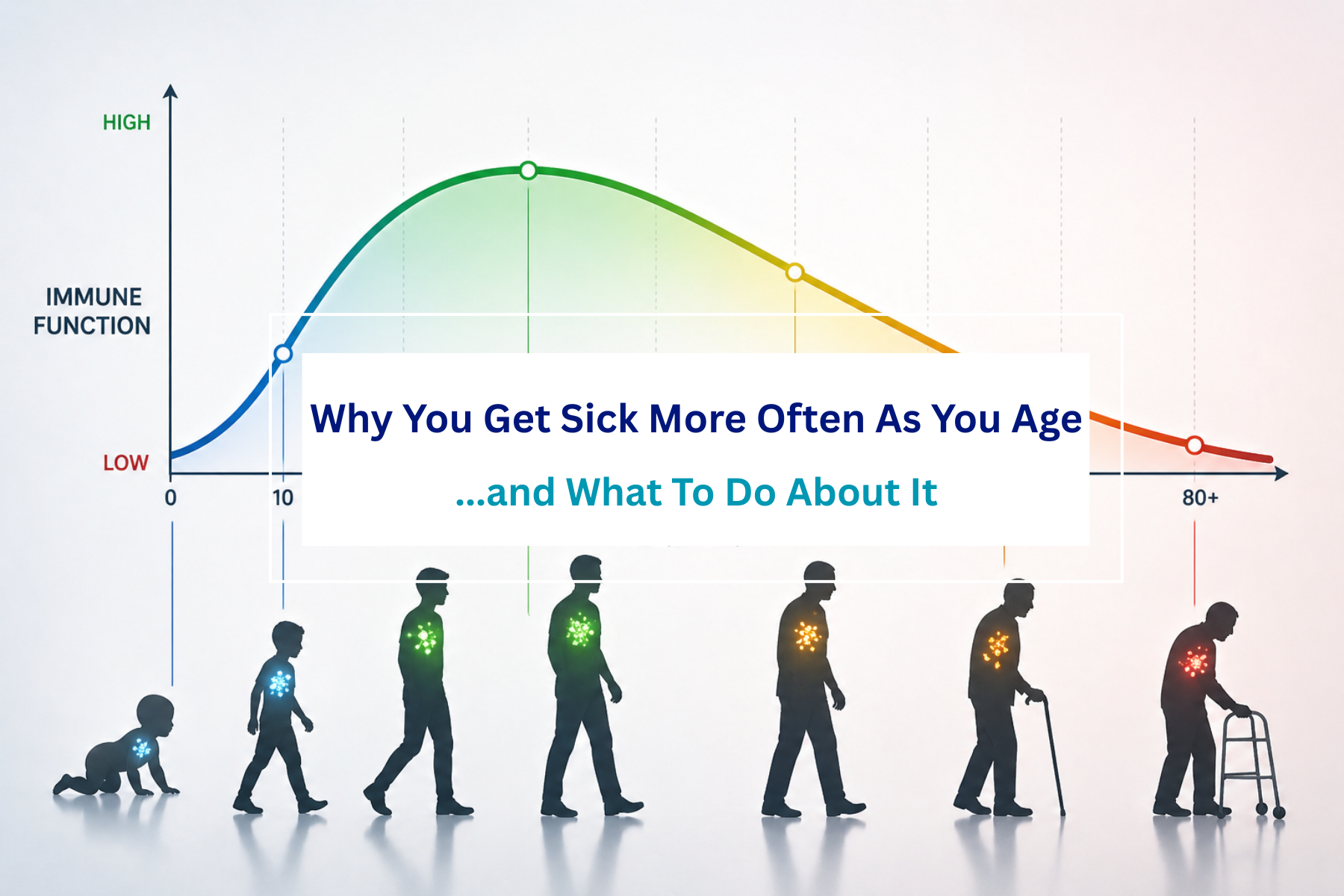
You take your vitamins, try to eat well, and still feel like every bug finds you now. A few years ago you bounced back fast; today, you catch more and recover slower.
What changed—and can you do anything about it?
Short answer: your immune system changes with age. But it's not just "getting old." Sleep, stress, hormones, body composition, the gut, and key nutrients all shape how your defenses respond.
Understanding that biology gives you something most people don't have: Leverage.
Why do you get sick more often as you age?
With age, the immune system becomes less adaptive and more reactive.
- The thymus produces fewer naïve T cells (immunosenescence) [1,14]
- Background inflammation rises (inflammaging) [2,15]
- Sleep, stress, and metabolic factors amplify both
The result is simple: Slower responses. Less precision. Longer recovery.
What aging does to your immune system
Your immune system has two arms:
- Innate (fast, general)
- Adaptive (slower, specific, memory-based)
Aging primarily affects the adaptive system.
Thymic decline
The thymus—where T cells are trained—shrinks significantly with age. By midlife, much of it is replaced with fat, reducing production of new T cells [1,14].
This limits your ability to respond to new infections, not ones you've seen before.
Antibody quality changes
B cells still produce antibodies, but the response may be:
- Slower
- Less targeted
This affects how efficiently your body clears infections.

Inflammaging: the background noise problem
Inflammaging is chronic, low-grade inflammation that increases with age [2,15].
Think of it as static in your immune system.
When baseline inflammation is high:
- Real threats are harder to detect
- Responses are delayed or misdirected
Major contributors
- Visceral fat (deep belly fat recruits immune cells) [10]
- Senescent cells releasing inflammatory signals
- Gut barrier changes increasing immune exposure
This constant low-level activation drains immune resources.
Sleep and stress: the invisible regulators
Sleep builds immune memory
During sleep, your body strengthens immune responses and consolidates immune memory [5].
Short sleep is directly linked to higher infection risk. People sleeping less than 7 hours are significantly more likely to develop cold symptoms [12,13].
Chronic stress disrupts immune control
Long-term stress leads to glucocorticoid resistance, where immune cells stop responding properly to cortisol [6].
This means:
- Inflammation stays elevated
- Immune responses become less coordinated
The gut–immune connection
A large portion of your immune system is located in the gut.
With age:
- Microbial diversity declines [7]
- Fiber intake often drops
- Production of short-chain fatty acids (SCFAs) decreases [8]
SCFAs help:
- Maintain gut barrier integrity
- Regulate immune responses
Less SCFA production = more immune "noise."
Nutrition: what your immune system depends on
Protein
Immune cells and antibodies require amino acids. Low protein intake can reduce immune responsiveness.
Key micronutrients
- Vitamin D supports immune signaling [3]
- Zinc is critical for T-cell function [4]
Even mild deficiencies affect immune performance.
Black cumin seed oil and immune support
Some individuals look beyond diet alone when addressing immune balance.
Black cumin seed oil (Nigella sativa) has been studied for its active compound, thymoquinone, which may support:
- Inflammatory signaling balance
- Glucose metabolism
- Immune modulation pathways
Evidence ranges from randomized trials to systematic reviews [16–18].
Important distinction: It does not replace foundational habits. It supports how your body responds to them.
Movement and body composition
Muscle and fat send very different signals to your immune system.
- Muscle releases anti-inflammatory myokines
- Visceral fat increases inflammatory cytokines [10]
Regular movement helps:
- Reduce inflammation
- Improve immune surveillance
Moderate, consistent activity is more effective than occasional intense exercise [9].
Environmental and lifestyle factors
Additional contributors include:
- Certain medications
- Alcohol disrupting sleep
- Air quality and pollutants
These don't act alone—but they accumulate.
Building a more resilient immune system
Instead of chasing "immune boosters," focus on consistency.
Core levers:
- 7–9 hours of sleep
- Daily movement
- Protein at each meal
- 25–35g fiber per day
- Stress regulation
- Adequate vitamin D and zinc
These reduce background inflammation and improve immune precision.
What to test and monitor
- Vitamin D levels [3]
- Zinc intake/status [4]
- Basic metabolic markers
- Waist circumference (visceral fat indicator)
These provide actionable insight.
Why people age differently
Two people of the same age can have very different immune function.
Key drivers:
- Sleep history
- Stress exposure
- Diet quality
- Microbiome diversity
- Muscle vs fat composition
This is why aging is not destiny.
Key takeaway
Getting sick more often is not random. It reflects how your body is managing:
- Inflammation
- Recovery
- Nutrient status
- Environmental stress
When those are aligned, immunity becomes more resilient.
Call to Action
Run a one-week reset:
- Sleep 7–8 hours nightly
- Eat protein + fiber at each meal
- Walk daily
- Reduce alcohol
Then evaluate how you feel. If needed, explore targeted support like black cumin seed oil alongside your clinician.
FAQ
What weakens immunity with age?
Reduced T-cell production and increased inflammation are primary drivers [1,2].
Can you reverse immune aging?
Not fully—but you can significantly improve function through lifestyle.
Does sleep really matter?
Yes—short sleep increases infection risk [12,13].
This article is for educational purposes only and not medical advice.
References
[1] Palmer DB. The effect of age on thymic function. Front Immunol. 2013;4:316. https://pubmed.ncbi.nlm.nih.gov/24109481/
[2] Franceschi C, Campisi J. Chronic inflammation (inflammaging) and its contribution to age-associated diseases. J Gerontol A Biol Sci Med Sci. 2014;69(Suppl 1):S4–S9. https://pubmed.ncbi.nlm.nih.gov/24833586/
[3] Aranow C. Vitamin D and the immune system. J Investig Med. 2011;59(6):881–886. https://pubmed.ncbi.nlm.nih.gov/21527855/
[4] Ibs KH, Rink L. Zinc-altered immune function. J Nutr. 2003;133(5 Suppl 1):1452S–1456S. https://pubmed.ncbi.nlm.nih.gov/12730441/
[5] Besedovsky L, Lange T, Born J. Sleep and immune function. Pflugers Arch. 2012;463(1):121–137. https://pubmed.ncbi.nlm.nih.gov/22071480/
[6] Cohen S, et al. Chronic stress, glucocorticoid receptor resistance, inflammation, and disease risk. Proc Natl Acad Sci U S A. 2012;109(16):5995–5999. https://pmc.ncbi.nlm.nih.gov/articles/PMC3341031/
[7] Odamaki T, et al. Age-related changes in gut microbiota composition from newborn to centenarian. BMC Microbiol. 2016;16:90. https://pubmed.ncbi.nlm.nih.gov/27220822/
[8] Calder PC. Feeding the immune system. Proc Nutr Soc. 2013;72(3):299–309. https://pubmed.ncbi.nlm.nih.gov/23688939/
[9] Simpson RJ, et al. Exercise and the regulation of immune functions. Prog Mol Biol Transl Sci. 2015;135:355–380. ResearchGate
[10] Weisberg SP, et al. Obesity is associated with macrophage accumulation in adipose tissue. J Clin Invest. 2003;112(12):1796–1808. https://pubmed.ncbi.nlm.nih.gov/14679176/
[11] Ferrucci L, Fabbri E. Inflammageing: chronic inflammation in ageing, cardiovascular disease, and frailty. Nat Rev Cardiol. 2018;15(9):505–522. https://pubmed.ncbi.nlm.nih.gov/30065258/
[12] Cohen S, et al. Sleep habits and susceptibility to the common cold. Arch Intern Med. 2009;169(1):62–67. https://pmc.ncbi.nlm.nih.gov/articles/PMC2629403/
[13] Prather AA, et al. Behaviorally assessed sleep and susceptibility to the common cold. Sleep. 2015;38(9):1353–1359. https://pubmed.ncbi.nlm.nih.gov/26118561/
[14] Nikolich-Žugich J. The twilight of immunity: emerging concepts in aging of the immune system. Nat Immunol. 2018;19(1):10–19. https://pubmed.ncbi.nlm.nih.gov/29242543/
[15] Franceschi C, et al. Inflammaging: a new immune–metabolic viewpoint for age-related diseases. Nat Rev Endocrinol. 2018;14(10):576–590. https://pubmed.ncbi.nlm.nih.gov/30046148/
[16] Koshak AE, et al. Nigella sativa supplementation improves asthma control and biomarkers: a randomized controlled trial. Phytother Res. 2017;31(3):403–409. https://pubmed.ncbi.nlm.nih.gov/28093815/
[17] Mahomoodally MF, et al. Nigella sativa L. and thymoquinone in diabetes: a systematic review. Int J Mol Sci. 2022;23(20):12111. https://pubmed.ncbi.nlm.nih.gov/36292966/
[18] Li Z, et al. Nigella sativa and health outcomes: an overview of systematic reviews and meta-analyses. Front Nutr. 2023;10:1107750. https://pmc.ncbi.nlm.nih.gov/articles/PMC10086143/


