

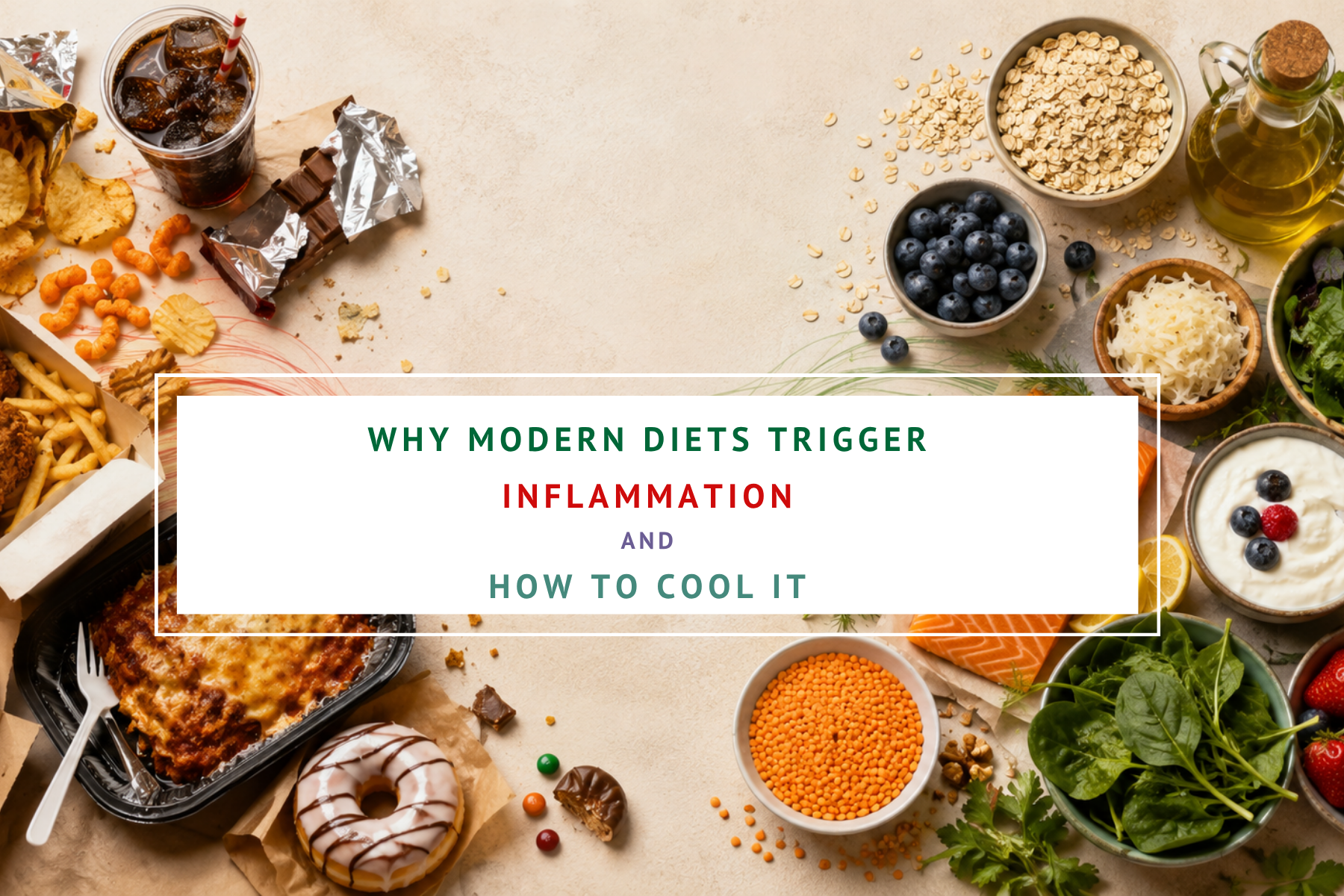
Why does inflammation keep coming back even when you "eat clean"?
You cut sugar. You cook more at home. Maybe you ditched dairy or gluten—and yet the puffy, achy, "on edge" feeling keeps creeping back in.
It's not just you.
Modern diets push the immune system into a low, constant alarm state.
The trick isn't to blame one villain food. It's to understand:
- what turns inflammation on
- and what's missing that's supposed to turn it off
Let's make sense of what "inflamed" really means, how modern food patterns keep nudging the immune system, and what actually lowers the fire without going extreme.
What "Inflamed" Really Means — And the Switch We Forget About
Diet-related chronic inflammation persists when pro-resolving "off" signals are too low while inflammatory "on" signals are constantly triggered.
Inflammation is your body's alarm system. It's supposed to:
- Turn on briefly
- Repair damage
- Turn back off
Cells release chemical messengers—cytokines and eicosanoids—to coordinate the response. Heat, swelling, redness, soreness: those are signs of the "on" phase.
But there's also an active "off" phase called resolution. Your body creates specialized molecules that tell immune cells: "The threat is over. Begin cleanup."
When those signals are weak, low-grade inflammation lingers. You may not feel "sick." You just feel:
- tired
- puffy
- reactive
- foggy
- less resilient
Think of It Like "ON" vs "OFF" Signals
| ON Signals | OFF Signals |
|---|---|
| Big glucose swings | SCFAs from fermentable fiber |
| Oxidized/reheated oils | Fermented foods that support microbial diversity |
| High-heat AGEs | Omega-3-derived SPMs |
| Gut barrier irritation | Time between meals |
| Constant snacking | Overnight fasting windows |
| Ultra-processed foods | Consistent sleep |
How Modern Foods Keep Inflammation "On"
In short: ultra-processed foods, overheated oils, high-heat browning, microbiome disruption, and additive-heavy foods all push inflammatory pathways repeatedly.
Ultra-Processed Foods Push "Chronic Snack Mode"
Ultra-processed foods are engineered to be soft, hyper-palatable, rapidly absorbed, and easy to overeat. In a tightly controlled study, people eating ultra-processed diets consumed about 500 extra calories per day compared with minimally processed diets.[1]
Extra body fat doesn't just store energy—it actively releases inflammatory signaling molecules. So the issue isn't only "junk food." It's the constant inflammatory environment these foods create.
Industrial Trans Fats and Overheated Oils Add Fuel
Industrial trans fats raise LDL, lower HDL, and increase inflammatory markers like CRP in humans.[2] Repeated high-heat frying also damages oils, creating oxidized compounds that stress cell membranes and immune pathways.
This matters because modern diets often combine refined carbohydrates, oxidized fats, low fiber, and low omega-3 intake. That's an inflammatory perfect storm.
High-Heat Browning Creates AGEs
That deep browning and charred flavor comes with compounds called AGEs (Advanced Glycation End Products). AGEs form when sugars bind to proteins and fats during high-heat cooking and processing. Diets high in AGEs are associated with oxidative stress, inflammatory signaling, and tissue damage over time.[4]
This doesn't mean grilled food is "bad." It means modern diets often stack processed foods, repeated browning, reheated oils, and high-temperature cooking all day long.
The Gut Firewall Gets Weaker
Your gut lining is only one cell thick. It separates the immune system below from the microbial world inside your intestines above.
Certain emulsifiers and additives may alter gut microbiota and weaken gut barrier integrity in animal models.[6] Some artificial sweeteners also appear to influence microbiome composition and glucose responses differently between individuals.[5]
When the barrier weakens, bacterial fragments like LPS (endotoxin) can more easily trigger immune activation.[3]
The Missing "Off" Signals: Fiber, Fermentation, and Omega-3s
If modern diets constantly push inflammatory "on" signals… what actually turns inflammation off? Two major things: what your microbes make from fiber, and what your cells make from omega-3 fats.
SCFAs: The Microbial Metabolites That Calm the System
When gut microbes ferment fiber, they produce butyrate, acetate, and propionate. These are called short-chain fatty acids (SCFAs). SCFAs:
- Strengthen the gut barrier
- Fuel colon cells
- Regulate immune signaling
- Calm inflammatory pathways[8]
This is one reason high-fiber diets are linked with healthier immune tone.
Fermented Foods Restore Missing Signals
Fermented foods add another powerful lever. In a randomized human trial, participants eating fermented foods experienced increased microbiome diversity and reductions in multiple inflammatory markers over 10 weeks.[7]
That's important because many modern guts are underexposed to live microbes, fermentation byproducts, and microbial diversity.
Easy Fermented Foods: Yogurt, Kefir, Sauerkraut, Kimchi, Miso, Tempeh
Omega-3s Create "Peacekeeper" Molecules
Your body converts EPA and DHA omega-3 fats into resolvins, protectins, and maresins. These are called Specialized Pro-Resolving Mediators (SPMs). SPMs don't suppress immunity—they help inflammation resolve appropriately while minimizing collateral damage.[10]
Low omega-3 intake may impair this "off switch." That's why increasing marine omega-3 intake often matters more than obsessively eliminating every omega-6-containing food.[9][10]
Human data and reviews suggest advantages of black cumin seed oil for maintaining healthy inflammatory balance, but a healhty food pattern should come first [11].
Stop Blaming Traditional Foods
It's tempting to blame gluten, dairy, lectins, carbs, or seed oils alone. For some people, individual triggers matter. But for most people, the issue is the overall modern dietary pattern:
- Shelf-stable processed meals
- Constant snacking
- Hyper-refined carbohydrates
- Low microbial diversity
- Low omega-3 intake
- High-heat processed foods
- Lack of fiber
- Lack of fermented foods
The problem is less "your grandmother's stew" and more "the modern always-on inflammatory environment."
What Actually Helps: A Practical Blueprint
Start With These 7 Changes
- Eat one fermented food daily
- Replace one ultra-processed meal with real food
- Use gentler cooking methods more often
- Eat fish twice weekly
- Use extra-virgin olive oil
- Leave a 12-hour overnight eating break
- Aim for 20–30g fiber daily
Build Meals That Steady the Wave
Meals that combine protein, colorful plants, natural fats, and fiber-rich carbohydrates create steadier glucose and lipid responses.
Examples:
- Eggs + greens + berries
- Lentils + vegetables + olive oil
- Salmon + root vegetables + yogurt sauce
- Beans + quinoa + roasted vegetables
Crowd Out Ultra-Processed Foods
Instead of banning everything, replace your default snack or lunch. The ultra-processed food trial showed people naturally overate without realizing it.[1] Make minimally processed foods easier to reach: nuts + fruit, lentils, yogurt, canned fish, leftovers, boiled eggs.
Add One Fermented Food Daily
A few forkfuls can be enough. Research suggests fermented foods improve microbiome diversity and inflammatory signaling.[7] Simple options: kefir, yogurt, kimchi, sauerkraut, miso, tempeh.
Feed the Microbiota That Feed You
Your microbes thrive on fermentable fibers. Work toward 20–30 grams of fiber daily.
Great Sources: Beans, Lentils, Oats, Barley, Apples, Berries, Onions, Garlic, Nuts, Seeds, Resistant starches
Over time, this encourages more butyrate production—a key anti-inflammatory SCFA.[8]
Mind Your Fats — Especially Heat and Source
Favor: Extra-virgin olive oil, Avocado, Nuts, Seeds, Marine omega-3s
Minimize: Reused fryer oils, Repeated deep frying, Industrial trans fats
The issue is often oxidation and heat damage—not simply the existence of fats themselves.[9][10]
Cook Gentler More Often
Lower-heat cooking reduces AGE formation.[4]
Better Methods: Steaming, Simmering, Stewing, Pressure cooking, Poaching
Helpful Trick: Acidic marinades with herbs may reduce AGE formation during cooking.
Time Your Eating So the Body Can Reset
Try leaving 12 hours between dinner and breakfast. This expands your repair window and reduces constant metabolic stimulation. Also: front-load calories earlier in the day, walk after meals, and avoid late-night grazing.
Watch the "Health Halo"
Many "healthy" foods are still ultra-processed: protein bars, keto cookies, flavored chips, fake-dessert snacks. If it's hyper-palatable, shelf-stable, and heavily processed—it often pushes the same inflammatory levers.
A Gentle-Heat Day Example
Breakfast: Poached eggs, sautéed spinach, tomatoes, berries
Lunch: Lentil-vegetable stew, cabbage slaw, kefir
Dinner: Baked salmon, broccoli, potatoes, yogurt-dill sauce
Why This Works
These changes work because they:
- Lower inflammatory "on" signals
- Restore anti-inflammatory "off" signals
- Support the gut barrier
- Stabilize blood sugar
- Reduce oxidative stress
- Improve microbial diversity
You're not "hacking" the body. You're restoring signals it already understands.
What If You Already "Eat Clean" But Still Feel Inflamed?
Often the sticking points are: too much high-heat cooking, not enough fermented foods, low omega-3 intake, ultra-processed "healthy" foods, or low microbial diversity. The issue may not be the ingredients themselves—it may be the cooking methods, the food structure, the microbiome inputs, or the overall pattern.
The Forever Plan
- One fermented food daily
- Fish twice weekly
- Mostly olive oil
- More plants
- Gentler cooking most days
- Ultra-processed foods occasionally—not constantly
- Movement after meals
- Overnight fasting window
None of this requires perfection. And none of it requires fearing traditional foods.
Call to Action
Pick two levers: one fermented food daily and gentler cooking methods. Run a two-week experiment. Track energy, digestion, bloating, joints, mood, and sleep. Your biology will tell you which switches matter most.
FAQ
How do I know if food is inflaming me if my labs are normal?
Low-grade inflammation can exist without obvious lab changes. Watch for patterns like bloating, fatigue, skin reactivity, or joint stiffness that improve with dietary shifts.
Do I need to eliminate all seed oils?
The larger issue is ultra-processed food intake and repeated high-heat oxidation. Prioritize omega-3 intake and gentler cooking methods.
Can fermented foods really lower inflammation?
In a randomized human trial, fermented foods increased microbiome diversity and reduced multiple inflammatory markers over 10 weeks.[7]
Are grilled foods bad?
Occasional grilling is fine. The concern is chronic exposure to high-heat AGEs from heavily browned foods.[4]
What's the simplest place to start?
Swap one ultra-processed meal for real food and add one fermented food daily.
Medical Disclaimer
This article is for informational purposes only and is not intended as medical advice, diagnosis, or treatment. Always consult your healthcare provider before making changes to your diet, supplements, or lifestyle, especially if you have a medical condition or take medications.
References
[1] Hall KD, et al. Ultra-processed diets cause excess calorie intake and weight gain. Cell Metab. 2019;30(1):67–77.e3. https://pubmed.ncbi.nlm.nih.gov/31105044/
[2] Mozaffarian D, et al. Dietary intake of trans fatty acids and systemic inflammation in women. Circulation. 2004;109(7):905–911. https://pubmed.ncbi.nlm.nih.gov/15051604/
[3] Cani PD, et al. Metabolic endotoxemia initiates obesity and insulin resistance. Diabetes. 2007;56(7):1761–1772. https://pubmed.ncbi.nlm.nih.gov/17456850/
[4] Uribarri J, et al. Advanced glycation end products in foods and practical reduction strategies. J Am Diet Assoc. 2010;110(6):911–916.e12. https://pubmed.ncbi.nlm.nih.gov/20497781/
[5] Suez J, et al. Non-caloric artificial sweeteners and the microbiome. Gut Microbes. 2015;6(2):149–155. https://pubmed.ncbi.nlm.nih.gov/25831243/
[5b] Suez J, et al. Personalized microbiome-driven effects of non-nutritive sweeteners. Cell. 2022;185(18):3307–3328.e19. https://pubmed.ncbi.nlm.nih.gov/35987213/
[6] Chassaing B, et al. Dietary emulsifiers impact the gut microbiota and promote inflammation. Nature. 2015;519(7541):92–96. https://pubmed.ncbi.nlm.nih.gov/25731162/
[7] Wastyk HC, et al. Gut-microbiota-targeted diets modulate human immune status. Cell. 2021;184(16):4137–4153.e14. https://pubmed.ncbi.nlm.nih.gov/34256014/
[8] Koh A, et al. Short-chain fatty acids as key bacterial metabolites. Cell. 2016;165(6):1332–1345. https://pubmed.ncbi.nlm.nih.gov/27259147/
[9] Calder PC. Omega-3 fatty acids and inflammatory processes. Br J Clin Pharmacol. 2015;75(3):645–662. https://pubmed.ncbi.nlm.nih.gov/22254027/
[10] Serhan CN. Pro-resolving lipid mediators and resolution physiology. Nature. 2014;510(7503):92–101. https://pubmed.ncbi.nlm.nih.gov/24899309/
[11] Ahmad A, et al. Therapeutic potential of Nigella sativa. Asian Pac J Trop Biomed. 2013;3(5):337–352. https://pubmed.ncbi.nlm.nih.gov/23646296/


