

"If My Calcium Score Is Zero, Am I Safe?"
A zero coronary artery calcium (CAC) score is one of the most reassuring results you can receive.
- No calcified plaque.
- Lower short-term cardiovascular risk.¹
But here's the truth most people don't hear:
A CAC score of 0 does not mean zero risk.
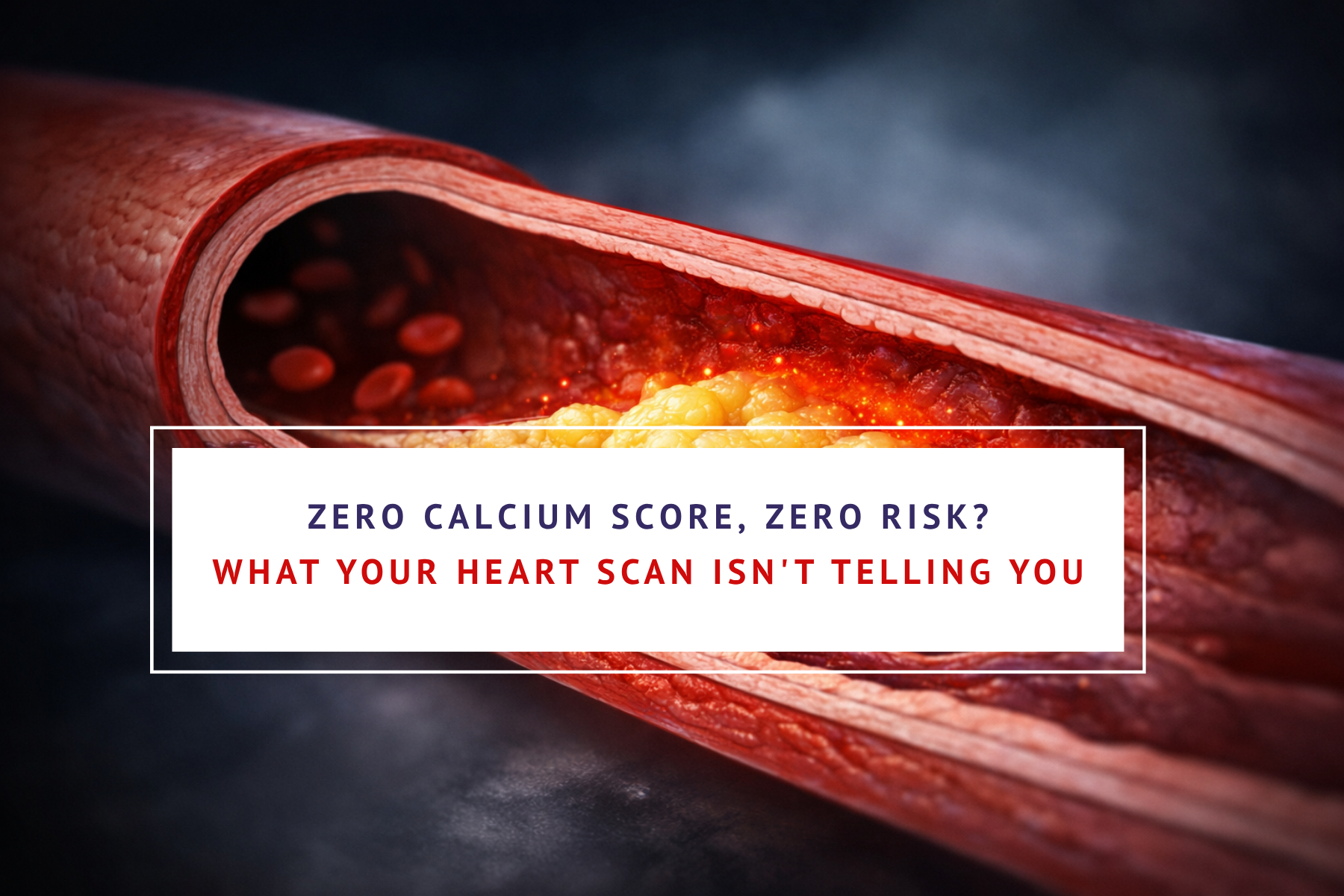
Because the earliest and most active stage of heart disease—soft plaque—doesn't show up on a calcium scan.²
Understanding what your scan doesn't show may be more important than what it does.
The Invisible Risk: What Your Calcium Scan Can't See
A coronary artery calcium (CAC) scan measures calcified (hardened) plaque in your arteries.
That's useful. But it only tells part of the story.
Because plaque doesn't start hard. It starts soft. Lipid-rich. Inflamed. Biologically active. And completely invisible on a calcium scan.²
This is the gap most people don't realize:
You can have a zero calcium score—and still have developing plaque.
Not advanced. Not necessarily dangerous yet. But present. And moving.
That's why a CAC score is best understood as: "No visible calcium right now" — not "no risk."
The Real Villain: Soft Plaque (The Stage Before It Shows Up)
If there's one concept to understand, it's this:
Heart disease doesn't begin with calcium. It begins with soft plaque.
Here's what's happening inside the body:
Step 1: Particle buildup
Atherogenic particles (like LDL and remnant lipoproteins) enter the arterial wall.³
Step 2: Inflammation response
The immune system reacts, creating irritation and early plaque formation.
Step 3: Soft plaque forms
This stage is unstable, lipid-rich, and not visible on CAC scans.
Step 4: Calcification (later stage)
The body stabilizes plaque by hardening it—this is what scans detect.
So by the time calcium appears, the process has already been happening for years.²
Why a Zero Calcium Score Doesn't Mean Zero Risk
Think of CAC = 0 as: "No visible scar tissue yet." But the underlying biology can still be active.
Here's where people get caught off guard:
1. Soft plaque doesn't show up
Non-calcified plaque can exist—even when your scan is completely clear.
2. Risk factors still matter
Your biology doesn't reset just because your scan is zero. Key drivers still include:
- High apoB or non-HDL cholesterol
- Elevated triglycerides
- Lp(a)
- Insulin resistance
- Smoking or vaping
- Chronic inflammation
3. This is a snapshot—not a timeline
A CAC scan shows where you are today. Not where you're heading. Without changes, soft plaque today can become calcified plaque later.
4. Symptoms always override scores
Chest pressure. Shortness of breath. Unexplained fatigue or discomfort. These always matter—regardless of CAC score.
The Shift: From "Clear Scan" to Real Prevention
Most people treat a zero score like an endpoint. But the healthiest people treat it as a starting point. Because if you catch the process early, you have the most leverage.
This is where the mindset shifts:
Not "Am I safe?" — But "What's happening beneath the surface?"
Build a Fuller Picture of Your Heart Health
If you want clarity beyond a CAC score, focus on systems—not snapshots.
Look deeper at lipoproteins
- ApoB
- Non-HDL cholesterol
- Lp(a)
These reflect the number of particles driving plaque formation.
Assess metabolic health
- Fasting glucose / A1c
- Triglycerides
- Blood pressure
- Waist circumference
Understand inflammation
- hs-CRP (one marker among many)
Consider advanced imaging (when appropriate)
In some cases, your clinician may recommend CCTA, which can detect both soft and calcified plaque.
What Actually Moves the Needle (Daily Habits That Matter)
No scan replaces what you do every day. These are the real levers:
Nutrition
- Fiber-rich foods (25–40g daily)
- Whole, minimally processed meals
- Healthy fats (olive oil, nuts, seeds)
- Reduced refined sugars and ultra-processed foods
Movement
- 150+ minutes/week of activity
- Strength training 2–3 times per week
- Short walks after meals
Sleep + Stress
- 7–9 hours per night
- Daily stress regulation (walking, breathwork, time outdoors)
Lifestyle
- No smoking or vaping
- Oral health (it matters more than most people think)
Where Supplements Fit (Support, Not Shortcuts)
Even with strong habits, there are still biological pathways that benefit from additional support. That's where targeted supplements can play a role. Not as replacements—but as amplifiers.
Citrus Bergamot and Cholesterol Metabolism
Citrus bergamot is a polyphenol-rich extract studied for its role in supporting:
- LDL and non-HDL cholesterol within normal ranges
- Metabolic balance
The key is choosing a product with standardized content and third-party testing—and using it alongside, not instead of, nutrition and movement.
Supporting the Gut–Heart Connection
Your gut, metabolism, and cardiovascular system are deeply connected. A balanced microbiome supports inflammatory regulation, metabolic signaling, and overall resilience. This is where fiber, polyphenols, and fermented foods play a foundational role.
A Simple 6-Week Reset (Built for Real Life)
Instead of overhauling everything, build momentum.
Weeks 1–2
- Track sleep, steps, blood pressure
- Add 10-minute walks after meals
Weeks 3–4
- Add strength training
- Increase fiber (chia, flax, legumes)
Weeks 5–6
- Optimize sleep window
- Replace refined snacks with whole options
- Reassess progress
When to Talk to Your Doctor
Consult your clinician if you:
- Have symptoms
- Have high-risk biomarkers
- Have a strong family history
- Need guidance on testing
FAQ
Q: If my CAC score is zero, can I skip all heart meds?
A: Not always. A zero score often means lower short-term risk, but your personal history, symptoms, apoB/non-HDL-C, Lp(a), blood pressure, and diabetes status still matter. Decisions about medication should be made with your clinician.
Q: How often should I repeat a calcium scan?
A: Many clinicians consider rescreening in 3–7 years if your risk changes, you develop risk enhancers, or as part of shared decision-making. Timing depends on age, baseline risk, and new information.
Q: Can a zero score increase quickly?
A: It can change over time, especially if risk factors are high. The goal is to support healthy lipids, blood pressure, and metabolic health so plaque remains minimal and stable.
Q: Does a CAC scan show all plaque?
A: No. It shows calcified plaque. Early, soft plaque is not visible, which is why a zero score does not guarantee zero risk.
Q: Can citrus bergamot replace diet, exercise, or medication?
A: No. It may support healthy cholesterol within the normal range, but works best as part of a comprehensive plan. Always review supplements with your healthcare professional.
Q: I'm young and active—should I still worry about soft plaque?
A: If you have a strong family history, smoke or vape, have elevated apoB or Lp(a), or high blood pressure, it's worth discussing with your clinician. A healthy lifestyle remains foundational, and targeted testing can provide clarity.
The Bottom Line
A zero calcium score is encouraging—but it is not a guarantee. Heart disease begins earlier than calcium appears. The goal is not to wait. It is to act early.
*This article is for informational purposes only and does not provide medical advice. It is not intended to diagnose, treat, cure, or prevent any disease. Always speak with your healthcare professional before making changes to your diet, exercise, or supplement routine, or if you have questions about a medical condition.
References
- Detrano R, et al. Coronary Calcium as a Predictor of Coronary Events. N Engl J Med. 2008. https://pubmed.ncbi.nlm.nih.gov/18367736/
- Puri R, Nicholls SJ, Shao M, et al. Impact of Statins on Serial Coronary Calcification During Atheroma Progression. J Am Coll Cardiol. 2015. https://pubmed.ncbi.nlm.nih.gov/25835438/
- Sniderman AD, Thanassoulis G, Williams K, et al. Apolipoprotein B vs LDL Cholesterol in Cardiovascular Risk Assessment. JAMA Cardiology. 2019. https://pubmed.ncbi.nlm.nih.gov/34773457/


