

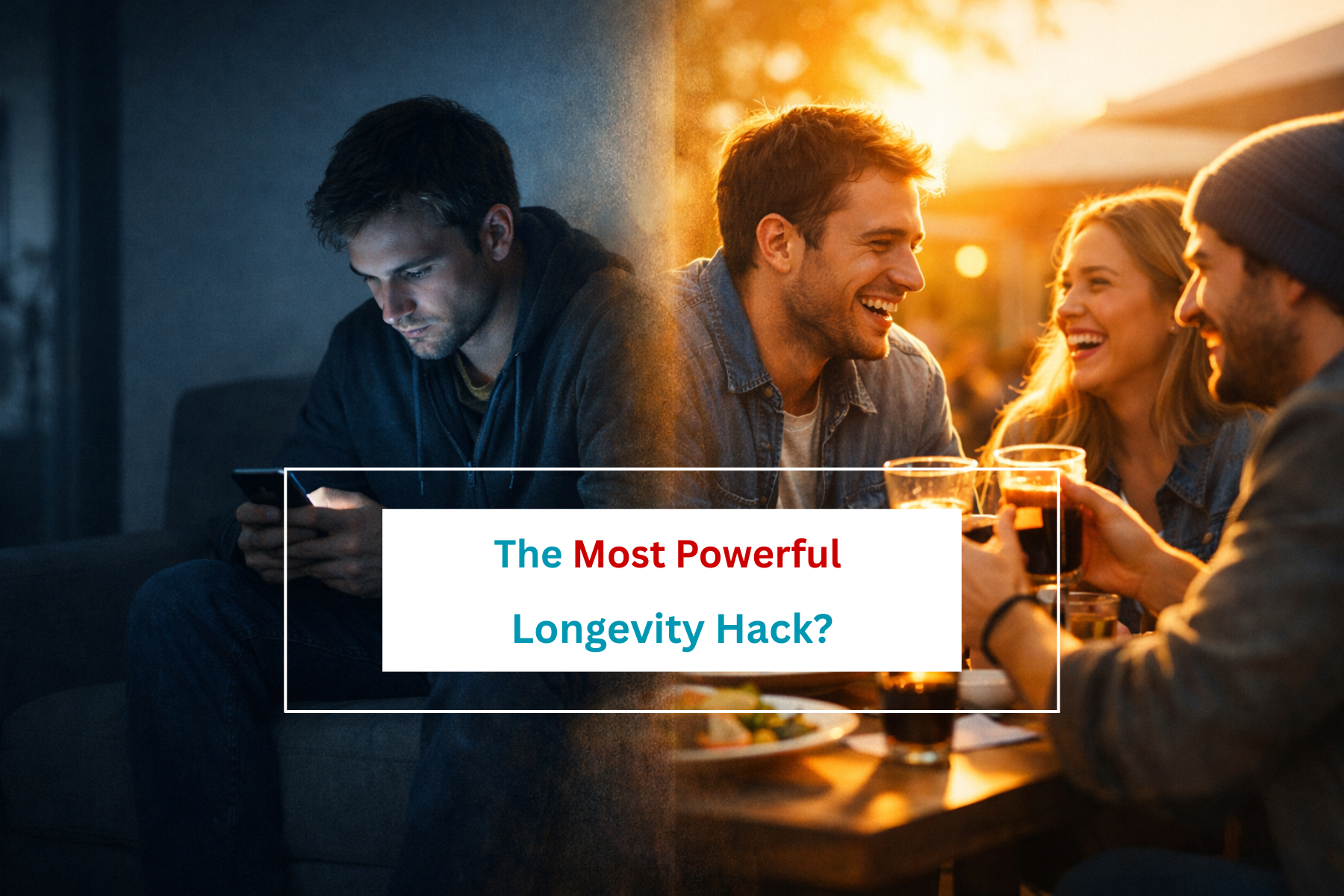
The Quiet Health Habit Most People Are Missing
When people think about improving their health, they usually focus on the basics: nutrition, exercise, sleep.
But one of the most powerful drivers of long-term health is often ignored—social connection.
Not just being around people. But feeling genuinely connected, seen, and supported.
Because your body doesn't just respond to what you eat or how you move. It responds to your environment—including your relationships.
A large body of research shows that social connection plays a direct role in stress regulation, immune system function, and emotional well-being. Studies on social relationships and health have consistently found that supportive connections help regulate physiological systems tied to stress and immunity, influencing overall health outcomes over time.¹⁻³
In contrast, a lack of meaningful connection can act as a chronic stressor—affecting both mental and physical health.²
In other words, connection isn't just a "nice to have." It's a biological signal that influences how your body functions every day.
The Invisible Villain: The Illusion of Connection
The real problem isn't that people aren't communicating. It's that most of that communication is surface-level connection. Fast. Efficient. Convenient. And completely missing the signals your body actually needs.
This is the illusion of connection:
- Messaging instead of presence
- Reacting instead of relating
- Staying "in touch" without ever feeling truly seen
It shows up quietly:
- You scroll past people you care about instead of calling them
- You sit next to someone while both of you are on your phones
- You end the day mentally exhausted… but not fulfilled
And over time, something subtle happens. Connection becomes thinner. And your body starts to feel it.
Why Humans Are Wired for Connection (And Why It Still Matters)
For most of human history, survival depended on belonging. Small groups shared food, protected one another, and navigated threats together. Being part of a group meant safety. Being alone meant risk.
Your biology hasn't changed. The human brain still interprets:
- Connection → safety
- Isolation → potential danger
Modern research shows that social experiences influence core systems in the body: the stress response (HPA axis), the autonomic nervous system, hormonal signaling, and immune regulation.
When you feel supported and connected, your body shifts into a calmer, more regulated state—supporting recovery, resilience, and balance.¹
Connection isn't just emotional. It's a biological signal of safety.
What Happens When Connection Is Missing
The danger of disconnection isn't dramatic. It's slow. Subtle. And easy to ignore.
Loneliness has become so common that it often feels normal. But the body doesn't treat it as neutral. A 2023 advisory from the U.S. Surgeon General identified loneliness as a major public health concern affecting millions of adults.²
Research links chronic loneliness with:
- Higher perceived stress
- Poor sleep quality
- Reduced immune function
- Increased anxiety and depression
- Greater cardiovascular risk
Some studies suggest its health impact may be comparable to smoking or physical inactivity.³
But here's what matters most: your body doesn't know the difference between social isolation and physical threat. When connection is missing, cortisol levels rise, inflammatory signals increase, and the nervous system stays on alert.
Over time, this becomes your baseline. Not because something is "wrong" with you—but because something essential is missing.
The Biology of Feeling Better: Social Buffering
One of the most powerful effects of real connection is something called social buffering.
When you go through stress alone, your brain treats it as a bigger threat. When you go through it with someone—everything changes.
Supportive relationships can:
- Reduce cortisol
- Improve emotional regulation
- Activate the parasympathetic ("rest and recover") system
- Increase feelings of safety
Even simple moments matter: laughing with someone, sharing a meal, having a real conversation. These aren't small things. They're signals. And your body responds to them immediately.
Connection, Mental Health, and Identity
Humans don't just need connection for support. We need it to understand ourselves.
Relationships provide a sense of belonging, space for emotional expression, validation during difficult moments, and shared joy and meaning.
Studies consistently show that stronger social networks are associated with lower depression, reduced anxiety, higher life satisfaction, and greater resilience.⁴
But there's something deeper happening. Connection shapes identity. Without it, people don't just feel alone. They feel unseen.
The Overlooked Link: Connection and Whole-Body Health
Emerging research shows that social experiences influence more than mood. They affect systems like the gut–brain axis—a communication network linking the brain, digestive system, immune signaling, and hormones.
Stress and emotional states can alter gut microbiota, digestion, and metabolic signaling. Which means your relationships don't just affect how you feel. They influence how your body functions.
Why Connection Predicts Longevity
One of the most striking findings in health research is this: people with strong social relationships live longer.
A large meta-analysis of over 300,000 individuals found that those with stronger social ties had a 50% higher likelihood of survival over time.³
Why? Because connection influences behavior and biology: healthier habits, better stress regulation, more support during illness, and greater emotional resilience.
This isn't a soft factor. It's a measurable one.
Why Modern Life Makes This So Hard
If connection is so important, why is it so easy to lose? Because modern life quietly works against it:
- Digital communication replaces presence
- Busy schedules reduce shared time
- People move frequently, weakening community ties
- Screens replace real-world interaction
None of these are inherently bad. But without intention, they create a life that looks connected—and feels empty.
The People Who Get This Right
The healthiest people aren't just focused on diet and exercise. They protect something most people overlook: real human connection.
They understand:
- Energy isn't just physical
- Resilience isn't just mental
- Health isn't just individual
It's relational. They don't leave connection to chance. They build it into their lives.
How to Rebuild Real Connection (Without Overcomplicating It)
You don't need a large network. You need real moments.
Start small:
- One uninterrupted dinner per week
- One walk with someone—no phones
- One conversation where you're fully present
Prioritize:
- Eye contact
- Listening without distraction
- Shared experiences
Even brief interactions matter: talking to a neighbor, connecting with a coworker, engaging with someone face-to-face.
Because connection isn't built in volume. It's built in presence.
Social Wellness Is Not Optional
We've been taught to think of health as diet, exercise, and sleep. But there's another pillar: connection.
It supports:
- Emotional resilience
- Stress regulation
- Immune balance
- Mental stability
- Overall well-being
Just like food fuels the body—connection fuels the nervous system.
The Bottom Line
In a world that rewards independence and constant productivity, it's easy to overlook something simple: humans were never designed to thrive alone.
The people who feel the most energized, resilient, and mentally clear aren't just managing their time. They're investing in connection.
Because at a biological level—connection isn't optional. It's fuel.
References
- Uchino BN. Social support and physical health: understanding the health consequences of relationships. Yale University Press. 2004. psycnet.apa.org
- U.S. Surgeon General. Our Epidemic of Loneliness and Isolation. 2023. hhs.gov
- Holt-Lunstad J, Smith TB, Layton JB. Social relationships and mortality risk: a meta-analytic review. PLOS Medicine. 2010;7(7):e1000316. journals.plos.org
- Kawachi I, Berkman LF. Social ties and mental health. Journal of Urban Health. 2001;78(3):458–467. pubmed.ncbi.nlm.nih.gov
- House JS, Landis KR, Umberson D. Social relationships and health. Science. 1988;241(4865):540–545. pubmed.ncbi.nlm.nih.gov
- Cacioppo JT, Cacioppo S. Loneliness in the modern age: an evolutionary theory of loneliness. Adv Exp Soc Psychol. 2018. sciencedirect.com


