

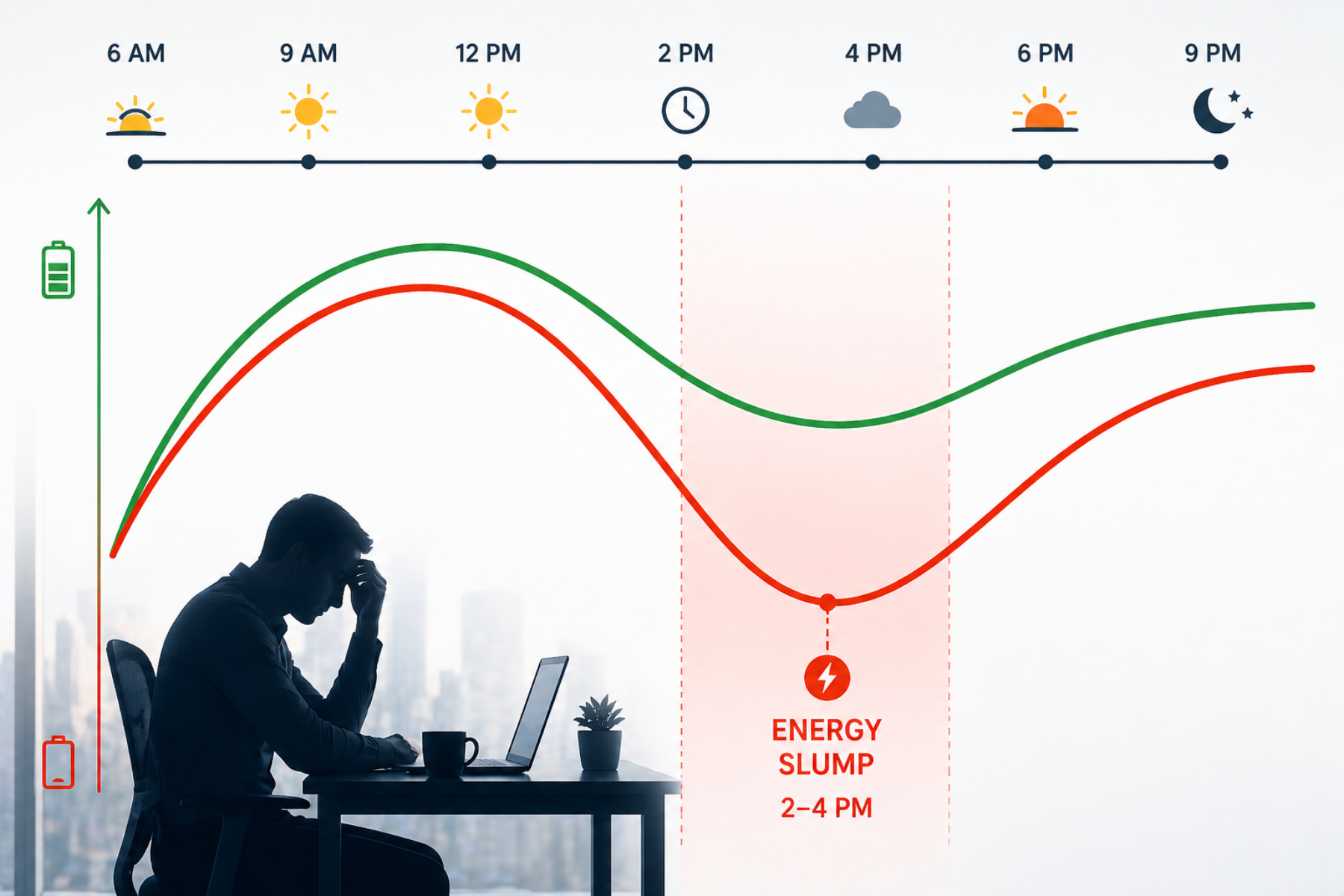
You power through your morning, eat a "decent" lunch, and then it hits: the 2–4 p.m. wall.
Heavy eyelids. Foggy focus. A subtle drop in motivation that turns even simple tasks into effort.
You reach for coffee or sugar just to stay functional.
If this "post-lunch dip" or afternoon fatigue is happening most days, it's not a willpower problem.
There is real biology behind it—and modern routines amplify it.
Windowless offices, artificial lighting, ultra-processed lunches, late nights, and poorly timed caffeine all combine to turn a normal circadian dip into a noticeable crash.
The goal is not to eliminate the dip entirely. It is to make it smaller, shorter, and easier to recover from.
What we'll discuss:
- The afternoon crash is mostly a normal circadian dip amplified by sleep debt and post-meal glucose swings.
- Bright light, balanced lower-glycemic meals, a 10-minute walk after lunch, steady hydration, and earlier caffeine cutoffs can shrink the 2 p.m. slump within 1–2 weeks.
What Causes Afternoon Energy Crashes?
The afternoon slump is driven by two overlapping systems:
- Circadian rhythm
- Sleep pressure (adenosine buildup)
Your circadian rhythm naturally creates a dip in alertness in the early afternoon—even if you skip lunch. This is a built-in biological pattern, not a flaw in your system [1].
At the same time, sleep pressure builds throughout the day. The longer you are awake, the more adenosine accumulates in the brain, signaling fatigue [9].
If you slept poorly, that signal is stronger. If you ate a fast-digesting lunch, the dip becomes more noticeable.
This is why the same afternoon can feel completely different depending on sleep, food, and environment.

Lunch and the "Energy Roller Coaster"
Food is one of the strongest signals affecting afternoon energy.
Fast-digesting carbohydrates—like white bread, sugary drinks, and refined snacks—can create rapid spikes in blood sugar followed by sharp drops.
This is often experienced as:
- Brain fog
- Sleepiness
- Cravings
- Irritability
This pattern is sometimes described as postprandial somnolence or reactive hypoglycemia-like symptoms.
What steadies the curve:
- Lower-glycemic, higher-fiber meals (beans, lentils, whole grains, cooled potatoes)
- 25–35 g of protein per meal
- 8–12 g of fiber
- Eating protein and vegetables before carbohydrates [15]
- Light movement after eating
Movement matters
Even a 5–10 minute walk after lunch can significantly reduce post-meal glucose spikes and insulin response [6].
Light, Screens, and the "Office Cave"
Your environment plays a larger role than most people realize.
Bright daylight has a direct alerting effect on the brain [2]. Dim indoor lighting—especially in the afternoon—signals the opposite.
If your workspace is dark, your brain interprets it as a cue to slow down.
Simple fixes:
- Sit near a window
- Step outside for 5–10 minutes
- Use brighter, cooler lighting in the afternoon
For night owls, shifting this light exposure slightly later in the day can help align with their natural rhythm.
Does Caffeine Cause Afternoon Crashes?
Caffeine works by blocking adenosine—the molecule that signals fatigue [4]. This creates temporary alertness. But it does not remove the underlying fatigue signal.
When caffeine wears off, the accumulated adenosine is still present.
Late-day caffeine also disrupts sleep. Even caffeine consumed 6 hours before bed can reduce sleep quality [8].
Practical approach:
- Front-load caffeine in the morning
- Reduce intake after early afternoon
- Pair smaller doses with movement instead of relying on larger doses
Creatine and "Brain Energy" — What Actually Matters
Creatine has gained attention recently for cognitive performance and "brain energy."
Some studies suggest it may support certain cognitive tasks, especially under sleep deprivation [17].
However, there is an important distinction: most of the research is based on creatine monohydrate, not gummies or novelty formats. Many creatine gummies provide doses that are too low to match research-backed intake levels unless taken in large quantities.
For most people:
- Creatine monohydrate powder is the more evidence-based and cost-effective option
- It should be viewed as a secondary tool—not a primary solution
Sleep, light exposure, meal structure, hydration, and movement remain far more impactful for resolving afternoon fatigue.
A Caffeine-Free Option to Support Afternoon Energy
If you're reducing caffeine but still want support for focus and stamina, a functional approach can help fill the gap. Nourishing Nutrients' Superfood 10 Mushroom Blend is a caffeine-free option designed to support steady energy and mental clarity, and daily performance—without the spike and crash.
It combines functional mushrooms traditionally used to support brain function and mental clarity, making it a useful addition to an afternoon routine [18]. It can also be taken alongside creatine monohydrate as part of a simple stack for both mental and physical support.
The key difference: instead of stimulating your system, it helps support more stable energy and focus as the day goes on.
Hydration and Mental Energy
Even mild dehydration can affect mood, focus, and perceived fatigue [7], [12].
In a typical workday, hydration is often inconsistent.
Simple structure:
- One glass on waking
- One mid-morning
- One with lunch
- One mid-afternoon
This alone can noticeably improve energy stability.
Environment: Air, CO₂, and Temperature
Indoor air quality directly affects cognitive performance.
Higher CO₂ levels, which are common in poorly ventilated spaces, have been shown to impair decision-making and mental clarity [13].
Warm environments also promote sleepiness.
Improvements:
- Open a window when possible
- Take calls outside
- Use a fan or slightly lower room temperature
A Simple Framework: The Five Levers
Instead of chasing quick fixes, focus on five core levers:
- Balanced Meals — Slow-digesting carbohydrates + protein + fiber
- Post-Meal Movement — 5–10 minute walk after eating
- Light Exposure — Morning light + afternoon boost
- Caffeine Timing — Morning-focused, limited late intake
- Hydration — Consistent fluid intake throughout the day
These small changes work together to reduce the intensity of the afternoon dip.
A 14-Day Plan to Reset Your Energy
Days 1–3: Foundation
- Fixed wake time
- Morning daylight exposure
- Hydration routine
- 10-minute walk after lunch
- Caffeine before early afternoon
Days 4–7: Nutrition
- Balanced breakfast
- Structured lunch (protein + fiber)
- Meal sequencing (protein first, carbs last)
- Movement breaks every 30 minutes
Days 8–14: Optimization
- Afternoon daylight exposure
- Optional short nap (10–20 minutes)
- Portion adjustments
- Evening sleep consistency
Track your energy at:
- 10 a.m.
- 2 p.m.
- 4 p.m.
Most people see measurable improvement within two weeks.
When the Crash Signals Something More
Consider speaking with a healthcare provider if you notice:
- Dizziness or heart rate changes after meals
- Persistent fatigue despite lifestyle changes
- Poor sleep quality or loud snoring
- Signs of nutrient deficiencies
- Strong blood sugar swings
These may require targeted evaluation.
The Science, Simply Put
- Circadian rhythms create a natural afternoon dip [1]
- Sleep debt amplifies fatigue [3]
- Blood sugar swings intensify energy fluctuations [5]
- Light improves alertness [2]
- Hydration supports cognitive function [7], [12]
- Caffeine masks fatigue but can worsen sleep [4], [8]
- Air quality affects mental performance [13], [14]
Key Takeaway
The afternoon crash is not random. It is the result of how your body processes:
- Light
- Food
- Sleep
- Stress
When those inputs are aligned, energy becomes stable.
Call to Action
Start simple this week:
- Take a 10-minute walk after lunch
- Move your caffeine earlier in the day
- Track your 2 p.m. energy for 14 days
If your energy improves, you're on the right track.
If it still feels inconsistent—despite dialing in meals, sleep, and movement—it may be time to support how your body processes energy, not just what you're feeding it.
FAQ
Is it normal to feel sleepy after lunch?
Yes, a mild dip is normal. A severe crash usually reflects modifiable factors.
What lunch prevents energy crashes?
Meals with protein, fiber, and slow-digesting carbohydrates.
Do carbs cause fatigue?
Fast-digesting carbs can create spikes and crashes. Balanced meals reduce this effect.
Is "adrenal fatigue" real?
It is not a recognized diagnosis. Most afternoon fatigue is explained by circadian rhythm, sleep, and metabolism.
Disclaimer
This article is for educational purposes only and is not a substitute for professional medical advice, diagnosis, or treatment.
References
[1] Monk TH. The post-lunch dip in performance. Chronobiol Int. 2005;22(1):173–181. https://europepmc.org/article/med/15892914
[2] Cajochen C. Alerting effects of light. Sleep Med Rev. 2007;11(6):453–464. https://pubmed.ncbi.nlm.nih.gov/17936041/
[3] Van Dongen HPA, Maislin G, Mullington JM, Dinges DF. The cumulative cost of additional wakefulness: dose-response effects of chronic sleep restriction. Sleep. 2003;26(2):117–126. https://pubmed.ncbi.nlm.nih.gov/12683469/
[4] Fredholm BB, Bättig K, Holmén J, Nehlig A, Zvartau EE. Actions of caffeine in the brain with special reference to factors that contribute to its widespread use. Pharmacol Rev. 1999;51(1):83–133. https://pubmed.ncbi.nlm.nih.gov/10049999/
[5] Ludwig DS. The glycemic index: physiological mechanisms relating to obesity, diabetes, and cardiovascular disease. Am J Clin Nutr. 2002;76(1 Suppl):274S–280S. https://pubmed.ncbi.nlm.nih.gov/11988062/
[6] Dunstan DW, Kingwell BA, Larsen R, et al. Breaking up prolonged sitting reduces postprandial glucose and insulin responses. Diabetes Care. 2012;35(5):976–983. https://pubmed.ncbi.nlm.nih.gov/22374636/
[7] Ganio MS, Armstrong LE, Casa DJ, et al. Mild dehydration impairs cognitive performance and mood of men. Br J Nutr. 2011;106(10):1535–1543. Link
[8] Drake C, Roehrs T, Shambroom J, Roth T. Caffeine effects on sleep taken 0, 3, or 6 hours before bedtime. J Clin Sleep Med. 2013;9(11):1195–1200. https://pubmed.ncbi.nlm.nih.gov/24235903/
[9] Porkka-Heiskanen T, Kalinchuk AV. Adenosine, energy metabolism and sleep homeostasis. Sleep Med Rev. 2011;15(4):263–270. https://pubmed.ncbi.nlm.nih.gov/20970361/
[10] Brooks A, Lack L. A brief afternoon nap following nocturnal sleep restriction: which nap is most recuperative? Sleep. 2006;29(6):831–837. https://pubmed.ncbi.nlm.nih.gov/16796222/
[11] Jansen RWM, Lipsitz LA. Postprandial hypotension: epidemiology, pathophysiology, and clinical management. Ann Intern Med. 1995;122(4):286–295. https://pubmed.ncbi.nlm.nih.gov/7825766/
[12] Armstrong LE, Ganio MS, Casa DJ, et al. Mild dehydration affects mood in healthy young women. J Nutr. 2012;142(2):382–388. https://pubmed.ncbi.nlm.nih.gov/22190027/
[13] Satish U, Mendell MJ, Shekhar K, et al. Is CO₂ an indoor pollutant? Direct effects of low-to-moderate CO₂ concentrations on human decision-making performance. Environ Health Perspect. 2012;120(12):1671–1677. https://pubmed.ncbi.nlm.nih.gov/23008272/
[14] Allen JG, MacNaughton P, Satish U, et al. Associations of cognitive function scores with carbon dioxide, ventilation, and volatile organic compound exposures in office workers. Environ Health Perspect. 2016;124(6):805–812. https://pubmed.ncbi.nlm.nih.gov/26502459/
[15] Shukla AP, Iliescu RG, Thomas CE, Aronne LJ. Food order has a significant impact on postprandial glucose and insulin levels. Diabetes Care. 2015;38(7):e98–e99. https://pubmed.ncbi.nlm.nih.gov/26106234/
[16] Wolever TMS, Jenkins DJA. The use of the glycemic index in predicting the blood glucose response to mixed meals. Am J Clin Nutr. 1988;48(5):1041–1045. https://pubmed.ncbi.nlm.nih.gov/3942088/
[17] McMorris T, Harris RC, Swain J, et al. Effect of creatine supplementation on cognitive performance and mood after sleep deprivation. Psychopharmacology (Berl). 2006;185(1):93–103. https://pubmed.ncbi.nlm.nih.gov/16416332/
[18] Mori K, Inatomi S, Ouchi K, Azumi Y, Tuchida T. Improving effects of the mushroom Yamabushitake (Hericium erinaceus) on mild cognitive impairment: a double-blind placebo-controlled clinical trial. Phytother Res. 2009;23(3):367–72. https://pubmed.ncbi.nlm.nih.gov/18844328/


