

You start the day strong. By midafternoon you feel foggy, hungry, and slow. So you reach for more coffee or a snack. You get a short lift, then an even bigger drop. Sound familiar?
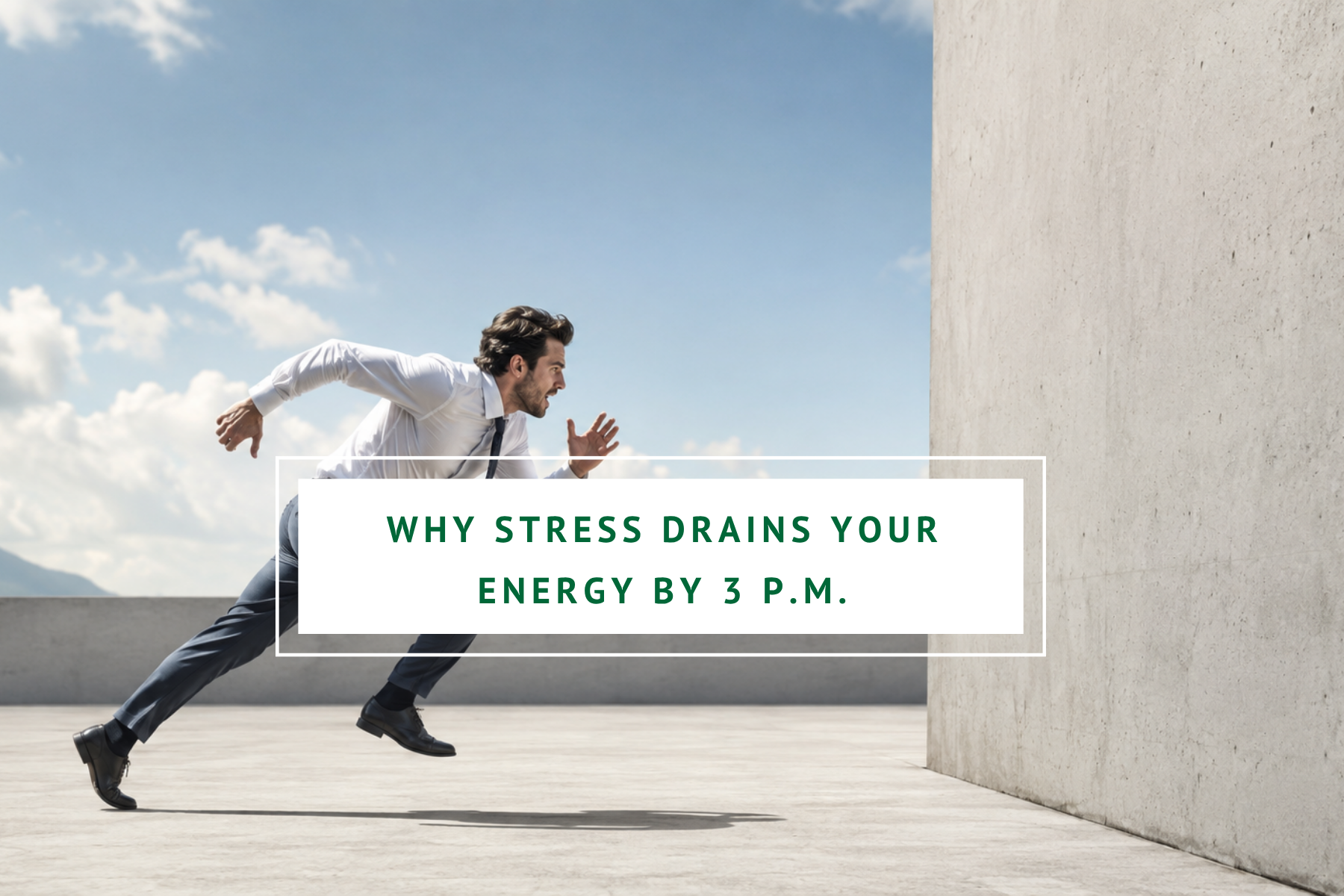
Stress puts your body into sprint mode. That mode is great for a quick challenge. Across a whole day, it throws off your cortisol timing, cuts into your sleep, and makes your blood sugar rise and fall. The result is the classic wired-then-tired feeling.
The good news is that once you see how stress shapes your energy, you can work with your body instead of against it. Below is what happens inside you, plus simple, science-backed steps for steady energy all day.
TL;DR
- Stress causes energy crashes by mis-timing cortisol, cutting sleep, and making blood sugar swing.
- Dim mornings and bright nights confuse your body clock and deepen the afternoon dip.
- Part of the 3 p.m. slump is normal. Your body clock has a built-in afternoon low.
- Three levers help most: morning light, balanced meals with a short walk, and slow breathing.
- Quick plan: outdoor light after waking, a protein-and-fiber lunch, a 10-minute walk after meals, five minutes of slow breathing, and no caffeine within six hours of bed.
What causes energy crashes from stress?
Stress triggers a rush of go-now chemistry, mainly adrenaline and cortisol. This helps you handle a short burst of pressure. But when stress runs all day, it scrambles your body clock, disturbs your sleep, and pushes your blood sugar up and then down [1][2][3][4]. Each of those swings shows up as tired, foggy energy.
How stress flips on your sprint switch
Stress is not only in your head. It is a full-body response built for short bursts. Your brain senses a challenge and hits the gas. Your heart beats faster. Cortisol frees up sugar for fast fuel. This is helpful before a big meeting. It wears you down when it lasts for hours.
Two systems run the show. Your fast fight-or-flight system sharpens focus and drives action. Your slower stress system, the HPA axis, releases cortisol to keep fuel ready. In small doses, both protect you. When they stay switched on, they create wear and tear that scientists call allostatic load. One of the first things you feel from that wear is shaky, unreliable energy [1][2].
Cortisol timing: when the clock slips, energy sinks
Cortisol should rise in the morning and fall at night. This daily curve helps you feel alert when you need it. Long stress, late nights, and odd schedules can flatten or shift that curve. When cortisol runs high at night and low in the afternoon, you feel buzzed when you want to rest and flat when you need to focus [3].
Sleep debt: the quiet energy drain
Sleep steadies your energy. After a short night, your body handles sugar less smoothly, so the same lunch causes a bigger spike and a harder crash [4]. Short sleep also shifts the hormones that control hunger. It lowers leptin, raises ghrelin, and nudges you toward quick, sugary fuel, often right around midafternoon [5].
The blood sugar roller coaster
Stress hormones tell your liver to release sugar so your brain can focus fast. Add quick carbs and a long stretch of sitting, and you get a sharp rise followed by a drop. Up, then down. Short movement breaks smooth this out. In lab studies, brief walking breaks during long sitting lowered post-meal blood sugar and insulin, which supports steadier energy afterward [9].
One thing that is not your fault: the built-in afternoon dip
Here is a nuance many people miss. Part of the 3 p.m. slump is simply built into your body clock. Humans have a natural dip in alertness in the early afternoon, separate from what you ate for lunch. So a small midday lull does not mean you failed at anything. It means you are human. You can work with this dip by saving lighter tasks for that window, and by using light, movement, and breathing to soften it.
Why other strong emotions can drain you too
Stress is not the only feeling that leaves you tired. Anger, worry, excitement, and even good news can wear you out. The reason is simple. Your body treats most strong emotions the way it treats stress. It switches on that same fast sprint chemistry, with a quicker heart and a burst of fuel [1][2]. Excitement before a big event and dread before a hard talk feel very different in your mind, yet both rev the same engine. When the burst passes, you feel the drop.
Holding feelings in has a cost too. When people hide a strong emotion, their outward face may stay calm, but their body works harder underneath. In lab studies, people told to mask their feelings showed more sympathetic nervous system activity, the same gas pedal that stress uses [21]. So bottling things up can quietly add to your fatigue.
Grief deserves its own note. Losing someone is one of the heaviest emotional loads there is, and it shows up in the body. Research links grief with poorer sleep, more inflammation signals, and a real drop in day-to-day energy [23]. That deep tiredness is a normal part of how the body adapts to loss, not a personal weakness.
What helps? Start by naming the feeling. Brain studies show that putting an emotion into words, such as "I feel worried" or "I feel angry," calms the brain's alarm center and lowers the charge [22]. From there, the same core habits that steady stress energy also help here: slow breathing, a short walk, morning light, and protecting your sleep. Connection helps too. A short talk with someone you trust can take your body out of sprint mode faster than trying to power through alone.
How to support steady energy all day (beyond more coffee)
You do not need a full life overhaul. A few well-timed habits can line up your body clock, your fuel, and your nervous system.
Get morning light and keep a steady wake time
Step outside within an hour of waking for 5 to 15 minutes, even on cloudy days. Morning light is your strongest wake-up signal. It also trains your body clock so your energy shows up at the right times tomorrow. When your mornings are dark, turn on the brightest indoor lights you have during your first hour. A steady wake time teaches your body when to bring your energy up [3][6][14].
Build meals that hold, then move after you eat
Pair protein, fiber, and a little fat to slow digestion and avoid sharp spikes. A simple target: aim for about 25 to 35 grams of protein at lunch, plus vegetables and a slow carb like beans or whole grains. Then move for about 10 minutes within an hour of eating. A walk, a few flights of stairs, or light stretching all work. That short activity helps your muscles soak up sugar and often heads off the 3 p.m. slump [9].
Use your breath to ease the stress response
Five minutes of slow breathing can help switch you out of always-on mode. Try about six breaths per minute. Breathe in for four to five seconds, then out for five to six seconds. Slow breathing supports your body's calming system and stress resilience. Studies show this kind of practice can lower feelings of stress and tension [13][15].
Hydrate early in the day
Even mild dehydration can drag down mood and raise fatigue [7][17]. Drink a glass of water soon after waking and another with breakfast. Sip through the morning and early afternoon. Coffee and tea do count toward fluids, but do not let them be your only ones. When you sweat a lot or eat very little salt, a bit of salt on food can help you hold on to fluid.
Treat caffeine as a tool, not a crutch
A morning cup of caffeine can lift alertness. A small early-afternoon cup can help on a rough day. Draw one clear line: keep caffeine out of the six hours before bed. Even that far ahead, it can still cut into your sleep and set up tomorrow's crash [10].
Take movement snacks
When you sit most of the day, set a timer for a two to three minute break every 45 to 60 minutes. Stand, stretch, walk the hall, or do a few squats. These movement snacks clear stress chemistry, help your muscles use sugar, and sharpen focus [9][12].
Nap short, if you nap
After a short night, a brief nap can help. Keep it to about 10 to 20 minutes, and take it in the early-to-mid afternoon. Longer naps drop you into deep sleep and can leave you groggy [8]. Go easy on caffeine when you plan to nap.
What about black maca?
Black maca is a variety of the Peruvian root Lepidium meyenii. It is often called an adaptogen, meaning a plant that may help the body respond to stress [20]. Some studies suggest maca may support mood in older women and slightly boost endurance in trained athletes, but none show it steadies all-day energy under stress [18][19]. When you want to try black maca, treat it as an extra, not a replacement for light, sleep, meals, and movement.
A simple day plan
- Morning: step outside for light and drink a glass of water.
- Breakfast: include protein, then take a two to three minute walk before you sit down.
- Lunch: protein and fiber, then a 10-minute walk within the hour.
- Midafternoon: five minutes of slow breathing instead of a second big coffee.
- Late afternoon: a quick walk or stretch to clear desk fog.
- Evening: dim the lights and screens so sleep signals arrive on time.
When to talk with a clinician
Some fatigue has a medical cause. When your low energy is strong or does not lift after a few weeks of these steps, check in with your healthcare provider. They may look at things like iron, thyroid, and vitamin B12, review your sleep quality, and rule out other causes. This is especially wise when you snore, wake up unrefreshed, or feel wiped out no matter what you try.
Key takeaways
- Stress and most strong emotions switch on the same sprint chemistry, which drains energy over a day.
- Mis-timed cortisol, short sleep, and blood sugar swings drive the afternoon crash.
- Part of the 3 p.m. dip is a normal body-clock low, so go easy on yourself.
- Naming a feeling, slow breathing, and a short walk calm the body fast.
- The daily anchors are morning light, balanced meals with movement, hydration, smart caffeine, and steady sleep.
Ready to steady your energy?
Pick two habits to try tomorrow: outdoor light soon after waking and a 10-minute walk after lunch. Rate your energy at 10 a.m., 2 p.m., and 6 p.m. for one week. Your notes will show which habits give you the biggest lift, and that becomes your own plan for steadier days.
Frequently asked questions
What causes energy crashes from stress?
Stress shifts you into sprint mode, where adrenaline and cortisol free up quick fuel. Over a day, mis-timed cortisol, sleep debt, and post-meal blood sugar spikes set up the wired-then-tired pattern, often in the midafternoon [1][3][4][9].
How can I ease stress-related fatigue without more caffeine?
Use three levers: light, movement, and breath. Get bright outdoor light in the first hour after waking, take short walking breaks after meals, and do five minutes of slow breathing with longer exhales. Drink water and pair protein with carbs at lunch. Keep caffeine out of the six hours before bed [6][9][10][13][15].
Why do I crash at 3 p.m.?
Two things stack up. Your body clock has a natural early-afternoon dip in alertness, and a quick, carb-heavy lunch plus long sitting can add a blood sugar drop on top of it. Light, a short walk, and balanced meals soften both [3][9].
Can other emotions like anger or grief make me tired?
Yes. Anger, worry, and excitement turn on the same sprint chemistry as stress, so the drop that follows feels like fatigue. Grief is heavier still and links with poorer sleep and lower daily energy. Naming the feeling, slow breathing, and a short walk help the body settle [21][22][23].
Does black maca help with energy and stress?
Black maca is popular, but human trials are small and short. Some suggest support for mood in older women and small endurance gains in trained athletes. There is no strong evidence it steadies all-day energy under stress. Use it, if you choose, alongside light, sleep, meals, and movement, not instead of them [18][19][20].
Health disclaimer
These statements have not been evaluated by the Food and Drug Administration. This product is not intended to diagnose, treat, cure, or prevent any disease. This article is for informational and educational purposes only. It is not medical advice, diagnosis, or treatment. Always talk with your healthcare provider about your specific health questions and before making changes to your diet, supplements, or medications.
References
[1] McEwen BS. Protective and damaging effects of stress mediators. N Engl J Med. 1998;338(3):171-179. https://pubmed.ncbi.nlm.nih.gov/9428819/
[2] Ulrich-Lai YM, Herman JP. Neural regulation of endocrine and autonomic stress responses. Nat Rev Neurosci. 2009;10(6):397-409. https://pubmed.ncbi.nlm.nih.gov/19469025/
[3] Scheer FAJL, Hilton MF, Mantzoros CS, Shea SA. Adverse metabolic and cardiovascular consequences of circadian misalignment. Proc Natl Acad Sci USA. 2009;106(11):4453-4458. https://pubmed.ncbi.nlm.nih.gov/19255424/
[4] Spiegel K, Leproult R, Van Cauter E. Impact of sleep debt on metabolic and endocrine function. Lancet. 1999;354(9188):1435-1439. https://pubmed.ncbi.nlm.nih.gov/10543671/
[5] Spiegel K, Tasali E, Penev P, Van Cauter E. Brief communication: sleep curtailment in healthy young men is associated with decreased leptin levels, elevated ghrelin levels, and increased hunger and appetite. Ann Intern Med. 2004;141(11):846-850. https://pubmed.ncbi.nlm.nih.gov/15583226/
[6] Cajochen C. Alerting effects of light. Sleep Med Rev. 2007;11(6):453-464. https://pubmed.ncbi.nlm.nih.gov/17936041/
[7] Armstrong LE, Ganio MS, Casa DJ, et al. Mild dehydration affects mood in healthy young women. J Nutr. 2012;142(2):382-388. https://pubmed.ncbi.nlm.nih.gov/22190027/
[8] Brooks A, Lack L. A brief afternoon nap following nocturnal sleep restriction: which nap duration is most recuperative? Sleep. 2006;29(6):831-840. https://pubmed.ncbi.nlm.nih.gov/16796222/
[9] Dunstan DW, Kingwell BA, Larsen R, et al. Breaking up prolonged sitting reduces postprandial glucose and insulin responses. Diabetes Care. 2012;35(5):976-983. https://pubmed.ncbi.nlm.nih.gov/22374636/
[10] Drake C, Roehrs T, Shambroom J, Roth T. Caffeine effects on sleep taken 0, 3, or 6 hours before going to bed. J Clin Sleep Med. 2013;9(11):1195-1200. https://pubmed.ncbi.nlm.nih.gov/24235903/
[11] Dantzer R, O'Connor JC, Freund GG, Johnson RW, Kelley KW. From inflammation to sickness and depression: when the immune system subjugates the brain. Nat Rev Neurosci. 2008;9(1):46-56. https://pubmed.ncbi.nlm.nih.gov/18073775/
[12] Puetz TW, O'Connor PJ, Dishman RK. Effects of chronic exercise on feelings of energy and fatigue: a quantitative synthesis. Psychol Bull. 2006;132(6):866-876. https://pubmed.ncbi.nlm.nih.gov/17073524/
[13] Lehrer PM, Vaschillo E, Vaschillo B. Heart rate variability biofeedback increases baroreflex gain and peak expiratory flow. Appl Psychophysiol Biofeedback. 2003;28(1):7-18.
[14] Souman JL, Tinga AM, te Pas SF, van Ee R, Vlaskamp BNS. Acute alerting effects of light: a systematic literature review. Behav Brain Res. 2018;337:228-239. https://pubmed.ncbi.nlm.nih.gov/28912014/
[15] Goessl VC, Curtiss JE, Hofmann SG. The effect of heart rate variability biofeedback training on stress and anxiety: a meta-analysis. Psychol Med. 2017;47(15):2578-2586. https://pubmed.ncbi.nlm.nih.gov/28478782/
[16] Marsland AL, Walsh C, Lockwood K, John-Henderson NA. The effects of acute psychological stress on circulating and stimulated inflammatory markers: a systematic review and meta-analysis. Brain Behav Immun. 2017;64:208-219. https://pubmed.ncbi.nlm.nih.gov/28089638/
[17] Pross N, Demazières A, Girard N, et al. Effects of changes in water intake on mood of high and low drinkers. PLoS One. 2014;9(4):e94754. https://pubmed.ncbi.nlm.nih.gov/24728141/
[18] Stone M, Ibarra A, Roller M, Zangara A, Stevenson E. A pilot investigation into the effect of maca supplementation on physical activity and sexual desire in sportsmen. J Ethnopharmacol. 2009;126(3):574-576. https://pubmed.ncbi.nlm.nih.gov/19781622/
[19] Brooks NA, Wilcox G, Walker KZ, Ashton JF, Cox MB, Stojanovska L. Beneficial effects of Lepidium meyenii (Maca) on psychological symptoms and measures of sexual dysfunction in postmenopausal women are not related to estrogen or androgen content. Menopause. 2008;15(6):1157-1162. https://pubmed.ncbi.nlm.nih.gov/18784609/
[20] Panossian A, Wikman G. Evidence-based efficacy of adaptogens in fatigue, and molecular mechanisms related to their stress-protective activity. Curr Clin Pharmacol. 2009;4(3):198-219. https://pubmed.ncbi.nlm.nih.gov/19500070/
[21] Gross JJ, Levenson RW. Emotional suppression: physiology, self-report, and expressive behavior. J Pers Soc Psychol. 1993;64(6):970-986. https://pubmed.ncbi.nlm.nih.gov/8326473/
[22] Lieberman MD, Eisenberger NI, Crockett MJ, Tom SM, Pfeifer JH, Way BM. Putting feelings into words: affect labeling disrupts amygdala activity in response to affective stimuli. Psychol Sci. 2007;18(5):421-428. https://pubmed.ncbi.nlm.nih.gov/17576282/
[23] O'Connor MF. Grief: a brief history of research on how body, mind, and brain adapt. Psychosom Med. 2019;81(8):731-738. https://pubmed.ncbi.nlm.nih.gov/31180982/


