

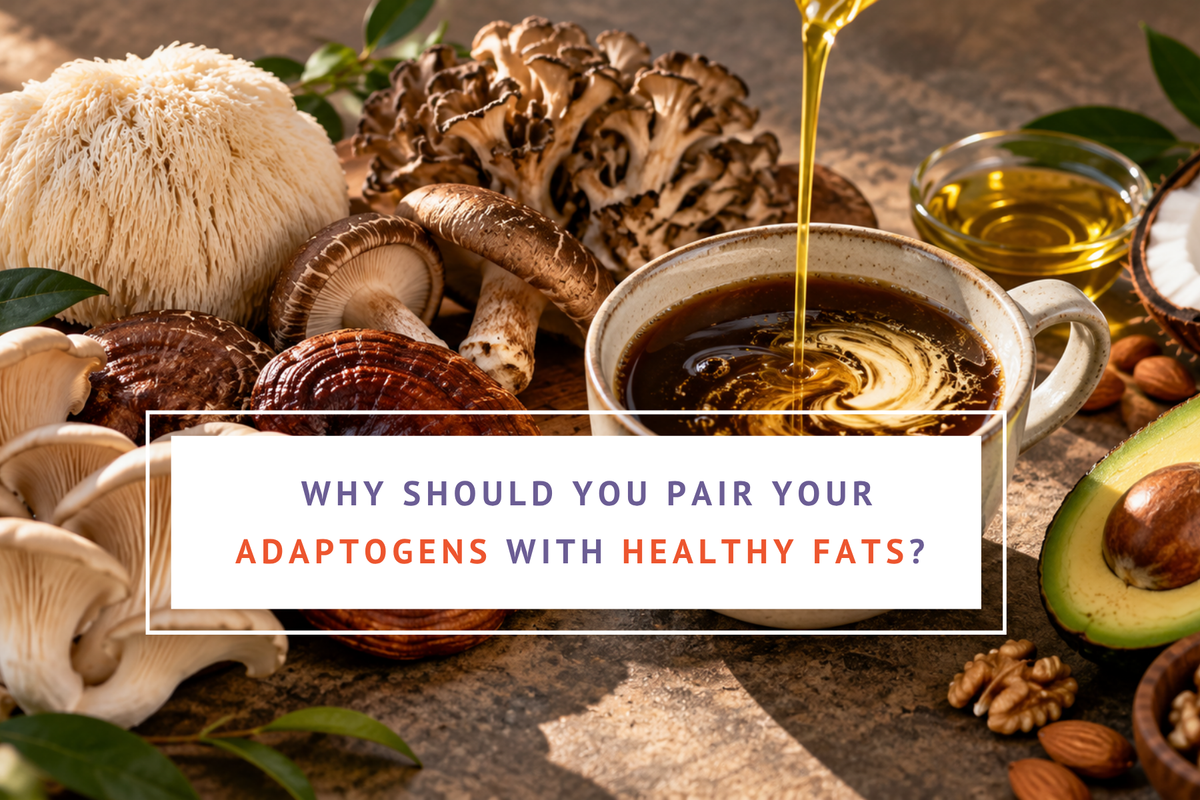
The way we choose our food is changing. Healthy mushrooms are no longer rare finds in specialty health-food stores. Today, they are kitchen staples for people who want to eat well.
But there is a big question many people forget to ask: how much of what we eat does the body actually take in?
Many people stir a blend of 10 organic mushrooms, such as Chaga, Shiitake, Reishi, and Lion’s Mane, into plain water and think they are set. The science is more nuanced. Mushrooms contain different types of compounds, and some fat-soluble compounds may be better absorbed when eaten with fat. Understanding the difference is the blueprint.
What’s inside a mushroom powder?
Two broad groups of compounds are useful to distinguish: water-loving beta-glucans and fat-soluble components.
1. The water-loving part: beta-glucans
High-quality mushroom powders are valued for beta-glucans, complex carbohydrates that are part of fungal cell walls. In our laboratory test for lot YZKB103250402, beta-glucans measured 42.9%, above our 30% guarantee. [1]
Beta-glucans behave differently from fat-soluble nutrients. They are not generally absorbed intact into the bloodstream. Instead, they can pass through the upper digestive tract and interact with gut microbes in the large intestine. [7] [8]
That is part of their normal role: their activity is associated with the gut and immune system, rather than needing to circulate in the blood. [17]
2. The fat-loving part: where healthy fats may help
Mushrooms can also contain fat-soluble compounds, which follow a different route through digestion. Dietary fat and bile help form tiny droplets that support absorption of fat-soluble nutrients. [4] [5] [6]
Three examples to know:
- Vitamin D2: Mushrooms exposed to sunlight or UV light can produce vitamin D2. In a study of adults with low vitamin D status, UV-treated mushrooms increased vitamin D levels. [11] Mushrooms can be one food-based source of vitamin D, though the amount varies by mushroom and preparation. [12]
- Ergosterol: This fungal compound can be converted into vitamin D2 when exposed to UV light. [15]
- Triterpenoids: Reishi contains triterpenoids. These compounds are typically extracted using methods different from water extraction, reflecting their distinct chemical properties. [15]
What healthy fats may do
Pairing mushroom powder with a meal containing fat is a practical way to include fat alongside fat-soluble components. Here are three relevant digestive processes:
1. Supporting bile release and micelle formation
Fat in the digestive tract stimulates signals including CCK, which prompts the gallbladder to release stored bile into the intestine. (Your liver makes bile; your gallbladder stores it.) Bile helps disperse fats into small droplets that support absorption of fat-soluble compounds. [4] [5]
This pathway is relevant to fat-soluble compounds such as vitamin D2. It does not turn water-soluble beta-glucans into fat-soluble compounds.
2. Slowing digestion
Fat can stimulate CCK and slow stomach emptying. [10] This can affect how quickly a meal moves through digestion, but it does not mean every nutrient is absorbed more effectively, and it does not change how beta-glucans behave.
3. Making a smoother, better-tasting drink
Mushroom powder can blend into creamy drinks and foods, which may improve texture and flavor. Try adding it to coffee with a little butter, ghee, or MCT oil if those ingredients fit your preferences. No complicated science required.
Easy kitchen ideas
A blend of 10 mushrooms can be a convenient addition to your routine. Try adding 1 gram of mushroom powder to foods that already contain fat:
- Creamy coffee: Stir mushroom powder into morning coffee with a tablespoon of grass-fed butter, ghee, or MCT oil. Blend for about 10 seconds for a frothy latte.
- Savory dinner: Stir it into pasta sauce, coconut-milk curry, or gravy made with olive oil during the final few minutes of cooking. Shiitake, Oyster, and Maitake can complement savory flavors.
- Snack bites: Fold it into homemade energy bars or protein balls made with almond butter, chia seeds, and cocoa.
These ideas pair the powder with fat-containing foods and may make it more enjoyable to use regularly. Choose ingredients that work for your dietary needs. Consistency matters more than a specific time of day.
The short version
- Beta-glucans: These water-loving fibers are not generally absorbed intact and can interact with gut microbes. [7]
- Fat-soluble compounds: Vitamin D2 and other fat-soluble components use digestive processes involving dietary fat and bile. [6]
- Slower digestion: Fat can slow stomach emptying, but that does not make every compound more absorbable. [10]
- Keep it practical: Add mushroom powder to a food or drink you enjoy, and pair it with a source of healthy fat if appropriate.
Enjoy your mushrooms with healthy fats, and share the science with care.
Sources
- Fungal cell wall composition — Frontiers in Microbiology, 2020.
- Chitin: a comparison between its main sources — Frontiers in Materials, 2025.
- Human gastric juice contains chitinase that can degrade chitin — Annals of Nutrition & Metabolism, 2007.
- Physiology, bile secretion — StatPearls.
- Physiology, nutrient absorption — StatPearls.
- Biochemistry, fat-soluble vitamins — StatPearls.
- Beta-glucans: gut microbiota and the immune system — Frontiers in Nutrition, 2023.
- Edible mushroom polysaccharides and gut microbiota — Frontiers in Nutrition, 2023.
- The cholesterol-lowering effect of oats and oat beta-glucan — Frontiers in Nutrition, 2019.
- Gastric sensory and motor functions and energy intake — Nutrients, 2021.
- Bioavailability of vitamin D2 from UV-B-irradiated button mushrooms (RCT) — European Journal of Clinical Nutrition, 2011.
- Mushrooms: a food-based solution to vitamin D deficiency — Frontiers in Nutrition, 2024.
- Effect of high- versus low-fat meal on serum 25-hydroxyvitamin D — International Journal of Endocrinology, 2011.
- Influence of food on 25-hydroxyvitamin D3 after supplementation — Nutrients, 2016.
- Ganoderma lucidum: chemistry, benefits and safety — Antioxidants, 2025.
- Digestive characteristics of Hericium erinaceus polysaccharides — Frontiers in Nutrition, 2022.
- Edible mushrooms and beta-glucans: impact on human health — Nutrients, 2021.
- Consuming Lentinula edodes (shiitake) mushrooms daily improves human immunity — Journal of the American College of Nutrition, 2015.
These statements have not been evaluated by the Food and Drug Administration. This product is not intended to diagnose, treat, cure, or prevent any disease.
This content is for informational purposes only and is not medical advice. Talk with your healthcare provider before starting any new supplement, especially if you are pregnant, nursing, taking medication, or managing a health condition.


