

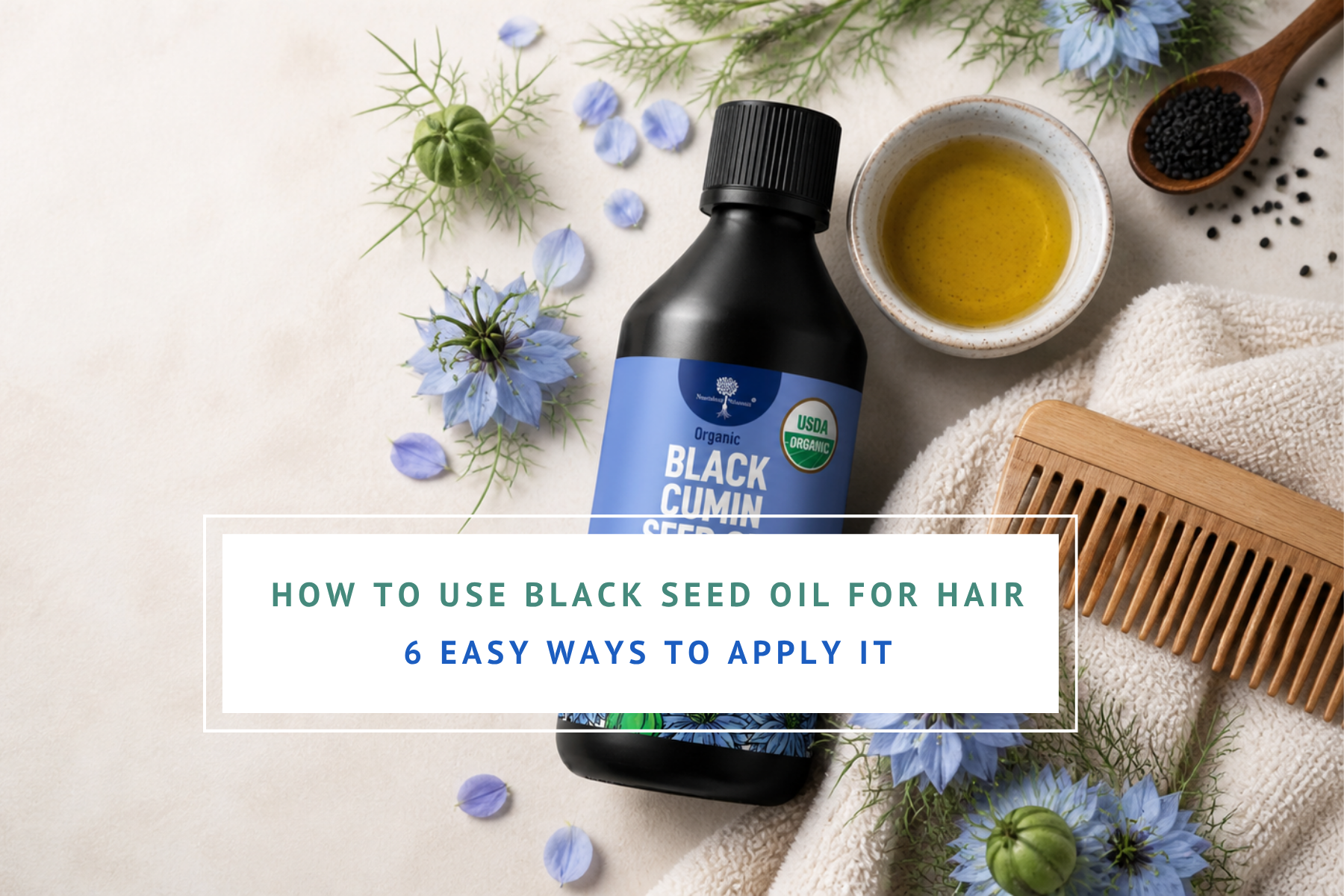
Wondering how to use black seed oil for hair without making your scalp or strands feel too oily? Black seed oil, pressed from the seeds of Nigella sativa, is often used as a natural hair and scalp oil. It may help moisturize dry areas, soften strands, and support a healthy-looking scalp.
Below, you'll learn how to apply black seed oil on hair, how long to leave it on, how often to use it, and six simple ways to add it to your hair-care routine.
Black seed oil has been valued for centuries in traditional medicine across the Middle East, Africa, and Asia. Historical texts such as Avicenna's Canon of Medicine (1025 A.D.) describe its use for vitality, skin, and hair care. Archeologists even discovered black seed in the tomb of King Tutankhamun, suggesting its importance in ancient Egypt [1].
Modern research has identified thymoquinone as one of the main active compounds in black seed oil. Reviews have studied Nigella sativa and thymoquinone for antioxidant and soothing properties [2]. For this reason, black seed oil is best described as a conditioning oil that may help support scalp comfort and healthy-looking hair.
Key Takeaways
- Black seed oil for hair is commonly used as a scalp and strand-conditioning oil.
- The easiest method is to massage a few drops into the scalp, leave on for 20–30 minutes, then shampoo.
- Start with 1–2 uses per week.
- Use a small amount to avoid greasy buildup.
- Patch test before applying black seed oil to your scalp.
How to Apply Black Seed Oil on Hair and Scalp
The simplest way to use black seed oil is as a pre-shampoo scalp and hair treatment.
Basic method:
- Start with dry or slightly damp hair.
- Add a few drops of black seed oil to your palms.
- Massage it into the scalp for 5–10 minutes.
- Smooth a small amount through the mid-lengths and ends.
- Leave it on for 20–30 minutes.
- Wash with a mild shampoo.
Use a small amount first. Black seed oil is rich and may feel heavy if too much is applied.
How Often Should You Use Black Seed Oil on Hair?
Most people can start by using black seed oil on the hair or scalp 1–2 times per week. If your hair is fine or oily, use only a few drops and focus on the ends. If your hair is thick, curly, coarse, or dry, you may prefer using it as a 20–30 minute pre-shampoo treatment.
Always patch test first, especially if you have sensitive skin.
How Long Should You Leave Black Seed Oil in Your Hair?
For most hair types, leave black seed oil on for 20–30 minutes before shampooing. Some people with very dry hair may leave a small amount on the ends longer, but avoid using too much near the scalp. Heavy oil buildup can make hair feel greasy or flat.
6 Ways to Use Black Seed Oil for Hair
1. Use Black Seed Oil as a Pre-Shampoo Scalp Treatment
The simplest way to use black seed oil for hair is on its own. Massaging black seed oil into the scalp may help moisturize dry areas and support scalp comfort.
Method:
- Warm a small amount of black seed oil between your palms.
- Massage into the scalp for 10–15 minutes.
- Leave on for 30 minutes before washing with a mild shampoo.
2. Use Black Seed Oil With an Apple Cider Vinegar Rinse
Apple cider vinegar is often used as a natural scalp rinse. Paired with black seed oil, it may help refresh the scalp and support balance.
Method:
- Apply black seed oil directly to the scalp and leave for 20–30 minutes.
- Rinse the scalp with a diluted apple cider vinegar solution (1 part vinegar, 3 parts water).
- Follow with shampoo.
3. Mix Black Seed Oil With Olive Oil for Dry Hair
Both olive oil and black seed oil are traditionally used for their moisturizing properties. Together, they make a nourishing blend.
Method:
- Mix equal parts black seed oil and olive oil.
- Massage into the scalp and along the hair.
- Leave on for 30 minutes, then rinse thoroughly.
4. Add Black Seed Oil to a Henna Hair Mask
Henna has long been used in hair masks, while black seed oil adds conditioning support.
Method:
- Mix henna powder with black seed oil to form a smooth paste.
- Apply to the scalp and hair as a mask.
- Leave on for 30 minutes, then rinse well with water.
5. Mix Black Seed Oil With Coconut Oil for Softer Hair
Coconut oil is a common natural conditioner that has been studied for its ability to help reduce hair damage from combing in laboratory hair models [4]. Combined with black seed oil, it may help soften and hydrate hair.
Method:
- Mix 1 tablespoon of black seed oil with 1 tablespoon of coconut oil.
- Apply from root to tip, covering the scalp.
- Wrap hair in a warm towel for 20 minutes.
- Rinse with shampoo.
6. Use Lemon Juice First, Then Apply Black Seed Oil
Lemon juice has been traditionally used in scalp care. Following with black seed oil may help reduce dryness and condition the scalp.
Method:
- Apply fresh lemon juice to the scalp for 10–15 minutes.
- Rinse with shampoo.
- Massage black seed oil into the scalp once the hair is dry.
Frequently Asked Questions
How do you use black seed oil for hair?
To use black seed oil for hair, massage a few drops into the scalp, smooth a small amount through the hair, leave it on for 20–30 minutes, then wash with a mild shampoo. Start with a small amount to avoid buildup.
How do you apply black seed oil on hair?
Apply black seed oil to dry or slightly damp hair. Rub a few drops between your palms, massage into the scalp, then work a light amount through the ends. Leave it on before washing, or use a tiny amount on dry ends as needed.
Can I leave black seed oil in my hair overnight?
Some people leave oils in overnight, but black seed oil may feel heavy or irritating for some scalps. A safer first step is to leave it on for 20–30 minutes, then shampoo. If your skin handles it well, you can test a longer time.
Should black seed oil be applied to wet or dry hair?
Black seed oil can be applied to dry or slightly damp hair. For scalp massage, dry hair is often easier. For smoothing ends, slightly damp hair may help spread the oil more evenly.
How often should I use black seed oil for hair?
Start with 1–2 times per week. Fine or oily hair may need less. Thick, curly, coarse, or dry hair may tolerate it more often.
Do you need to dilute black seed oil before applying it to the scalp?
Diluting black seed oil with a carrier oil, such as coconut oil or olive oil, may be helpful for sensitive scalps. Always patch test first.
Does black seed oil help hair grow?
There is not enough strong human research to say that black seed oil grows hair. It is better supported as a traditional hair and scalp oil that may help condition the scalp, soften strands, and support healthy-looking hair.
What makes black seed oil unique for hair care?
Black seed oil is naturally rich in thymoquinone, a compound studied for antioxidant and soothing properties [2]. The oil provides concentrated nourishment compared with whole seeds.
How can I mask the taste if I take black seed oil orally?
Many people mix a spoonful of black seed oil with honey or nut butter, or take it after using mouthwash, to help mask its strong flavor.
Are there side effects?
Black seed oil is generally well tolerated in moderation. Some people report mild digestive upset if taken orally or mild sensitivity with topical use. Pregnant or nursing individuals, and those with health conditions, should consult a healthcare provider before use.
These statements have not been evaluated by the Food and Drug Administration. This content is for educational purposes only and is not intended to diagnose, treat, cure, or prevent any disease. Talk with your healthcare provider before using black seed oil, especially if you are pregnant, nursing, taking medication, or have a medical condition.
References
- Ahmad A, Husain A, Mujeeb M, et al. A review on therapeutic potential of Nigella sativa: A miracle herb. Asian Pac J Trop Biomed. 2013;3(5):337–352. https://pmc.ncbi.nlm.nih.gov/articles/PMC3642442/
- Tavakkoli A, Mahdian V, Razavi BM, Hosseinzadeh H. Review on clinical trials of black seed (Nigella sativa) and its active constituent, thymoquinone. J Pharmacopuncture. 2017;20(3):179–193. doi:10.3831/KPI.2017.20.021
- Salem ML. Immunomodulatory and therapeutic properties of the Nigella sativa L. seed. Int Immunopharmacol. 2005;5(13–14):1749–1770. PMID: 16275613.
- Rele AS, Mohile RB. Effect of mineral oil, sunflower oil, and coconut oil on prevention of hair damage. J Cosmet Sci. 2003;54(2):175–192. PMID: 12715094.


