

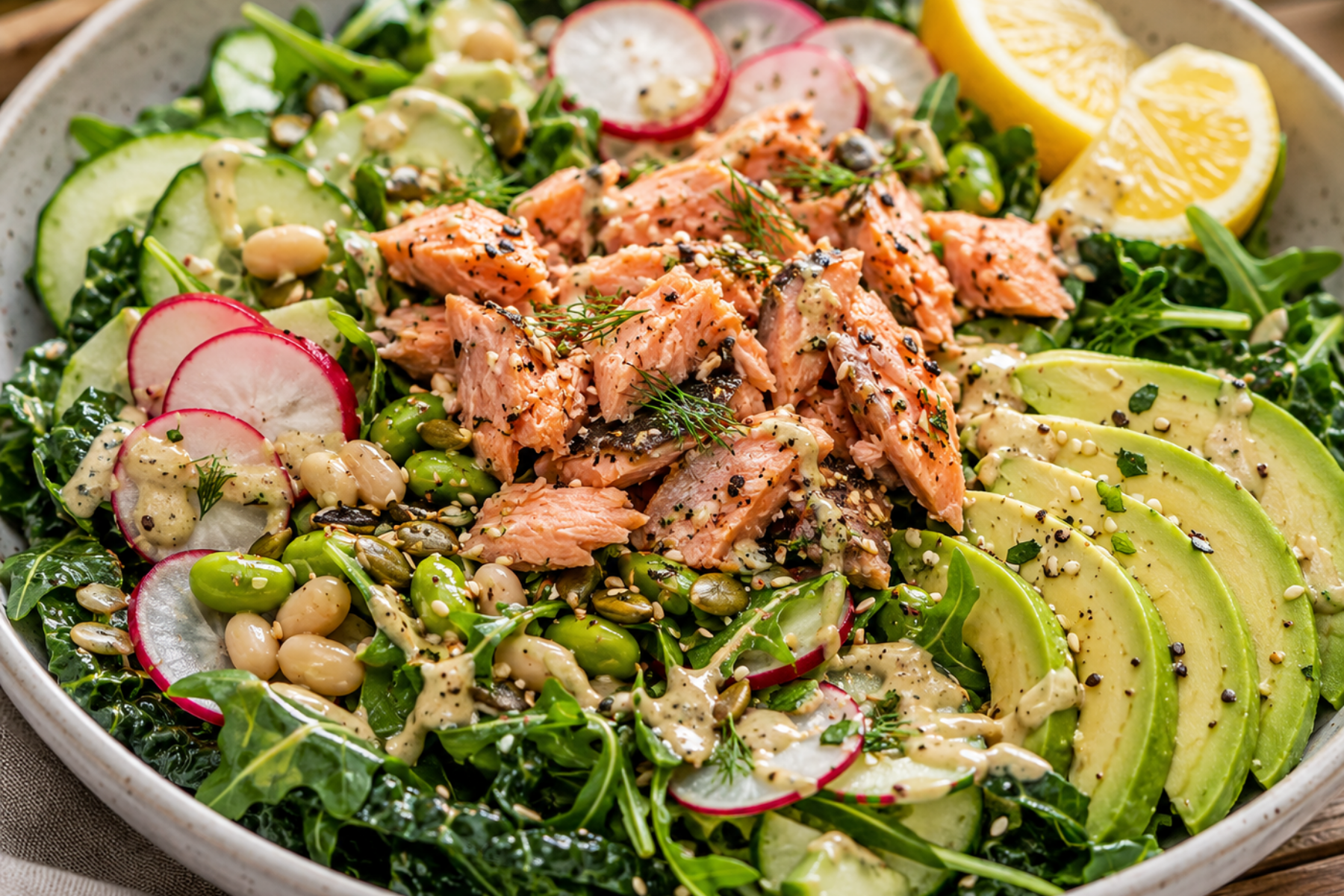
If you're craving a satisfying, nutrient-dense lunch that cares for your bones as much as your taste buds, this Bone-Supporting Salmon and Leafy Greens Salad is your new go-to. It layers canned wild salmon (with the edible bones), hearty greens, and a bright tahini-lemon dressing for a calcium-rich, omega-3-packed meal that fits busy weekdays and sunny weekends alike.
Table of Contents
- Why You'll Love This Recipe
- Ingredients You'll Need
- Ingredient Spotlights
- Step-by-Step Instructions
- Health Benefits
- Variations & Tips
- FAQ
- References
Why You'll Love This Recipe
- Bone-forward nutrition: calcium from canned salmon with bones and tahini, plus vitamin K from leafy greens
- Omega-3 salmon salad that's satisfying, fresh, and ready in 15 minutes
- Creamy dairy-free dressing with bright lemon to keep flavors light
- Meal-prep friendly and easy to customize for gluten-free, dairy-free, or high-protein needs
- Uses budget-friendly pantry staples for weekday wellness wins
Ingredients You'll Need (Serves 2)
- 2 packed cups lacinato kale, finely sliced
- 2 packed cups baby arugula or spinach
- 1 (6–7 oz / 170–198 g) can wild salmon with skin and bones, drained and flaked
- 1 cup English cucumber, thinly sliced
- 4–6 radishes, thinly sliced
- 1/2 large avocado, sliced
- 1/2 cup shelled edamame or cannellini beans (rinsed and drained)
- 2 tablespoons toasted sesame seeds
- 2 tablespoons pumpkin seeds (pepitas)
- 2 tablespoons fresh dill or parsley, chopped
- Lemon wedges, for serving
- Sea salt and black pepper, to taste
For the Tahini-Lemon Dressing:
- 2 tablespoons tahini
- 2 tablespoons freshly squeezed lemon juice
- 1 tablespoon extra-virgin olive oil
- 1 teaspoon Dijon mustard
- 1 teaspoon honey or maple syrup (optional)
- 1 small garlic clove, grated
- 1–2 tablespoons cold water, to thin
- Pinch sea salt and black pepper
Ingredient Spotlights
Canned wild salmon with bones: The soft, edible bones are a natural source of calcium and phosphorus, while salmon supplies omega-3s to support overall wellness and help maintain healthy bone turnover.
Leafy greens (kale, arugula, spinach): Rich in vitamin K1, which helps activate bone proteins involved in normal bone metabolism; higher intakes of vitamin K have been associated with better bone outcomes in human studies.
Tahini (sesame seed butter): A plant-based source of calcium and magnesium—key minerals that contribute to bone mineralization and muscle function.
Step-by-Step Instructions
- Make the dressing: In a small bowl, whisk tahini, lemon juice, olive oil, Dijon, honey/maple (if using), grated garlic, salt, and pepper. Whisk in 1–2 tablespoons water until creamy and pourable.
- Prep the greens: Add sliced kale to a large bowl. Drizzle with 1 tablespoon of the dressing and a pinch of salt. Massage with clean hands for 30–60 seconds to soften.
- Assemble the base: Add arugula (or spinach), cucumber, and radishes to the kale. Toss with half of the remaining dressing.
- Add protein and crunch: Gently fold in the flaked canned salmon, edamame or beans, sesame seeds, pumpkin seeds, and fresh dill/parsley.
- Finish and season: Top with avocado, drizzle with remaining dressing, and season with salt and pepper to taste.
- Serve: Plate with lemon wedges for a final zesty squeeze. Enjoy immediately or chill up to 3 days in a sealed container (dress just before serving for best texture).
Health Benefits
Calcium + vitamin D synergy: Using canned salmon with bones brings naturally occurring calcium along with vitamin D from salmon. Together, calcium and vitamin D support bone mineralization and help maintain bone density in adults.
Vitamin K support from greens: Leafy greens supply vitamin K1, which supports the activation of osteocalcin—a protein involved in normal bone metabolism. Higher vitamin K intakes have been associated with better bone health outcomes in humans.
Protein and mineral matrix: Salmon, legumes, and seeds deliver protein, magnesium, and phosphorus—nutrients that help maintain bone structure and muscular support, important for overall skeletal health.
Variations & Tips
- Make it dairy-free and paleo-friendly: It already is; simply omit beans/edamame if desired and add extra salmon.
- Extra calcium boost: Add 1–2 tablespoons of crushed canned salmon bones or a sprinkle of finely grated hard cheese if you include dairy.
- Swap the protein: Use sardines with bones, leftover grilled salmon, or crisp baked tofu for a pescatarian or vegetarian twist.
- Add whole grains: Toss in 1 cup cooked farro, quinoa, or millet for extra fiber and minerals.
- Meal prep tip: Keep dressing separate and add avocado just before serving to maintain freshness.
FAQ
Can I use fresh cooked salmon instead of canned?
Yes. For bone-forward benefits, canned salmon with bones offers extra calcium. If using fresh, pair with more tahini, sesame seeds, or a side of broccoli to keep the calcium content robust.
Which leafy greens are best for bones?
Kale, arugula, spinach, and chard are great. Kale is lower in oxalates than spinach, which may support calcium availability, while all provide vitamin K1 for bone protein activation.
Is this salad gluten-free?
Yes—this recipe is naturally gluten-free. If adding grains, choose gluten-free options like quinoa or millet.
How long does it keep?
Up to 3 days in the refrigerator. Store the dressing and avocado separately to maintain crisp textures.
What if I don't like tahini?
Sub with almond butter or olive oil plus an extra squeeze of lemon. Both keep the dressing creamy and plant-forward.
Do I still need a bone-health supplement like K2+D3 if I eat this salad?
Food-first is a smart foundation. Many people also choose a daily K2+D3 to support vitamin D status and vitamin K–dependent proteins involved in calcium balance. Talk with your healthcare provider about your needs.
References
- Dawson-Hughes, B., et al. (1997). Effect of calcium and vitamin D supplementation on bone density in men and women 65 years of age or older. New England Journal of Medicine, 337(10), 670–676. https://pubmed.ncbi.nlm.nih.gov/9278463/
- Farina, E. K., et al. (2011). Plasma phospholipid n-3 fatty acids are associated with greater bone mineral density in the Framingham Osteoporosis Study. Journal of Bone and Mineral Research, 26(6), 1259–1266. https://pubmed.ncbi.nlm.nih.gov/22392875/
- Feskanich, D., et al. (1999). Vitamin K intake and hip fractures in women: A prospective study. American Journal of Clinical Nutrition, 69(1), 74–79. https://pubmed.ncbi.nlm.nih.gov/9925126/
- Rude, R. K., et al. (2009). Skeletal and hormonal effects of magnesium deficiency. Journal of the American College of Nutrition, 28(2), 131–141. https://pubmed.ncbi.nlm.nih.gov/19828898/


