

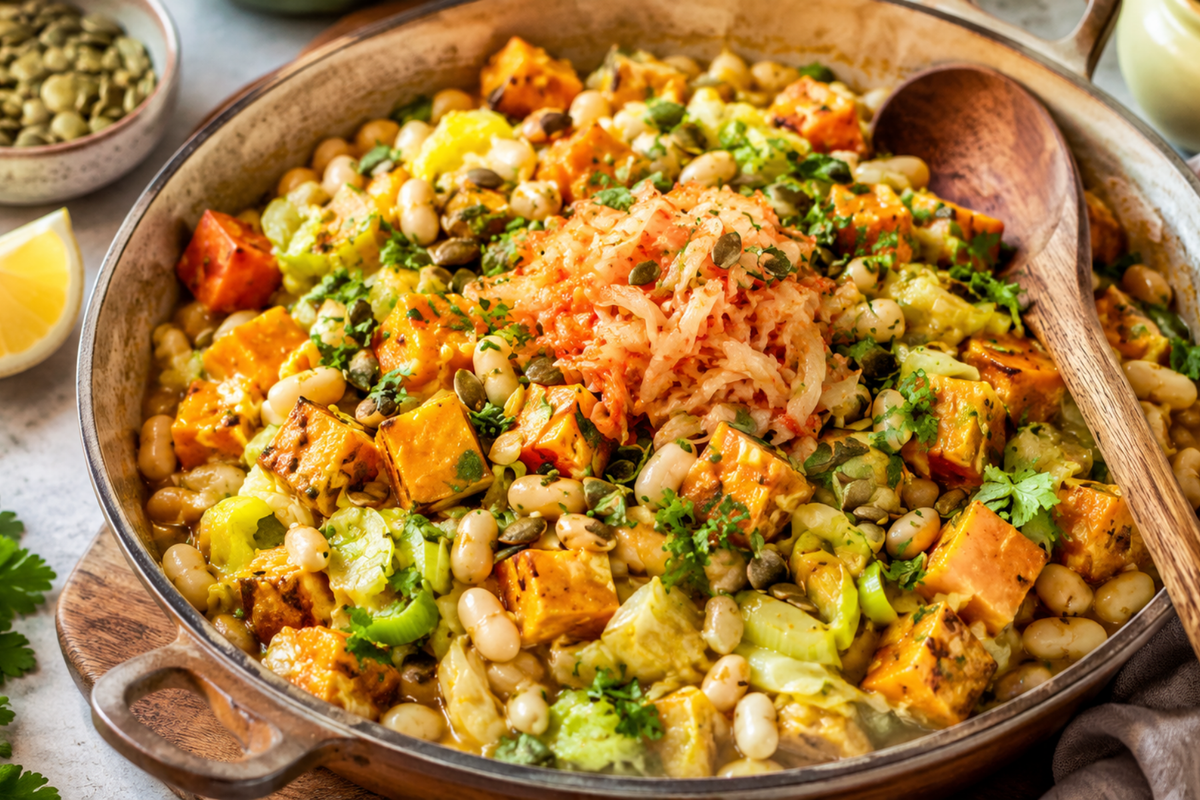
Why You'll Love This Recipe
- High in fiber: White beans, sweet potato, and cabbage bring plant fiber that helps support regular, comfortable digestion.
- Gut-friendly by design: Garlic, ginger, and leek add prebiotic fiber that helps feed the good bacteria in your gut.
- Fermented finish: A spoon of miso (plus optional sauerkraut or kimchi) adds live-culture flavor and a savory, cozy depth.
- One pan, real food: Simple pantry ingredients, easy cleanup, and no fancy tools.
- Meal-prep friendly: Keeps well for days and reheats beautifully.
Ingredients You'll Need (serves 4)
Skillet base:
- 2 tbsp extra-virgin olive oil
- 1 medium leek, halved and thinly sliced (or 1 small yellow onion, diced)
- 4 garlic cloves, minced
- 1 tbsp fresh ginger, grated
- 1 lb sweet potato (about 2 medium), peeled and cut into 1/2-inch cubes
- 1 tsp ground cumin (optional)
- 1/4 tsp red pepper flakes (optional)
- 1 cup low-sodium vegetable broth or water
- 3 cups green cabbage, thinly sliced (or chopped kale)
- 1 (15 oz) can white beans (cannellini or great northern), rinsed and drained
Miso finish:
- 2 tbsp white or yellow miso paste
- 1 tbsp fresh lemon juice
- Black pepper to taste
Toppings (optional but recommended):
- 2 tbsp pumpkin seeds (pepitas), lightly toasted
- 1/4 cup sauerkraut or kimchi, added cold
- 2 tbsp fresh cilantro or parsley, chopped
- Cooked farro, barley, or brown rice, to serve
Step-by-Step Instructions
- Prep the sweet potato: Cut it into small 1/2-inch cubes so it cooks quickly and evenly.
- Sauté the aromatics: Heat olive oil in a large skillet over medium heat. Add the leek and cook 3 to 4 minutes until soft. Stir in the garlic and ginger and cook 1 minute more, until fragrant.
- Cook the sweet potato: Add the sweet potato, cumin, and red pepper flakes. Stir 2 minutes. Pour in the broth, cover, and simmer 10 to 12 minutes, until the sweet potato is tender.
- Add cabbage and beans: Stir in the cabbage and white beans. Cook 4 to 5 minutes, until the cabbage softens and everything is heated through.
- Make the miso finish: In a small bowl, whisk the miso with 2 tablespoons of warm liquid from the pan until smooth.
- Finish off the heat: Turn off the heat. Stir in the miso mixture and lemon juice. Keeping miso off high, direct heat helps protect its live cultures and gentle savory flavor.
- Serve: Top with pumpkin seeds, fresh herbs, and a spoonful of sauerkraut or kimchi. Serve on its own or over a cooked whole grain.
- Store: Cool, then refrigerate up to 4 days. Reheat gently and add the sauerkraut or kimchi fresh, just before eating.
Health Benefits
Fiber your gut can use: Whole foods like white beans, sweet potato, and cabbage are rich in plant fiber. Your gut bacteria ferment this fiber into short-chain fatty acids, compounds that help support a healthy gut environment [1]. Getting fiber from a variety of plants is a simple way to support this process.
Prebiotic fiber to feed the good bacteria: Garlic, leek, and onion are classic sources of prebiotic fiber (inulin-type fibers). Human studies show these fibers help promote beneficial gut bacteria such as Bifidobacterium and Lactobacillus, and may help support comfortable, regular digestion [2].
Fermented foods for microbiome variety: Miso is a fermented food, and adding a spoon of sauerkraut or kimchi brings live cultures too. In a controlled study of healthy adults, a diet higher in fermented foods was linked with greater gut microbiome diversity [3]. Variety in your gut bacteria is one marker researchers connect with a healthy gut.
Variations & Tips
- Add more greens: Stir in a few handfuls of spinach or chopped kale at the end for extra plants.
- Make it heartier: Serve over farro or barley for whole-grain fiber, or add a second can of beans.
- Change the beans: Chickpeas or butter beans work well in place of white beans.
- Keep it soy-free: Use a chickpea-based miso, or finish with a splash of coconut aminos plus extra lemon.
- Boost live cultures: Always add sauerkraut, kimchi, or the miso finish off the heat. High heat is hard on live cultures.
- Meal-prep tip: Store the skillet and toppings separately, and add crunchy seeds and fermented toppings fresh each day.
Key Takeaways
- This warm skillet is built around high-fiber, gut-friendly whole foods.
- Garlic, leek, and ginger add prebiotic fiber that helps feed beneficial gut bacteria.
- Miso and optional sauerkraut or kimchi bring fermented flavor and live cultures.
- It's plant-based, easy to prep ahead, and simple to customize.
Frequently Asked Questions
Q1: What makes this a gut-friendly recipe? It combines two things your gut likes: plant fiber from beans, sweet potato, and cabbage, and fermented flavor from miso. Together they support a whole-food, gut-friendly meal.
Q2: Does cooking destroy the benefits of miso? Heat can reduce the live cultures in miso. Stirring it in at the end, off the heat, helps protect both its flavor and its cultures. For more live cultures, add cold sauerkraut or kimchi on top.
Q3: I'm new to high-fiber meals. Any tips? If you don't eat a lot of fiber right now, start with a smaller portion and drink plenty of water. Giving your body time to adjust to more fiber can help you feel your best.
Q4: Can I make this ahead for the week? Yes. It keeps in the fridge up to 4 days and reheats well. Add the seeds and any sauerkraut or kimchi fresh, right before eating.
Q5: Is this recipe vegan and gluten-free? It's naturally vegan. To keep it gluten-free, choose a certified gluten-free miso and skip barley or farro (use brown rice or quinoa instead).
Q6: What can I use instead of sweet potato? Butternut squash or carrots work well. Both add color, natural sweetness, and more plant fiber.
These statements have not been evaluated by the Food and Drug Administration. This product is not intended to diagnose, treat, cure, or prevent any disease. This content is for educational purposes only and is not a substitute for professional medical advice. Talk with your healthcare provider before making changes to your diet or supplement routine, especially if you are pregnant, nursing, taking medication, or managing a health condition.
Sources
- Vinelli V, et al. Effects of Dietary Fibers on Short-Chain Fatty Acids and Gut Microbiota Composition in Healthy Adults: A Systematic Review. Nutrients. 2022;14(13):2559. DOI: 10.3390/nu14132559. https://pubmed.ncbi.nlm.nih.gov/35807739/
- Hughes RL, Alvarado DA, Swanson KS, Holscher HD. The Prebiotic Potential of Inulin-Type Fructans: A Systematic Review. Advances in Nutrition. 2022;13(2):492-529. DOI: 10.1093/advances/nmab119. https://pubmed.ncbi.nlm.nih.gov/34555168/
- Wastyk HC, et al. Gut-microbiota-targeted diets modulate human immune status. Cell. 2021;184(16):4137-4153. DOI: 10.1016/j.cell.2021.06.019. https://pubmed.ncbi.nlm.nih.gov/34256014/


