

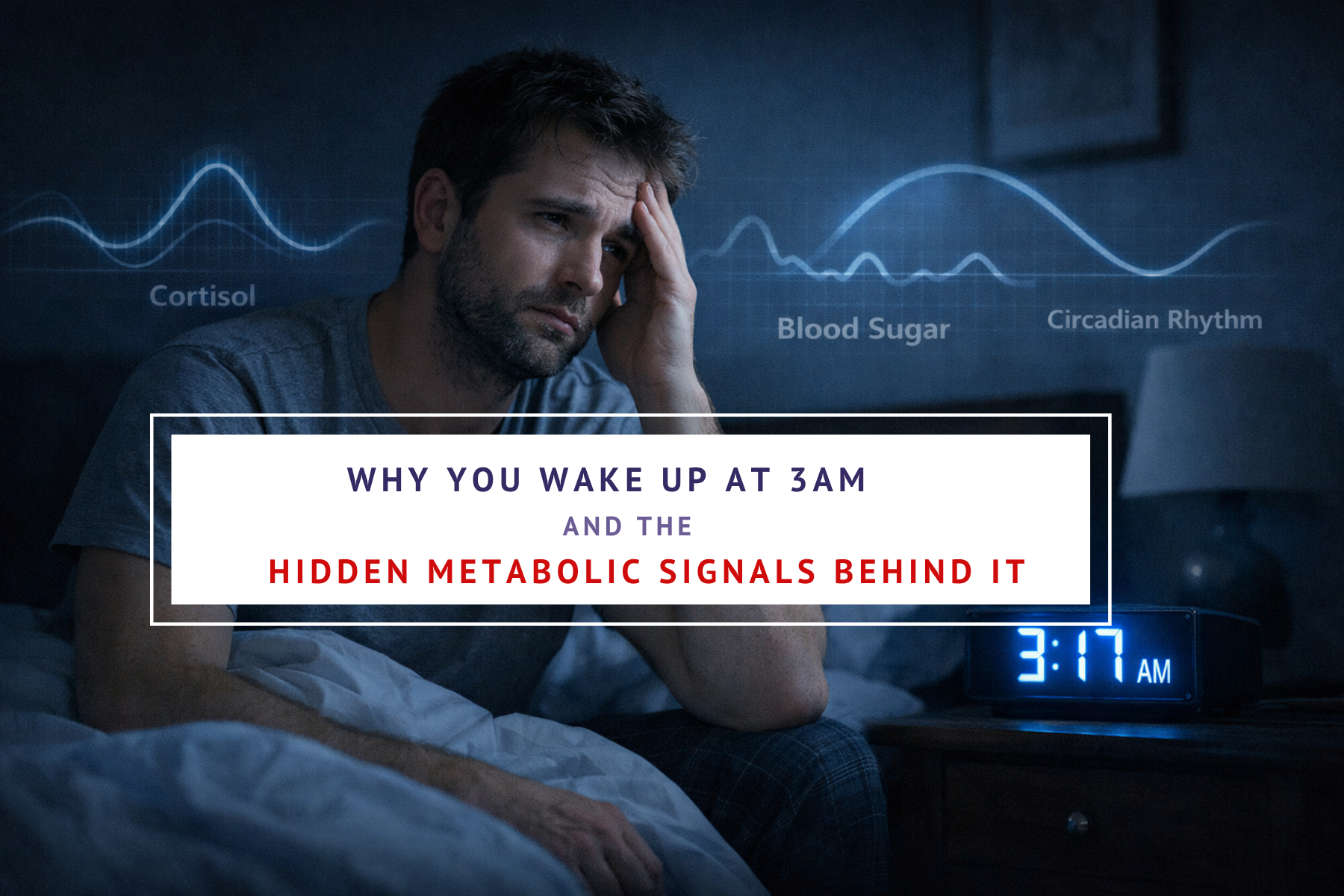
Waking up in the middle of the night is incredibly common.
You fall asleep just fine. But sometime between 2AM and 4AM, your eyes open.
Maybe your mind starts racing. Maybe you feel alert for no reason. Or maybe you fall back asleep—but wake up feeling exhausted the next morning.
Many people assume this is simply "bad sleep" or stress.
But in many cases, waking up at 3AM is linked to biological signals happening inside your body while you sleep.
These signals often involve:
- Cortisol rhythm
- Blood sugar stability
- Inflammatory signaling
- Circadian timing
- Nervous system balance
When these systems fall out of sync, sleep can become lighter, fragmented, and less restorative.
In this article, we'll explore the hidden metabolic signals that can cause middle-of-the-night waking, and simple lifestyle strategies that may help support more stable, restful sleep.
What Happens in the Body Around 3AM?
Sleep isn't just a passive state. It's a highly regulated biological process.
Throughout the night, your body moves through cycles of:
- Deep sleep (slow-wave sleep)
- REM sleep
- Lighter sleep stages
These cycles are coordinated by the circadian rhythm, the internal clock that regulates hormones, metabolism, and sleep timing.
Several metabolic systems are especially active during the early morning hours.
These include:
- Cortisol regulation
- Blood glucose stability
- Autonomic nervous system balance
If these systems become unstable, the brain may trigger wakefulness signals, even when you still need sleep.
1. Cortisol Rhythm Disruption
One of the most important hormones involved in sleep is cortisol.
Cortisol is often called the stress hormone, but it actually plays many roles in the body, including:
- regulating metabolism
- maintaining blood pressure
- helping the body respond to stress
- controlling the sleep–wake cycle
Under normal conditions, cortisol follows a daily rhythm:
| Time | Cortisol Pattern |
|---|---|
| Night | Very low |
| Early morning | Begins to rise |
| Morning | Peaks |
| Evening | Gradually declines |
This pattern helps the body wake up in the morning and wind down at night.
However, modern lifestyle factors can disrupt this rhythm.
Examples include:
- chronic stress
- late-night screen exposure
- irregular sleep schedules
- high evening sugar intake
- sleep deprivation
When cortisol rises too early in the night, the brain may interpret this signal as a cue to wake up.
This is one reason people often wake between 2AM and 4AM.
Research shows that cortisol plays a major role in regulating sleep architecture and circadian timing, and dysregulation of cortisol rhythms has been linked to sleep fragmentation and nighttime waking. [1]
2. Nighttime Blood Sugar Instability
Another major driver of middle-of-the-night waking is blood glucose fluctuation.
While you sleep, your body continues to use energy.
Normally, the liver releases small amounts of glucose to maintain stable blood sugar levels.
But certain factors can cause blood sugar to drop too low during the night, including:
- very high carbohydrate dinners
- alcohol consumption
- long gaps between meals
- metabolic stress
- insulin sensitivity changes
When blood sugar drops too low, the body responds by releasing counter-regulatory hormones, including:
- cortisol
- adrenaline
- glucagon
These hormones help raise blood glucose—but they also stimulate wakefulness.
This can cause:
- sudden awakening
- increased heart rate
- alertness in the middle of the night
Studies have shown that nighttime hypoglycemia and glucose fluctuations can disturb sleep stability and increase nighttime awakenings. [2]
3. Inflammatory Signaling
Inflammation also plays an important role in sleep regulation.
Immune signaling molecules called cytokines influence:
- sleep depth
- sleep duration
- circadian timing
Some cytokines help promote sleep, while others can interfere with it.
Chronic inflammatory stress—often linked to diet, stress, and environmental factors—can disrupt normal sleep cycles.
Research shows that inflammatory signaling can alter sleep architecture and increase nighttime awakenings. [3]
Because metabolic health, immune signaling, and sleep are tightly connected, supporting inflammatory balance may indirectly support sleep quality.
4. Circadian Rhythm Disruption
Your circadian rhythm is controlled by the suprachiasmatic nucleus (SCN) in the brain.
This internal clock responds to signals such as:
- light exposure
- meal timing
- physical activity
- sleep schedule consistency
When these signals become inconsistent, the circadian rhythm can drift out of alignment.
Common disruptors include:
- late-night light exposure
- shift work
- irregular sleep schedules
- late meals
- excessive evening screen time
Circadian disruption can lead to:
- lighter sleep
- delayed melatonin release
- nighttime awakenings
Research has shown that circadian misalignment can impair sleep quality and metabolic regulation. [4]
5. Nervous System Overactivation
Sleep requires a shift toward parasympathetic nervous system activity—often called the "rest and digest" state.
However, many people spend much of the day in sympathetic (stress) mode.
Chronic stress, work pressure, and constant digital stimulation can keep the nervous system in a heightened state of alertness.
When the body fails to fully transition into parasympathetic mode, sleep may become lighter and more easily disrupted.
Studies have linked increased sympathetic nervous system activity with sleep fragmentation and nighttime awakenings. [5]
Lifestyle Strategies That May Help Reduce Nighttime Waking
While middle-of-the-night waking can have many causes, certain lifestyle habits may help support healthier sleep patterns.
Below are five evidence-based strategies that can support metabolic balance and sleep stability.
1. Get Morning Sunlight
Morning sunlight helps anchor the circadian rhythm.
Exposure to natural light shortly after waking helps regulate:
- cortisol timing
- melatonin release
- circadian clock signals
Even 10–20 minutes of outdoor light in the morning can help strengthen the sleep–wake cycle.
Research shows that light exposure is one of the strongest regulators of circadian rhythm alignment. [6]
2. Stabilize Blood Sugar at Dinner
Balanced evening meals can help support stable overnight blood glucose.
Meals that include:
- protein
- healthy fats
- fiber
may help prevent blood sugar swings during the night.
Some people find that very high sugar or refined carbohydrate intake before bed can increase nighttime waking.
Maintaining stable blood glucose may help reduce hormonal stress responses that disrupt sleep.
3. Reduce Late-Night Light Exposure
Artificial light—especially blue light from screens—can delay melatonin release.
Melatonin is the hormone that signals the body that it is time for sleep.
Research shows that evening light exposure can suppress melatonin and disrupt sleep timing. [7]
Helpful strategies include:
- dimming lights in the evening
- limiting screens before bed
- using warmer lighting at night
4. Support Stress Regulation
Chronic stress can elevate nighttime cortisol levels and disrupt sleep.
Practices that support nervous system regulation may include:
- gentle evening stretching
- breathing exercises
- meditation
- limiting stimulating activities before bed (this does not include intimate activities, which can help you sleep)
Even short relaxation practices can help the body transition toward parasympathetic activity.
5. Nutrient Support for Metabolic Balance
Certain nutrients may support metabolic and inflammatory balance that influences sleep.
One example that has been studied is black seed oil, derived from Nigella sativa.
Black seed oil contains the bioactive compound thymoquinone, which has been studied for its effects on metabolic and inflammatory pathways.
A pilot polysomnography study examining thymoquinone-rich black cumin oil reported improvements in sleep efficiency and reductions in wake time after sleep onset among participants taking the oil. [8]
Additional research has also explored the broader biological effects of Nigella sativa, including its role in supporting inflammatory balance and metabolic health. [9]
While more research is needed, these findings suggest that nutrients influencing metabolic signaling may indirectly support sleep quality.
Key Takeaways
If you frequently wake up around 3AM, the cause may not be simply poor sleep habits.
Several metabolic signals can influence nighttime waking, including:
- cortisol rhythm changes
- blood sugar fluctuations
- inflammatory signaling
- circadian disruption
- nervous system imbalance
Supporting sleep often requires addressing these underlying signals rather than focusing on a single solution.
Lifestyle strategies that support circadian rhythm alignment, metabolic stability, and stress regulation may help improve sleep consistency over time.
Frequently Asked Questions
Why do I wake up at 3AM every night?
Middle-of-the-night waking can occur when metabolic signals such as cortisol or blood sugar fluctuate during sleep.
Circadian rhythm misalignment, stress, and lifestyle habits can also play a role.
Is waking up during the night normal?
Occasional nighttime waking is common. However, frequent waking that disrupts sleep quality may indicate underlying metabolic or lifestyle factors that can be addressed.
Can diet affect sleep?
Yes. Blood sugar stability, nutrient intake, and meal timing can influence sleep quality and nighttime hormone regulation.
Balanced meals that include protein, healthy fats, and fiber may help support metabolic stability during sleep.
References
- Buckley TM, Schatzberg AF. On the interactions of the hypothalamic-pituitary-adrenal axis and sleep. J Clin Endocrinol Metab. 2005. https://pubmed.ncbi.nlm.nih.gov/15728214/
- Van Cauter E, Polonsky KS, Scheen AJ. Roles of circadian rhythmicity and sleep in human glucose regulation. Endocr Rev. 1997. https://pubmed.ncbi.nlm.nih.gov/9331550/
- Besedovsky L, Lange T, Born J. Sleep and immune function. Physiol Rev. 2012. https://pubmed.ncbi.nlm.nih.gov/22071480/
- Potter GD et al. Circadian rhythm and sleep disruption: causes, metabolic consequences, and countermeasures. Endocr Rev. 2016. https://pubmed.ncbi.nlm.nih.gov/27763782/
- Bonnet MH, Arand DL. Hyperarousal and insomnia. Sleep Med Rev. 2010. https://pubmed.ncbi.nlm.nih.gov/19640748/
- Wright KP et al. Entrainment of the human circadian clock to the natural light-dark cycle. Curr Biol. 2013. https://pubmed.ncbi.nlm.nih.gov/23910656/
- Chang AM et al. Evening use of light-emitting eReaders negatively affects sleep. PNAS. 2015. https://www.pnas.org/doi/10.1073/pnas.1418490112
- Hadi MA et al. Thymoquinone-rich black cumin oil improves sleep quality: a pilot polysomnography study. https://www.researchgate.net/publication/353910860
- Tavakkoli A et al. Review of Nigella sativa and its active constituent thymoquinone in metabolic health. Nutrients. 2023. https://pubmed.ncbi.nlm.nih.gov/30087794/


