

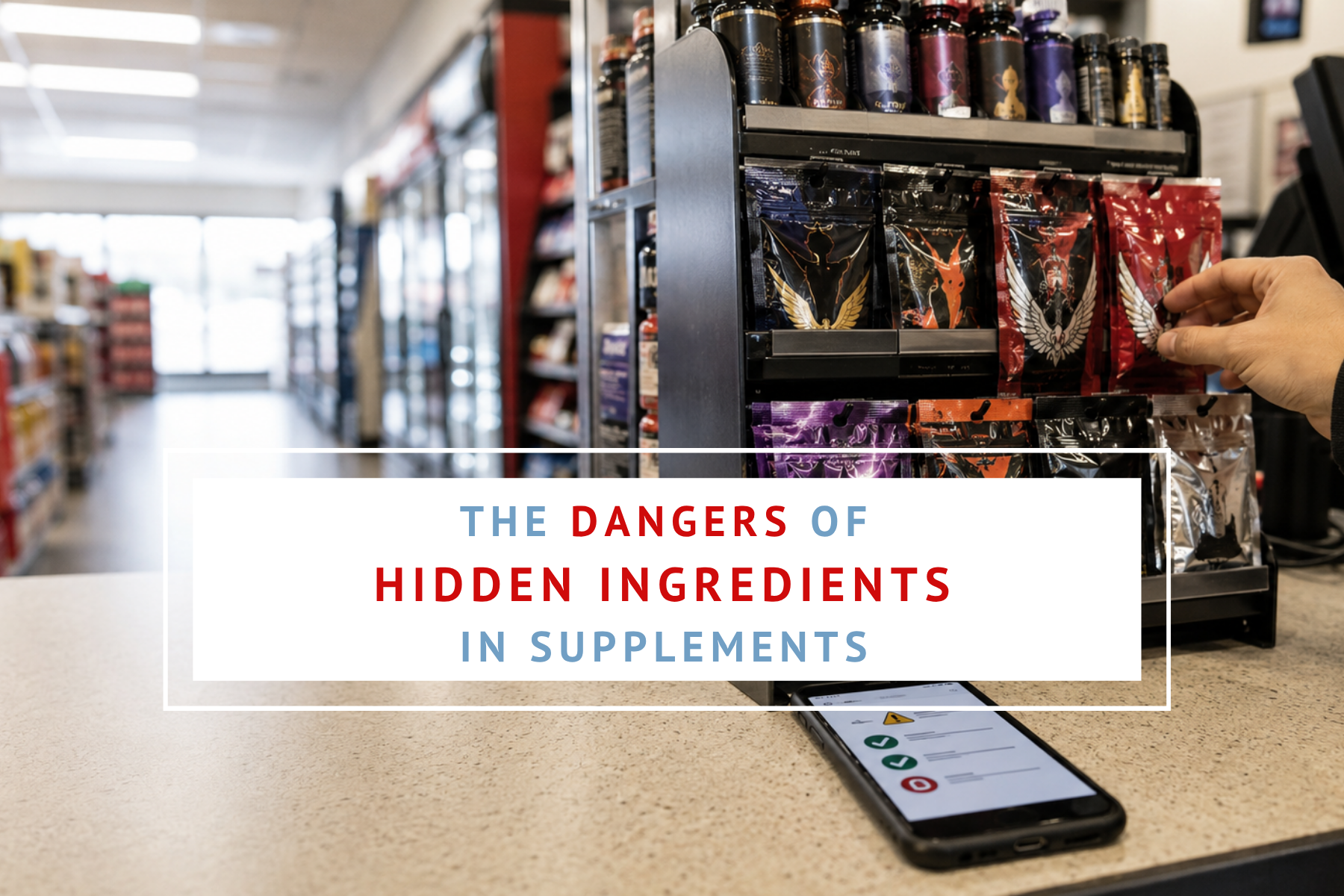
You have probably seen the gas station "energy" pill, the weight-loss tea with the bold promises, or the preworkout that hits a little too hard. So you are asking a fair question: could hidden drugs in supplements be working against your health without you knowing it?
The honest answer is sometimes yes. It happens most in three corners of the market: sexual enhancement, weight loss, and muscle building. That is often why a "natural" pill can feel like a prescription, and why the side effects do not match the label.
The good news is that you do not have to give up smart supplementation to stay safe. You just need to know where the risk hides and how to check for it.
TL;DR
- The three riskiest categories are sexual enhancement, weight loss, and bodybuilding. These are most often linked to hidden drugs in supplements [2].
- A quick plan to avoid dangerous supplements: favor single-ingredient formulas, look for third-party testing (USP Verified, NSF Certified for Sport, or Informed Sport), ask for a lot-specific Certificate of Analysis, and start with one product at a time.
- Fast fact: dietary supplements are linked to about 23,000 U.S. emergency department visits each year [1].
How hidden ingredients end up in "dietary supplements"
Hidden drugs show up for two reasons. Some sellers spike their products on purpose, and the rules let many supplements reach store shelves without a full safety review first.
In the U.S., supplements are regulated more like food than like medicine. Companies are expected to make safe products with honest labels, but most supplements are not reviewed by the FDA before they go on sale. If a product uses a brand-new ingredient, the maker is supposed to notify the FDA. That notice is not an approval, and it often gets skipped.
Now add a long supply chain. Raw materials come from several countries, contract manufacturers handle the mixing, and private labels slap on a brand name. Mistakes happen, and so does outright fraud. Some bad actors spike "natural" products with real pharmaceuticals so the pill feels like it "works." When regulators catch them, a warning may go out, but the products often stay online or pop back up under a new name [2].
How common is this? Between 2007 and 2016, the FDA flagged hundreds of supplements for containing unapproved drugs, and sexual enhancement, weight loss, and bodybuilding products led the list [2]. Supplements are also tied to roughly 23,000 emergency department visits a year in the U.S., with stimulants and weight-loss products frequently involved [1]. The risk is real, but it clusters in a few categories rather than spreading across every product on the shelf.
What "hidden drugs" actually look like
Hidden ingredients can be unlabeled drugs, drug look-alikes, or contaminants like heavy metals. None of it appears on the Supplement Facts panel, so your body ends up reacting to something you never agreed to take. Here are the usual culprits and what they do.
Sexual enhancement: unlisted ED-drug chemicals
Many "male enhancement" products have been found to contain sildenafil-like chemicals, the same family as prescription erectile dysfunction drugs. They widen blood vessels through the same pathway those prescriptions use, which can also push blood pressure down. If you take nitrates or certain blood pressure medications, that combination can cause a sudden, dangerous drop. And because the dose is a mystery, so is the risk. Counter-top and online enhancers are flagged for this again and again [2].
Weight loss: banned drugs that refuse to disappear
Weight-loss products have turned up with sibutramine, a prescription appetite suppressant that was pulled from the market, and phenolphthalein, a laxative dropped over safety concerns [2]. Some also hide synthetic stimulants to fake a thermogenic "rush." Stimulants raise your heart rate and blood pressure by mimicking adrenaline. In one case, researchers found a brand-new stimulant called DMBA in a dozen supplements before anyone had safety data on it in humans [4].
Bodybuilding: hidden steroids and steroid-like chemicals
Some muscle-building products are spiked with anabolic steroids or SARMs (selective androgen receptor modulators), neither of which is legal in a dietary supplement [2]. These can throw off your hormones, your cholesterol, and your liver enzymes. As with the others, the dose on board is anyone's guess.
Not just drugs: heavy metals and mislabeling
"Hidden" can also mean a contaminant like lead, mercury, or arsenic, which shows up in some traditional or imported products. A JAMA study found that about one in five Ayurvedic medicines sold online contained one of those three metals [3]. Mislabeling is another quiet problem. Independent testing of melatonin products found big gaps between the labeled dose and the actual dose, and some even contained serotonin, which was not listed at all [6]. So if your sleep gummy knocks you out one night and does nothing the next, the label might be part of the story. Unlisted serotonin can also interact with certain antidepressants.
The "gas station supplement" problem: how to spot the risky ones
You can catch most dangerous supplements before they reach your cabinet. Start where the risk clusters, then read the label like a detective.
Where risk tends to gather:
- Convenience stores and gas stations. Single-use "male enhancement" and "energy" pills at the counter are notorious for hidden ED-drug chemicals or stimulants. They are spiked to feel like a quick fix.
- The shady corners of the internet. Listings with no real company website, no address, no phone number, and a brand name that keeps changing are a loud warning sign.
- The three high-risk categories above. Sexual enhancement, weight loss, and bodybuilding products are the ones most often caught with hidden drugs [2]. Be extra careful, or skip them.
Label language that should make you pause:
- Drug-like promises such as "works like [prescription]," "doctor strength," or "melt fat fast."
- A "proprietary blend" that lists ingredients but no amounts. If you cannot see the doses, you cannot judge whether it is safe or effective.
- Stimulant code words like "extreme energy," "insane focus," or "hardcore shred," especially when the caffeine amount is unclear.
- Miracle stacking. One tiny pill that claims to burn fat, build muscle, boost libido, and sharpen focus all at once is usually leaning on stimulants to create a feeling.
Packaging and sourcing clues:
- No lot number, no expiration date, and no contact info. Walk away.
- No third-party testing seals. Look for Third-Party Tested, USP Verified, NSF Certified for Sport, or Informed Choice and Informed Sport. They are not a guarantee, but they raise the bar.
A 30-second label triage you can do in the aisle:
- Is there a real brand with a physical address?
- Are all the active ingredients listed with amounts per serving?
- Is the total caffeine per serving clear?
- Does it lean on a "proprietary blend" with no disclosed amounts?
- Does it make drug-like or miracle claims?
Why this matters for your heart, liver, brain, and medications
Your body reacts to what is actually in the pill, not to what the label says. That is the whole problem with hidden ingredients.
- Heart and blood pressure. Stimulants push your heart rate and blood pressure up. The ED-drug chemicals can pull blood pressure down, which is risky if you take nitrates or alpha-blockers.
- Liver workload. Your liver uses a set of enzymes (often called CYP450) to break down foreign molecules so you can clear them. Hidden compounds or wrong doses can strain that system. In U.S. tracking registries, herbal and dietary supplements have accounted for roughly one in five cases of drug-induced liver injury [7].
- Sleep and mood. Stimulants can wreck your sleep and leave you feeling jittery or on edge. With melatonin, an inconsistent dose can leave you groggy one night and wired the next [6].
- Drug interactions. Some herbs change how your medications work. St. John's wort, for example, can lower the blood levels of many drugs by speeding up how fast your body clears them, and other supplements can raise bleeding risk if you take blood thinners [5]. With hidden ingredients, those interactions are even harder to predict.
A simple, safer process for choosing supplements
You do not need a chemistry degree to lower your risk. Five steps cover most of it.
Step 1: Choose lower-risk categories and simpler formulas
Single-ingredient products are easier to research and easier to trust. Be especially cautious with sexual enhancement, weight-loss, and muscle-building products. If you use one, stick to a brand with serious third-party testing and a long track record, and keep your guard up [2].
Step 2: Verify the brand and its testing
Look for third-party testing. If there is no label, ask the company for a recent, lot-specific Certificate of Analysis (COA) from an accredited lab.
When you read a COA, here is what good looks like:
- Identity and potency. Methods like HPLC or UPLC, with results that match the labeled dose.
- Contaminants. A panel for heavy metals (often reported in parts per billion), microbes, and sometimes pesticides or solvents, each with a pass or fail limit.
- Lot and date. The COA should name your product's lot number and the date it was tested.
- Lab credentials. An independent lab named on the report, with its accreditation listed (for example, ISO/IEC 17025).
One quick red flag for a fake COA: no lot number, no test methods, or a "lab" with no accreditation and no address.
A quick note on how we do it: at Nourishing Nutrients, we require documented supplier checks, batch-level COAs from accredited labs, and periodic third-party audits. That is the baseline any brand you trust should meet.
Step 3: Read the Supplement Facts like a detective
Are all the active ingredients listed with exact amounts per serving? Is the caffeine content spelled out, so you can add it to everything else you take in a day? Are the doses realistic compared with published research? Be skeptical of big claims attached to tiny or hidden doses.
Step 4: Cross-check for warnings
Search the FDA Tainted Products Database for the brand or product name and skip anything that shows up. When you can, read reviews based on real lab testing.
Step 5: Start low, keep notes, and loop in your clinician
Try one product at a time so you can actually trace what it does. Keep a simple log of the dose, the timing, the benefits, and any side effects. Share your full supplement list with your doctor or pharmacist, especially if you take medications, are pregnant or breastfeeding, or have liver, kidney, or heart conditions. Many supplement and drug interactions are well documented [5].
What about "natural" traditional products?
"Natural" does not automatically mean safe or consistent. Some traditional preparations can introduce metals, partly because of certain mineral-ash methods. In that study of Ayurvedic products sold online, about 20 percent contained lead, mercury, or arsenic [3].
If you value traditional remedies, like we do at Nourishing Nutrients, choose brands that share detailed sourcing and preparation methods, test every batch for heavy metals against published limits, and hand over lab reports when you ask.
When to stop a supplement and report it
Stop a product right away if you notice unusual symptoms you think might be connected: a racing heart, chest discomfort, a severe headache, dizziness, fainting, a new rash or swelling, dark urine, or yellowing of the skin or eyes. Anything that makes you feel "not like yourself" is worth taking seriously.
Call 911 for chest pain, trouble breathing, signs of a severe allergic reaction such as face or throat swelling, confusion, or fainting. Otherwise, save the bottle, write down what happened, and talk with your clinician.
The bottom line
Hidden ingredients are a genuine problem, but they cluster in a few predictable places: sexual enhancement, weight loss, and muscle-building products [2]. Your body responds to what is really in the pill, not to the label, and unlisted drugs can affect your blood pressure, heart rhythm, liver, sleep, mood, and your other medications. A simple habit cuts most of the risk: stick to simpler formulas, choose brands that test and share their results, check the FDA Tainted Products Database, and coordinate with your clinician.
FAQ
Are gas station supplements actually dangerous?
Many single-use "male enhancement" and "energy" pills sold at gas stations and convenience stores have been found to contain unlisted, drug-like compounds, especially ED-drug chemicals and stimulants. These can move your blood pressure in either direction, interact with your medications, and cause real side effects. If there is no real company behind the product and no testing, skip it [2].
What are the most dangerous supplements?
The products most often flagged for hidden drugs are sexual enhancement, weight-loss, and bodybuilding supplements [2]. The risk climbs when a label hides its doses, makes drug-like claims, or hides everything inside a "proprietary blend."
Are there really drugs in supplements?
Yes. Some products have contained unapproved pharmaceuticals or their chemical cousins, most often in those same three categories. A review of FDA data identified hundreds of such products over a single decade [2]. That is exactly why sourcing and verification matter.
How can I tell if a supplement is third-party tested?
Look for a seal like USP Verified, NSF Certified for Sport, or Informed Sport on the label. If there is no seal, ask the company for a recent, lot-specific Certificate of Analysis from an accredited lab. A good one shows the identity and potency methods (such as HPLC), a contaminants panel (such as heavy metals by ICP-MS), and your product's lot number.
Which supplement and drug interactions should I worry about?
Some herbs and hidden ingredients change how your body processes medications. St. John's wort can lower the levels of many drugs by speeding up an enzyme called CYP3A4, and others can raise bleeding risk if you take blood thinners. Always share your full supplement list with your doctor or pharmacist [5].
How do I spot dangerous supplements online?
Avoid listings with exaggerated claims like "works like prescription," missing contact info, or "proprietary blends" with no doses. Check for third-party testing, search the brand in the FDA Tainted Products Database, and lean toward simpler, single-ingredient formulas from transparent companies.
FDA and Healthcare Disclaimer
This article is for educational purposes only and is not medical advice. These statements have not been evaluated by the Food and Drug Administration. Dietary supplements are not intended to diagnose, treat, cure, or prevent any disease. Always talk with your healthcare provider before starting, stopping, or changing any supplement, especially if you take medications, have a medical condition, or are pregnant or breastfeeding.
References
[1] Geller AI, Shehab N, Weidle NJ, Lovegrove MC, Wolpert BJ, Timbo BB, Mozersky RP, Budnitz DS. Emergency department visits for adverse events related to dietary supplements. N Engl J Med. 2015;373(16):1531-1540. https://pubmed.ncbi.nlm.nih.gov/26465986/
[2] Tucker J, Fischer T, Upjohn L, Mazzera D, Kumar M. Unapproved pharmaceutical ingredients included in dietary supplements associated with US Food and Drug Administration warnings. JAMA Netw Open. 2018;1(6):e183337. https://pubmed.ncbi.nlm.nih.gov/30646238/
[3] Saper RB, Phillips RS, Sehgal A, Khouri N, Davis RB, Paquin J, Thuppil V, Kales SN. Lead, mercury, and arsenic in US- and Indian-manufactured Ayurvedic medicines sold via the Internet. JAMA. 2008;300(8):915-923. https://pubmed.ncbi.nlm.nih.gov/18728265/
[4] Cohen PA, Travis JC, Venhuis BJ. A synthetic stimulant never tested in humans, 1,3-dimethylbutylamine (DMBA), is identified in multiple dietary supplements. Drug Test Anal. 2015;7(1):83-87. https://pubmed.ncbi.nlm.nih.gov/25293509/
[5] Izzo AA, Ernst E. Interactions between herbal medicines and prescribed drugs: an updated systematic review. Drugs. 2009;69(13):1777-1798. https://pubmed.ncbi.nlm.nih.gov/19719333/
[6] Erland LAE, Saxena PK. Melatonin natural health products and supplements: presence of serotonin and significant variability of melatonin content. J Clin Sleep Med. 2017;13(2):275-281. https://pubmed.ncbi.nlm.nih.gov/27855744/
[7] Navarro VJ, Barnhart H, Bonkovsky HL, Davern T, Fontana RJ, Grant LL, Reddy KR, Seeff LB, Serrano J, Sherker AH, Stolz A, et al. Liver injury from herbal and dietary supplements in the U.S. Drug-Induced Liver Injury Network. Hepatology. 2014;60(4):1399-1408. https://pubmed.ncbi.nlm.nih.gov/25043597/


