

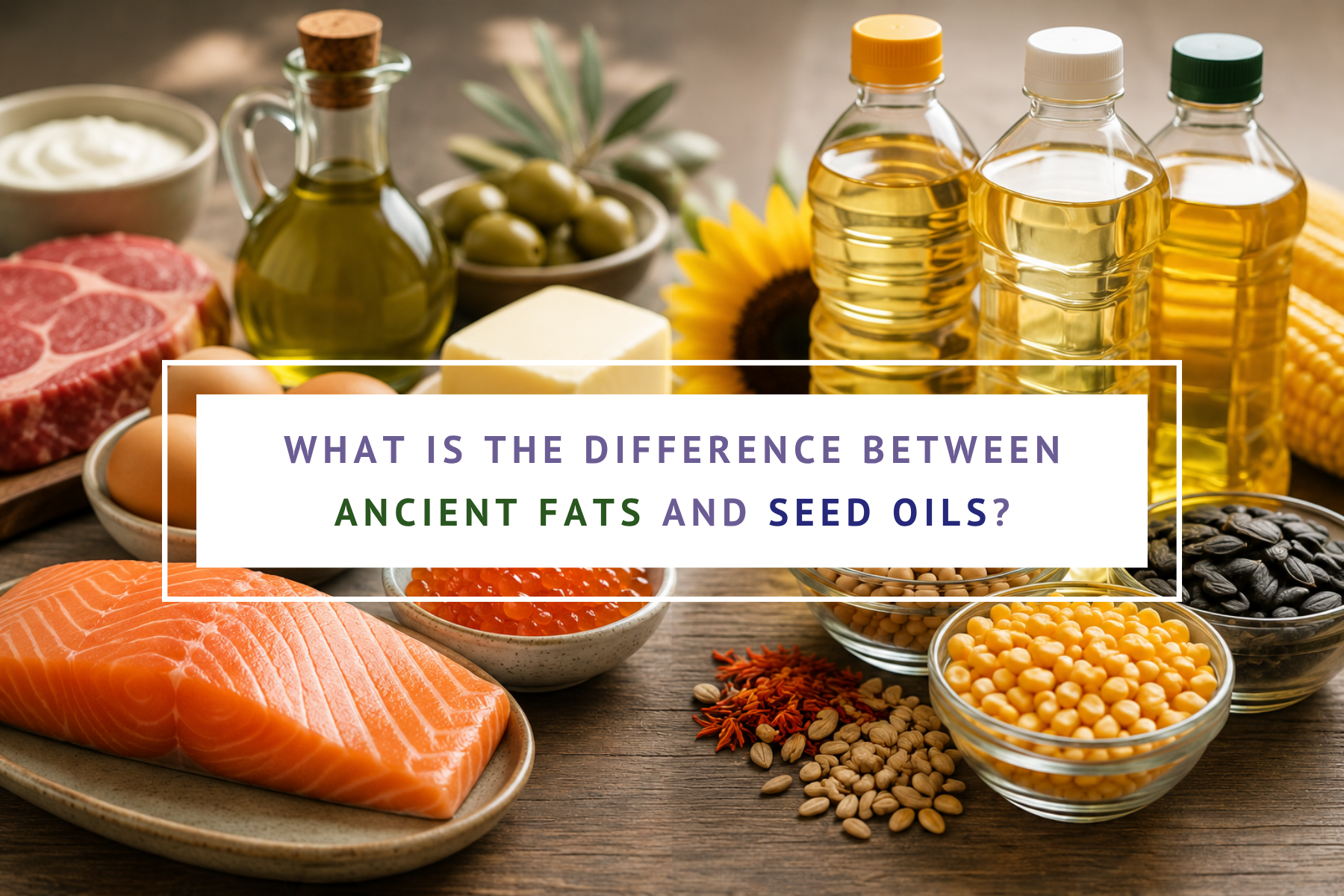
You clean up your diet. More eggs and salmon, cooking with butter or olive oil, fewer packaged snacks. And you just feel better. Steadier energy. Fewer cravings. A clearer head. If you are a U.S. adult somewhere between 30 and 65, you have probably felt this shift and wondered whether it is real. Is it a placebo, or did modern diets lose something that traditional fats still have? That question sits at the heart of real food diets vs processed modern fats.
When we say ancient fats, we mean minimally processed fats that people have eaten for a very long time. Think of the fat that comes naturally with eggs, dairy, ruminant meats, fish and fish eggs, plus olives and nuts. We are not talking about the refined, high-linoleic seed oils (soybean, corn, safflower, sunflower) that surged in the last century.
TL;DR: The kinds of fat you eat become the fat in your cells, and that changes how those cells work — from how flexible their membranes are to the signaling molecules your body makes. Over the last century, a shift toward ultra-processed foods and high omega-6 seed oils changed that inner chemistry. Going back to whole-food, ancient fats can help shift it back. Change your fat sources and your cell membranes change over the following weeks, satiety and signaling shift with them, and many people report steadier energy and mood. Red blood cell omega-3 status usually rises within 8 to 16 weeks when people add fatty fish or fish eggs and cut back on high-linoleic seed oils [5].
What Is the Difference Between Ancient Fats and Seed Oils?
Short answer: Ancient fats deliver more oleic acid and long-chain omega-3s (DHA and EPA) along with membrane-building phospholipids, while modern seed oils concentrate omega-6 linoleic acid with few nutrients attached.
A few generations ago, most dietary fat came from whole foods: dairy, eggs, fish, meat, olives, and nuts. In the last century, industrially refined seed oils like corn, soybean, sunflower, and safflower moved in. U.S. intake of linoleic acid (LA, an omega-6 fat) rose from roughly 2% of calories early in the 1900s to about 7 to 8% by the end of the century as these oils displaced traditional fats [1]. For context, common oils are high in LA. Corn oil is about 55%, soybean about 50 to 55%, high-LA safflower about 70%, and conventional sunflower about 60 to 65% by fatty acid composition.
Why that matters: your body builds cell membranes from the fatty acids you eat. Over weeks to months, the balance of omega-6 and omega-3 fats in your diet shows up in your red blood cell (RBC) membranes and other tissues [5]. That balance influences how fluid your membranes are, which affects receptor function, and it sets the raw materials available for signaling molecules that help turn inflammation on and off [2], [10]. When people trade ultra-processed foods cooked in high-LA oils for eggs, fish, olive oil, and unprocessed meats, they are not just changing calories. They are rebuilding the fat architecture of their cells toward a pattern that may support steadier signaling and metabolism.
Key takeaway: Moving from high-linoleic seed oils toward whole-food fats changes the fatty acids in your cell membranes within weeks to months.
How Do the Fats You Eat Affect Your Cells and Mood?
Short answer: The fats you eat become the structure of your cells and the raw material for the messengers your body uses to coordinate responses, which is why they can influence energy, mood, and recovery.
Every cell in your body is wrapped in a membrane made of phospholipids. Those phospholipids carry fatty acids (saturated, monounsaturated, and polyunsaturated) in proportions that affect the membrane's flexibility and the behavior of receptors and transporters. Docosahexaenoic acid (DHA), the long-chain omega-3 abundant in marine foods and fish eggs, is a standout. Its shape makes membranes more flexible and can influence how nerves signal and how cells respond to hormones [3].
Your body also turns fatty acids into short-lived messengers (eicosanoids and specialized pro-resolving mediators) that help coordinate immune and repair responses. Omega-6 arachidonic acid and omega-3 EPA and DHA yield different families of these messengers. Diets heavy in omega-6 linoleic acid tend to load membranes with more arachidonic acid, while omega-3-rich foods shift the balance toward EPA and DHA. That balance helps set the tone of the inflammatory response and how quickly it resolves [2], [10]. In plain English, when you eat more omega-3s and less excess omega-6, your body is better at turning inflammation off on time.
There is one more layer. Omega-6 and omega-3 precursors compete for the same enzymes. A high LA intake can crowd the pathway and reduce how much plant omega-3 (ALA) your body converts into EPA and DHA. This depends on the actual amounts of each fat you eat, which is one reason plant sources alone often do not move omega-3 status very far [4]. In practice, both what you add (marine omega-3s) and what you dial back (excess LA from processed foods) matter.
Key takeaway: DHA-rich and EPA-rich foods change membrane structure and the signaling molecules your body makes, which can influence energy, mood, and recovery.
What Is Actually Inside Eggs, Fish Eggs, and Traditional Animal Fats?
Short answer: Whole-food fats bring more than calories. They arrive packaged with phospholipids, choline, and long-chain omega-3s that your cell membranes use directly.
Egg Yolks: Fat Paired with Phospholipids and Choline
Egg yolk fat is not just triglycerides. It is rich in phospholipids like phosphatidylcholine — molecules that become part of your cell membranes and help move lipids around the body. Yolk phospholipids and choline work together in lipid metabolism, and studies suggest egg phospholipids can influence cholesterol transport and inflammation-related pathways in ways that differ from isolated fats [6]. In other words, eggs deliver the same building blocks your membranes are made from, along with nutrients that help your body shuttle and use fats efficiently.
Fish Eggs and Marine Fats: DHA and EPA in Phospholipid Form
Fish eggs concentrate omega-3s, especially DHA, often bound in phospholipids — the same structural form your cell membranes use. Phospholipid-bound omega-3 may be especially good at enriching membranes and can be handled differently than triglyceride-bound forms during digestion and transport [7]. Many people notice clearer thinking or steadier mood when they regularly eat salmon, sardines, mackerel, or fish eggs. That fits what we know about the body, since DHA is a core structural fat in the brain and retina [3].
Ruminant and Pasture Fats: Stearic-Rich and Oleic-Rich
Traditional animal fats vary by species and feed, but two themes show up often. First, stearic acid (a saturated fat common in cocoa butter and beef tallow) has a different metabolic profile from some other saturated fats in how it affects blood lipids. Second, monounsaturated oleic acid (the main fat in olive oil) is abundant in many animal fats, especially when animals eat forage-rich or acorn-rich diets [8]. These fats deliver a different fatty acid mix than high-linoleic seed oils, and they tend to be more stable for cooking — a real practical benefit at home.
A Cultural Case in Point: Ibérico Pork and Acorn-Fed Fats
In Spain, acorn-fed Ibérico pigs develop fat that is unusually rich in oleic acid — the same fat at the heart of extra-virgin olive oil. It is a clear example of how an animal's diet shifts its fat composition. This higher-oleic profile makes for flavorful, stable cooking fat and a different membrane-building mix than high-LA seed oils.
Key takeaway: Eggs, fish eggs, and traditional animal fats deliver phospholipids, choline, oleic acid, and DHA and EPA that your body readily incorporates into cell membranes.
So Why Do Some People Feel Better on Real-Food Fats?
Short answer: Because membrane fats and signaling molecules shift within weeks, which can steady energy, mood, and satiety.
- Membrane makeovers. Over weeks, RBC and tissue fatty acid profiles come to reflect your diet [5]. As EPA and DHA rise and excess linoleic acid falls, membranes often become more flexible and the pool of signaling fats tilts toward molecules that help the body resolve normal inflammatory responses [2], [10]. Many people report steadier energy, clearer thinking, and better recovery from training or busy days.
- Smoother signals. DHA-rich membranes can influence how receptors for hormones and neurotransmitters work [3]. It is not magic, it is mechanics. When the landing pads on your cells sit in a more flexible sea, their behavior changes.
- Practical satiety. Meals built around eggs, fish, meat, beans, vegetables, and natural fats come with protein and fiber, and they tend to be more satisfying per bite than ultra-processed foods. In a tightly controlled metabolic-ward study, people ate about 500 more calories per day on an ultra-processed diet than on a minimally processed diet, even when the two diets were matched for calories and macros on offer. The likely drivers were the speed of eating, the hyper-palatability, and the texture — all features of processing rather than macros alone [9].
- Less competition in the enzyme lanes. Dialing back a very high LA intake from industrial snacks and dressings can remove some of the metabolic crowding, which makes it easier for your body to use the omega-3s you do eat [4].
Key takeaway: Swap ultra-processed, high-LA foods for whole-food fats and you often feel the difference within a month or two.
Are Seed Oils Actually Bad for You?
Short answer: Not exactly. Omega-6 fats are essential and you need some linoleic acid to build healthy skin and membranes. The real issues are dose and context: how much, how hot, how refined, and what else is on the plate.
Modern diets push LA high by default through restaurant fryers, packaged snacks, and bottled dressings. That can crowd out omega-3s in your membranes and tilt signaling toward omega-6-derived messengers [1], [10]. For high-heat or repeated frying, PUFA-rich oils can also oxidize faster and generate aldehydes and other breakdown products, especially when oils are reheated many times in commercial fryers [11]. For home cooking, choosing more stable fats and avoiding repeated reheating helps limit that oxidation.
If most of your fats come from whole foods, olive oil, nuts, and seeds in their natural form, your omega-6 to omega-3 balance looks very different than if your fats come mainly from ultra-processed foods cooked in refined seed oils. So rather than framing this as good oils versus bad oils, think about how often, how hot, and what else is on the plate.
Key takeaway: Keep omega-6 intake moderate, favor whole-food fats, and use more stable options for high heat. You do not have to ban every seed oil to improve your fat pattern.
Is Black Cumin Seed Oil a “Seed Oil” You Should Avoid?
Short answer: No. Cold-pressed black cumin seed oil (Nigella sativa) is a traditional, minimally processed oil used by the teaspoon for its thymoquinone content, not an industrially refined cooking oil used by the tablespoon.
When this article warns about seed oils, it means industrially refined, high-linoleic oils like soybean, corn, safflower, and sunflower — the kind used by the tablespoon in fryers and packaged foods. Black cumin seed oil does not belong in that group. People have used the seed for thousands of years, the oil is cold-pressed rather than industrially refined, and you use it by the teaspoon instead of as a cooking fat.
The reason to reach for it is not its fatty acids. It is thymoquinone, the plant compound that gives the oil its antioxidant character in laboratory analysis [13]. A small daily serving delivers thymoquinone while adding only a trace of fat to your day, so it does not meaningfully change your omega-6 load — especially when your everyday cooking fats are olive oil, butter, or ghee. Use it cold by drizzling it over food or taking a small serving, and keep it off high heat so those delicate compounds stay intact. That is the same rule you already follow with extra-virgin olive oil.
Potency is where sourcing shows up. Thymoquinone content varies widely from one black seed oil to the next depending on the seeds and how they are pressed.
How Do You Cook with Ancient Fats at Home?
Short answer: You do not need perfection, just a repeatable pattern: use stable fats for heat, keep delicate oils for cold uses, and eat fatty fish or roe a few times a week.
Which Fats Should You Use, and When?
- Daily defaults: extra-virgin olive oil for room-temperature uses and gentle cooking, butter or ghee for flavor and medium heat, and avocado oil to fill gaps.
- For higher heat: use more stable fats like ghee and beef tallow, and do not reuse oils repeatedly, which raises oxidation products [11].
- For omega-3s that build brain and cell membranes: eat fatty fish two to three times per week, or include fish eggs when you can. Plant omega-3s (flax, chia, walnuts) are valuable, but they convert poorly to EPA and DHA when LA intake is high [4].
- As a specialty add-on: a small daily serving of cold-pressed black cumin seed oil for its thymoquinone content, kept off high heat [13].
Which Whole-Food Fats Belong on Your Plate?
- Eggs most days if they agree with you, since they bring phospholipids and choline alongside protein [6].
- Sardines, salmon, mackerel, herring, or trout weekly for DHA and EPA [2], [3].
- If you eat meat, favor unprocessed cuts and, when you can, animals raised on natural diets, and rotate in shellfish for minerals.
- Watch the invisible oils. Packaged snacks, chain-restaurant fried foods, and bottled sauces are the biggest sources of excess LA for most people [1].
What Does a Real-Food-Fats Day Look Like?
Before (processed modern fats): a breakfast pastry with coffee creamer, a fried chicken sandwich and fries for lunch, chips for a snack, and takeout noodles stir-fried in vegetable oil for dinner.
After (real food fats): eggs and sautéed greens in olive oil for breakfast, a grilled chicken bowl with an olive-oil vinaigrette for lunch, yogurt with walnuts for a snack, and baked salmon with rice and roasted vegetables in butter or ghee for dinner.
How Do You Track Whether It Is Working?
- Simple tracking: jot quick notes on energy, cravings, digestion, and training recovery for two to four weeks as you adjust your fats. Many people notice changes within weeks.
- Objective marker: RBC omega-3 testing (the Omega-3 Index) reflects long-term intake and membrane enrichment. An index around 8% or higher is a commonly used target for higher long-chain omega-3 status in research and clinical programs [5], [12]. Retest after 8 to 16 weeks of consistent choices to see your progress.
Key takeaway: Match the fat to the job, eat fatty fish or roe weekly, cut the invisible oils, and give it four to twelve weeks before you judge the results.
Frequently Asked Questions
Q: What are the benefits of traditional animal fats?
A: Traditional animal fats typically offer membrane-building nutrients like the phospholipids and choline in eggs [6], more oleic acid, and from marine foods and fish eggs, the DHA and EPA that enrich cell membranes [2], [3], [7]. They also tend to be more stable for cooking than high-PUFA seed oils at high heat [11], and they arrive with protein and micronutrients packaged alongside the fat, which supports satiety and steady meals.
Q: What is the main difference between ancient fats and modern seed oils?
A: Ancient fats from eggs, fish, meat, olives, and nuts bring phospholipids and a fatty acid profile with more oleic acid and DHA and EPA. Refined seed oils concentrate omega-6 linoleic acid with few accompanying nutrients [1] to [7], [10].
Q: Do I have to cut out all seed oils?
A: No. Focus on the main sources, which are fried takeout and packaged snacks, and swap those for home-cooked versions using olive oil, ghee, or tallow. That change alone can lower your LA load while you raise marine omega-3s [1], [2], [4], [11].
Q: Is black cumin seed oil just another seed oil?
A: By its fatty acids, black cumin oil does contain omega-6. But that misses how it is used. It is cold-pressed and minimally processed, taken by the teaspoon rather than the tablespoon, and valued for thymoquinone, an antioxidant compound, rather than as a bulk cooking fat [13]. A small daily serving adds those compounds without meaningfully raising your omega-6 load, especially when your main cooking fats are olive oil, butter, or ghee.
Q: If I do not eat fish, can plant omega-3s cover me?
A: Plant omega-3 (ALA) is valuable, but conversion to EPA and DHA is limited, and it drops further when LA is high [4]. If you avoid fish, consider algae-based DHA and EPA, keep high-LA processed foods low, and work with your clinician on what fits you.
Q: Are saturated animal fats bad while olive oil is good?
A: Different fats do different jobs. Traditional animal fats often contain a mix of stearic and oleic acids, which affect blood lipids differently than some other saturated fats [8]. Olive oil remains a great daily default, but you do not need to fear every gram of animal fat. Context and your overall pattern matter more.
Q: How long until real-food fats change my omega-3 status?
A: Red blood cell omega-3 levels usually rise within 8 to 16 weeks of consistently eating fatty fish or roe and cutting back on high-linoleic seed oils [5]. Many people notice steadier energy and cravings sooner than that, within a week or two.
Q: Real food diets vs processed modern fats — what is the practical first step?
A: Start where LA is highest, which is restaurant fryers and packaged snacks. Swap one fried or ultra-processed meal per day for a home-cooked meal with olive oil, eggs, fish, and unprocessed meats, and add one serving of fatty fish weekly. That single shift changes both your fat quality and your calorie dynamics [1], [9].
FDA / Healthcare Disclaimer
This article is for informational purposes only and does not provide medical advice. It is not a substitute for professional diagnosis or treatment. Always seek the guidance of your physician or other qualified health provider with any questions about a medical condition or before making changes to your diet, medications, or supplement routine. These statements have not been evaluated by the Food and Drug Administration. This product is not intended to diagnose, treat, cure, or prevent any disease.
References
[1] Blasbalg, T. L., Hibbeln, J. R., Ramsden, C. E., Majchrzak, S. F., & Rawlings, R. R. (2011). Changes in consumption of omega-3 and omega-6 fatty acids in the United States during the 20th century. The American Journal of Clinical Nutrition, 93(5), 950–962. https://pubmed.ncbi.nlm.nih.gov/21367944/
[2] Calder, P. C. (2015). Marine omega-3 fatty acids and inflammatory processes: Effects, mechanisms and clinical relevance. Biochimica et Biophysica Acta, 1851(4), 469–484. https://pubmed.ncbi.nlm.nih.gov/25149823/
[3] Salem, N., Jr., Litman, B., Kim, H. Y., & Gawrisch, K. (2001). Mechanisms of action of docosahexaenoic acid in the nervous system. Lipids, 36(9), 945–959. https://pubmed.ncbi.nlm.nih.gov/11724467/
[4] Goyens, P. L., Spilker, M. E., Zock, P. L., Katan, M. B., & Mensink, R. P. (2006). Conversion of alpha-linolenic acid in humans is influenced by the absolute amounts of alpha-linolenic acid and linoleic acid in the diet and not by their ratio. The American Journal of Clinical Nutrition, 84(1), 44–53. https://pubmed.ncbi.nlm.nih.gov/16825680/
[5] Hodson, L., Skeaff, C. M., & Fielding, B. A. (2008). Fatty acid composition of adipose tissue and blood in humans and its use as a biomarker of dietary intake. The American Journal of Clinical Nutrition, 88(5), 1526–1534. https://pubmed.ncbi.nlm.nih.gov/18435934/
[6] Blesso, C. N. (2015). Egg phospholipids and cardiovascular health. Nutrients, 7(4), 2731–2747. https://pubmed.ncbi.nlm.nih.gov/25871489/
[7] Küllenberg, D., Taylor, L. A., Schneider, M., & Massing, U. (2012). Health effects of dietary phospholipids. Lipids in Health and Disease, 11, 3. https://pubmed.ncbi.nlm.nih.gov/22221489/
[8] Mensink, R. P., Zock, P. L., Kester, A. D., & Katan, M. B. (2003). Effects of dietary fatty acids and carbohydrates on the ratio of serum total to HDL cholesterol and on serum lipids and apolipoproteins: A meta-analysis of 60 controlled trials. The American Journal of Clinical Nutrition, 77(5), 1146–1155. https://pubmed.ncbi.nlm.nih.gov/12716665/
[9] Hall, K. D., Ayuketah, A., Brychta, R., et al. (2019). Ultra-processed diets cause excess calorie intake and weight gain: An inpatient randomized controlled trial of ad libitum food intake. Cell Metabolism, 30(1), 67–77.e3. https://pubmed.ncbi.nlm.nih.gov/31105044/
[10] Calder, P. C. (2008). Polyunsaturated fatty acids, inflammatory processes and inflammatory bowel diseases. Molecular Nutrition & Food Research, 52(8), 885–897. https://pubmed.ncbi.nlm.nih.gov/18504706/
[11] Choe, E., & Min, D. B. (2007). Chemistry of deep-fat frying oils. Journal of Food Science, 72(5), R77–R86. https://pubmed.ncbi.nlm.nih.gov/17995742/
[12] Harris, W. S., & von Schacky, C. (2004). The Omega-3 Index: A new risk factor for death from coronary heart disease? Preventive Medicine, 39(1), 212–220. https://pubmed.ncbi.nlm.nih.gov/15208005/
[13] Singh, S., Das, S. S., Singh, G., Schuff, C., de Lampasona, M. P., & Catalán, C. A. N. (2014). Composition, in vitro antioxidant and antimicrobial activities of essential oil and oleoresins obtained from black cumin seeds (Nigella sativa L.). BioMed Research International, 2014, 918209. https://pubmed.ncbi.nlm.nih.gov/24689064/


