

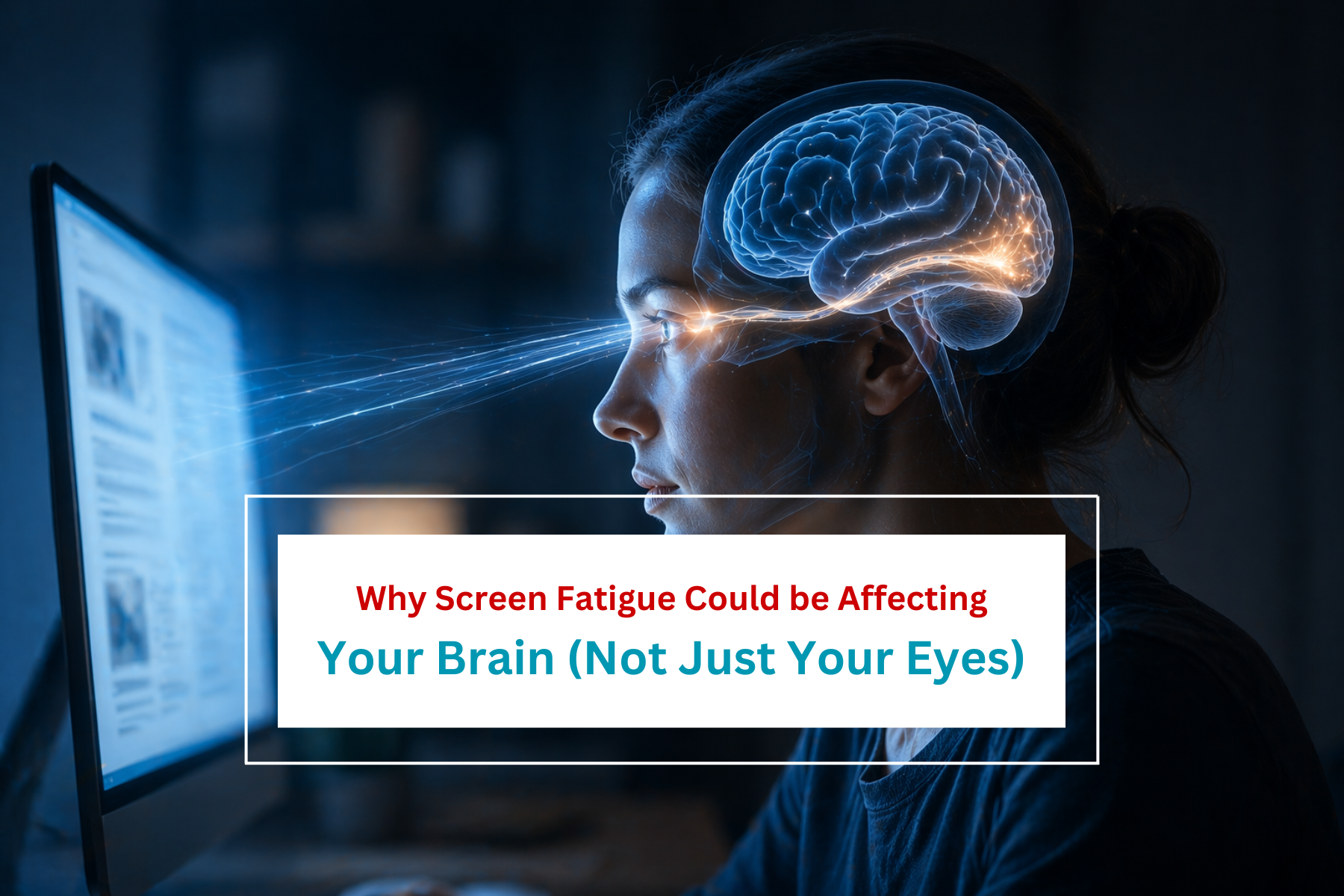
Struggling with screen fatigue—even after a normal workday?
You close your laptop…
but your brain doesn't switch off.
Your eyes feel strained.
Your head feels heavy.
Your focus is gone—even though the day isn't over.
Most people assume this is just eye strain from screens.
But what you're feeling isn't just visual.
It's cognitive fatigue—and it affects your brain more than your eyes.
And once you understand that shift, everything about how you approach it changes.
The Real Problem Isn't Your Eyes—It's Your Brain on Overload
Screens don't just affect how you see.
They affect how your brain processes information.
Every scroll, notification, and tab switch forces your brain to:
- shift attention
- process new stimuli
- make micro-decisions
- stay in a constant state of alert¹
It's active, continuous cognitive work. And unlike physical effort, you don't always feel it building in real time. But it is.
Over time, that creates something deeper than eye strain: cognitive fatigue.
And unlike tired eyes… your brain doesn't recover as quickly…especially when the stimulation never fully stops.
What Screen Fatigue Actually Does to Your Brain
When screen exposure becomes constant, your brain stays in what can be described as "high input mode."
Instead of cycling between focus and recovery, it stays engaged for hours at a time. That leads to several key effects:
1. Mental Overload
Your brain is designed to process information—but not at the volume and speed modern screens demand.
Emails. Notifications. Tabs. Messages. Content. Each one requires attention. Each one creates a small cognitive load. Individually, they seem insignificant. But together, they accumulate.
The result?
- reduced focus
- mental fog
- slower decision-making
- increased mistakes
It's not that your brain is underperforming. It's overloaded.¹,²
2. Reduced Attention Span
Constant switching between tasks trains your brain to expect novelty.² Your attention becomes fragmented. So when you try to sit down and focus deeply… your brain resists.
Not because you lack discipline. But because your brain has been conditioned to operate differently. Over time, this makes sustained focus feel harder—even when nothing else has changed.
3. Nervous System Overstimulation
Screens don't just deliver information. They stimulate your nervous system.
- bright light
- fast-moving visuals
- constant updates
- unpredictable inputs
All of these signals tell your brain: "Stay alert." The problem is, there's no clear off-switch. So your system stays partially activated—even when you're trying to relax.³
This makes it harder to:
- unwind at the end of the day
- transition into rest
- feel mentally settled
4. Disrupted Sleep and Recovery
One of the most overlooked effects of screen fatigue is how it impacts sleep. Screen exposure—especially at night—delays melatonin production.⁴,⁵
But it's not just about light. It's also about stimulation. If your brain is still processing, reacting, and engaging… it doesn't fully transition into sleep mode.
So even if you fall asleep, the quality of that sleep may be lower. And that means:
- less recovery
- more fatigue the next day
- a cycle that continues
Why Screen Fatigue Feels Worse Over Time
At first, screen fatigue feels manageable. You just feel a little tired. A little unfocused. But over time, the effects compound:
- mental fatigue sets in earlier
- focus becomes harder to maintain
- recovery takes longer
- sleep quality declines
And eventually, it starts to feel like: "My brain just isn't as sharp as it used to be."
But this isn't a loss of ability. It's cumulative overload without sufficient recovery or support.³
The Missing Piece: Your Brain Isn't Getting Support—Only Stimulation
Most people try to solve screen fatigue by:
- taking breaks
- reducing screen time
- using blue light filters
And those are helpful. But they only address part of the problem. Because the core issue isn't just exposure. It's an imbalance.
Your brain is constantly being stimulated… but not supported.
Focus, clarity, and resilience don't just depend on reducing input. They depend on how well your brain can process, adapt, and recover from that input.
5 Ways to Reduce Screen Fatigue and Support Your Brain
1. Create Real Breaks (Not Just "No Screen" Moments)
Most breaks aren't real breaks. You close one screen… and open another. Your brain never fully disengages.
A true reset requires a change in input. What works better:
- stepping outside
- looking at natural light⁴
- letting your eyes and brain relax
Even 5–10 minutes can help shift your system out of "input mode."
2. Reduce Cognitive Switching
Every time you switch tasks, your brain has to reorient. This consumes energy—even if you don't notice it. Over time, this constant switching becomes exhausting.²
Try:
- batching similar tasks
- limiting multitasking
- working in focused blocks
This reduces cognitive load and improves efficiency.
3. Support Your Brain—Not Just Your Eyes
Most solutions focus on eye strain. But screen fatigue is primarily a brain issue. Your brain needs:
- nourishment
- recovery
- structural support
Not just less stimulation. And this is where most people stop short.
4. Build a Daily "Off-Switch" Routine
If your brain is constantly stimulated, it needs a clear signal to stop. Without that signal, stimulation carries into the night.
Simple reset routine:
- dim lights in the evening
- reduce screens 60 minutes before bed
- shift to low-input activities
This helps your brain transition out of active mode and into recovery.⁴,⁵
5. Support Recovery—Not Just Performance
Most people try to push through fatigue. But pushing doesn't restore function. Recovery does. And recovery requires consistency. Daily support—especially for brain and nervous system function—helps your system reset more effectively over time.
How to Give Your Brain an Extra Boost
Even if you improve your habits, your brain is still dealing with:
- high levels of daily input
- constant stimulation
- ongoing cognitive demand
This is where most solutions fall short—they try to reduce screen exposure, but don't support the brain that's dealing with it.
This is where something like fish egg capsules (hoki roe) fits naturally into your routine. As something that supports the structure and function of your brain itself.
Because your brain isn't just getting tired from screens. It's working harder than ever—and it needs the right building blocks to keep up.
Why This Matters for Screen Fatigue
Fish roe is naturally rich in nutrients that play a direct role in brain function:
- Phospholipid-bound DHA — Supports neuronal membrane structure and signaling⁶
- Choline — Essential for neurotransmitter production (linked to focus and memory)⁷
- Omega-3 fatty acids — Support inflammatory balance and cognitive performance⁶
- Fat-soluble nutrients — Support overall brain and nervous system health
Unlike standard fish oil, these omega-3s are delivered in forms that may be more efficiently incorporated into cell membranes, including those in the brain.⁶ They are also consumed within a whole-food matrix (e.g., fatty fish or fish roe), which includes proteins, phospholipids, and micronutrients. This matrix may help explain why diets rich in fatty fish and fish eggs are consistently associated with better health outcomes compared to isolated fish oil supplements.
What This Looks Like in Real Life
When your brain has the support it needs, the difference is noticeable:
- your thinking feels clearer
- focus lasts longer
- mental fatigue doesn't hit as early
- you recover faster after long screen days
To better understand how these nutrients also support visual comfort and help reduce screen-related eye strain, this article explains the connection clearly:
How omega 3 fish egg supplements support eye health focus and visual comfort
Because instead of just reducing input… you're supporting your brain's ability to handle it.
Why Consistency Matters
Screen use is daily. So support needs to be daily too.
Fish egg capsules don't create a spike like caffeine. They support:
- brain structure
- neural communication
- cognitive resilience over time⁶
Which is exactly what modern screen use demands.
How to Reduce Screen Fatigue Naturally
If you want to improve focus and reduce screen fatigue:
- take real breaks away from screens
- reduce multitasking
- create a nighttime wind-down routine
- support your brain—not just your eyes
- use consistent nutritional support for brain function
Final Thoughts: Screen Fatigue Is a Brain Issue—Not Just an Eye Issue
What feels like "tiredness" is often:
- overstimulation
- cognitive overload
- lack of recovery
When you address those:
- focus improves
- energy stabilizes
- mental clarity returns
Not because you pushed harder—but because your brain finally has what it needs.
FAQs
What is screen fatigue?
Screen fatigue refers to the mental and physical strain caused by prolonged screen use, affecting focus, energy, and cognitive performance.
Is screen fatigue only about eye strain?
No—screen fatigue also affects the brain, including attention, stress response, and mental clarity.
How can I reduce screen fatigue naturally?
Take real breaks, reduce multitasking, limit evening screen exposure, and support brain health through nutrition and routine.
Do fish egg capsules help with brain function and focus?
Nutrients like DHA, phospholipids, and choline—found in fish roe—play an important role in brain structure, signaling, and cognitive performance.
How long does it take to recover from screen fatigue?
Short breaks help immediately, but consistent daily habits and support lead to longer-term improvement.
References
- Ophir, E., Nass, C., & Wagner, A. D. (2009). Cognitive control in media multitaskers. Proceedings of the National Academy of Sciences, 106(37), 15583–15587. https://www.pnas.org/doi/10.1073/pnas.0903620106
- Leroy, S. (2009). Why is it so hard to do my work? The challenge of attention residue when switching between work tasks. Organizational Behavior and Human Decision Processes, 109(2), 168–181. https://www.researchgate.net/publication/46489122
- Charmandari, E., Tsigos, C., & Chrousos, G. (2005). Endocrinology of the stress response. Endocrine Reviews, 26(2), 256–293. https://pubmed.ncbi.nlm.nih.gov/15709959/
- Cajochen, C. (2007). Alerting effects of light. Sleep Medicine Reviews, 11(6), 453–464. https://pubmed.ncbi.nlm.nih.gov/17936041/
- Chang, A. M., Aeschbach, D., Duffy, J. F., & Czeisler, C. A. (2015). Evening use of light-emitting eReaders negatively affects sleep, circadian timing, and next-morning alertness. Proceedings of the National Academy of Sciences, 112(4), 1232–1237. https://www.pnas.org/doi/10.1073/pnas.1418490112
- Yurko-Mauro, K., et al. (2010). Beneficial effects of docosahexaenoic acid on cognition in age-related cognitive decline. Alzheimer's & Dementia, 6(6), 456–464. https://pubmed.ncbi.nlm.nih.gov/20434961/
- Zeisel, S. H. (2006). Choline: Critical role during fetal development and dietary requirements in adults. Annual Review of Nutrition, 26, 229–250. https://onlinelibrary.wiley.com/doi/abs/10.1111/j.1753-4887.2006.tb00202.x


