

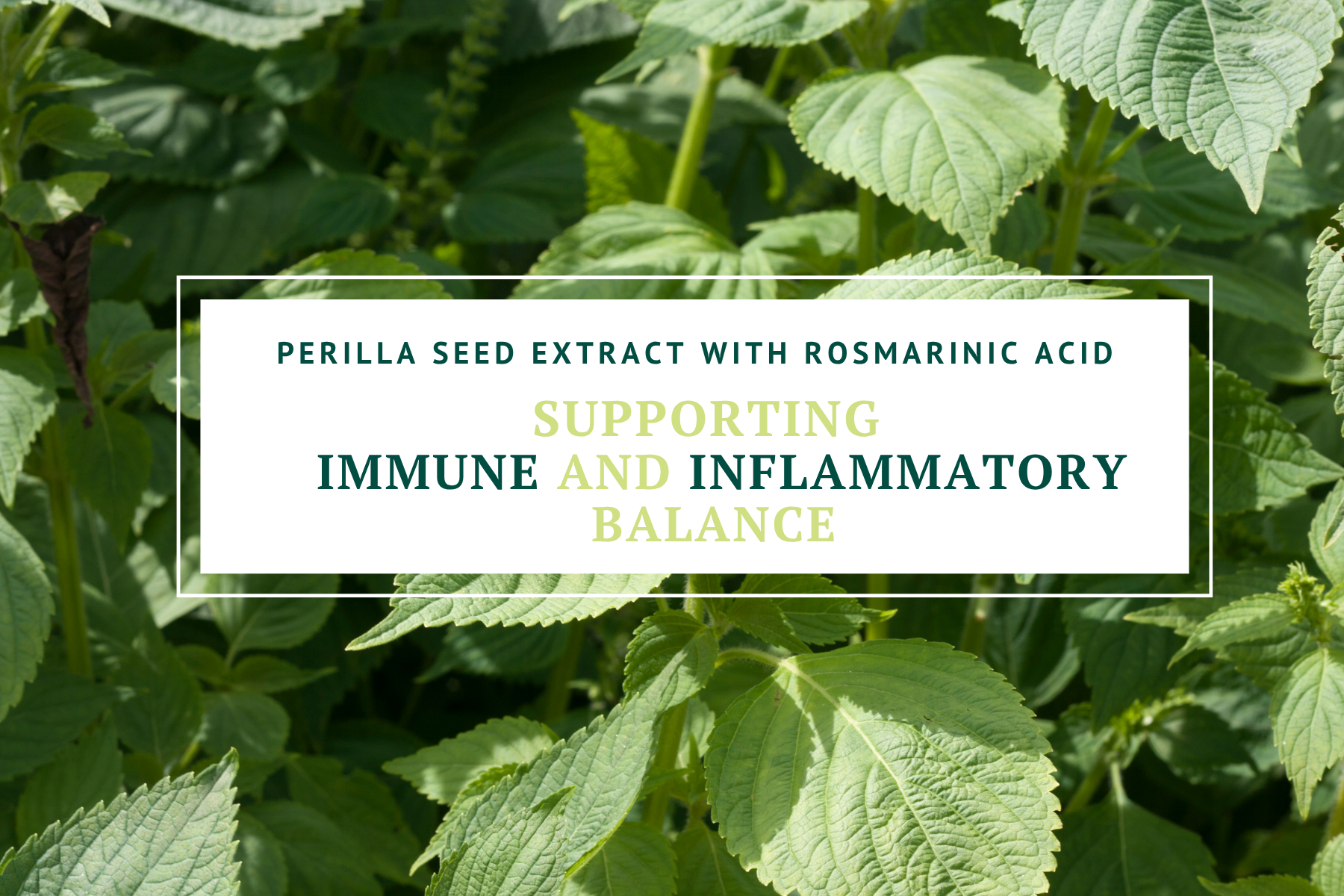
What Is Perilla Seed Extract?
Perilla (Perilla frutescens) is an aromatic herb long used in East Asian food and traditional medicine. Its seeds and leaves are naturally rich in rosmarinic acid, a plant polyphenol known for supporting the body's antioxidant and immune systems.
Modern studies show that compounds in perilla can help the body maintain normal immune responses, cellular protection, and inflammatory balance as part of a healthy lifestyle (1–3).*
Traditional Roots and Modern Discovery
For centuries, perilla was valued in Japan, Korea, and China for its calming, cleansing, and balancing effects.
- In Traditional Chinese Medicine (TCM): perilla seeds (Zi Su Zi) were used to support comfortable breathing and digestion.
- In Kampo medicine (Japan): perilla was taken seasonally to promote immune balance and clear airways.
- In Korean herbalism: perilla oil and teas were consumed to nourish vitality and balance energy.
Today, laboratory and clinical research has begun to validate many of these uses by identifying rosmarinic acid and perilla proteins as active components that help protect cells from oxidative and inflammatory stress (1, 4, 5).
How Rosmarinic Acid Works in the Body
Rosmarinic acid is a polyphenolic compound synthesized by plants in the mint family. It supports cellular wellness through several mechanisms:
- Antioxidant activity: helps neutralize reactive oxygen species (ROS) and supports the body's own antioxidant enzymes (1, 6).
- Inflammatory modulation: interacts with molecular targets such as NF-κB and COX-2, helping maintain healthy inflammatory signaling (3).
- Immune regulation: promotes a balanced Th1/Th2 cytokine profile and supports normal histamine responses (2, 4).
These combined effects make perilla seed extract standardized for rosmarinic acid a valuable botanical for everyday immune and inflammatory support.*
1. Antioxidant Power Confirmed by Cell Studies
A 2025 Biologics study analyzed fractionated perilla leaf extract and found high levels of polyphenols—especially rosmarinic acid—that enhanced antioxidant capacity and improved cellular stress-response pathways in vitro (1).
Cells exposed to oxidative stress showed stronger activation of defense proteins and higher viability when treated with perilla extract. This supports the idea that perilla polyphenols help the body defend itself against environmental and metabolic stressors.*
2. Anti-Inflammatory Potential
A comprehensive review in Frontiers in Pharmacology summarized decades of evidence showing that rosmarinic acid helps regulate inflammatory signaling across multiple systems (3). It can inhibit overactive mediators like TNF-α and IL-6 while promoting antioxidant enzyme activity—key steps in maintaining a healthy inflammatory balance.
These findings align with earlier phytochemical studies showing that perilla's active compounds reduce oxidative and inflammatory markers without disrupting normal immune function.*
3. Immune Balance and Seasonal Support
Human studies show that perilla extract may support a balanced immune response during seasonal changes.
In a 2003 clinical trial published in Phytotherapy Research, perilla extract and its active constituents helped maintain normal histamine and cytokine levels in participants exposed to environmental triggers (2).
Researchers concluded that the extract's rosmarinic acid content contributed to more comfortable immune adaptation through modulation of Th2-associated pathways.*
4. Cellular Protection and Apoptotic Regulation
Beyond its immune effects, rosmarinic acid has been shown to influence cell-protective and apoptotic processes.
In a 2021 International Journal of Molecular Medicine study, rosmarinic acid reduced abnormal cell proliferation and migration while promoting normal apoptotic signaling in human cell models (7).
This supports the compound's broader role in maintaining healthy cellular turnover and metabolic balance when oxidative or inflammatory stress is present.*
5. Protein and Peptide Support from Perilla Seeds
While rosmarinic acid is concentrated in perilla leaves and seeds, the seed meal itself provides bioactive proteins and peptides with complementary benefits.
A 2025 Foods review described how perilla seed proteins contribute antioxidant, anti-inflammatory, and metabolic-supportive activities in experimental models (4).
Together, these findings show that both perilla's polyphenols and peptides contribute to its wellness effects.*
How Perilla Seed Extract Supports Whole-Body Balance
| Function | Key Bioactives | Mechanism | Benefit* |
|---|---|---|---|
| Antioxidant Support | Rosmarinic acid, flavonoids | Scavenge free radicals, enhance cellular enzymes | Helps protect cells from oxidative stress |
| Inflammatory Modulation | Rosmarinic acid, proteins | Balance NF-κB and COX-2 pathways | Maintains inflammatory homeostasis |
| Immune Balance | Rosmarinic acid | Regulates cytokines and histamine | Supports healthy seasonal comfort |
| Metabolic Harmony | Seed peptides, ALA | Promote lipid and glucose regulation | Supports overall vitality |
6. Scientific Consensus on Rosmarinic Acid
According to classic and recent reviews, rosmarinic acid is a well-characterized antioxidant and anti-inflammatory compound with diverse health applications (6).
Its dual role—protecting cells and modulating immune messengers—makes it a model plant polyphenol for promoting balance rather than suppression.
This combination of traditional use, laboratory validation, and human studies gives perilla seed extract a unique position among plant-based functional ingredients.
How to Choose a High-Quality Perilla Supplement
When evaluating supplements, look for:
- Standardized rosmarinic acid content (≥ 8-20%)
- Cold-pressed or water-based extraction to preserve actives
- Third-party testing for purity and heavy metals
- Full-spectrum extract that includes both leaf and seed components for synergistic antioxidant activity
Key Takeaways
- Perilla seed extract naturally provides rosmarinic acid, peptides, and omega-3 precursors that help maintain normal immune and inflammatory balance.
- Modern research confirms its antioxidant and stress-response effects at the cellular level.
- Traditional wisdom and modern biochemistry meet in this botanical, supporting resilience and wellness from within.*
References
- Lia, F., & Baron, B. (2025). Analysis of polyphenolic composition, antioxidant power and stress-response effects of fractionated Perilla leaf extract on cells in vitro. Biologics, 5(1), 2. https://doi.org/10.3390/biologics5010002
- Makino, T., Furuta, Y., Wakushima, H., Fujii, H., Saito, K., & Kano, Y. (2003). Anti-allergic effect of Perilla frutescens and its active constituents. Phytotherapy Research, 17(3), 240–243. https://doi.org/10.1002/ptr.1115
- Luo, C., Zou, L., Sun, H., Peng, J., Gao, C., Bao, L., Ji, R., Jin, Y., & Sun, S. (2020). A review of the anti-inflammatory effects of rosmarinic acid on inflammatory diseases. Frontiers in Pharmacology, 11, 153. https://doi.org/10.3389/fphar.2020.00153
- Hu, Y., Luo, H., Netala, V. R., Li, H., Zhang, Z., & Hou, T. (2025). Comprehensive review of biological functions and therapeutic potential of Perilla seed meal proteins and peptides. Foods, 14(1), 47. https://doi.org/10.3390/foods14010047
- Guan Z, Li S, Lin Z, Yang R, Zhao Y, Liu J, Yang S, Chen A. Identification and quantitation of phenolic compounds from the seed and pomace of Perilla frutescens using HPLC/PDA and HPLC-ESI/QTOF/MS/MS. Phytochem Anal. 2014 Nov-Dec;25(6):508-13. doi: 10.1002/pca.2521. Epub 2014 Apr 16. PMID: 24737524.
- Petersen, M., & Simmonds, M. S. J. (2003). Rosmarinic acid. Phytochemistry, 62(2), 121–125. https://doi.org/10.1016/S0031-9422(02)00513-7
- Liu, Y., Xu, X., Tang, H., Pan, Y., Hu, B., & Huang, G. (2021). Rosmarinic acid inhibits cell proliferation, migration, and invasion and induces apoptosis in human glioma cells. International Journal of Molecular Medicine, 47(2), 67. https://doi.org/10.3892/ijmm.2021.4900
FDA Disclaimer
These statements have not been evaluated by the Food and Drug Administration. This product is not intended to diagnose, treat, cure, or prevent any disease. Consult your healthcare provider before starting any supplement, especially if you are pregnant, nursing, or have a medical condition.


