

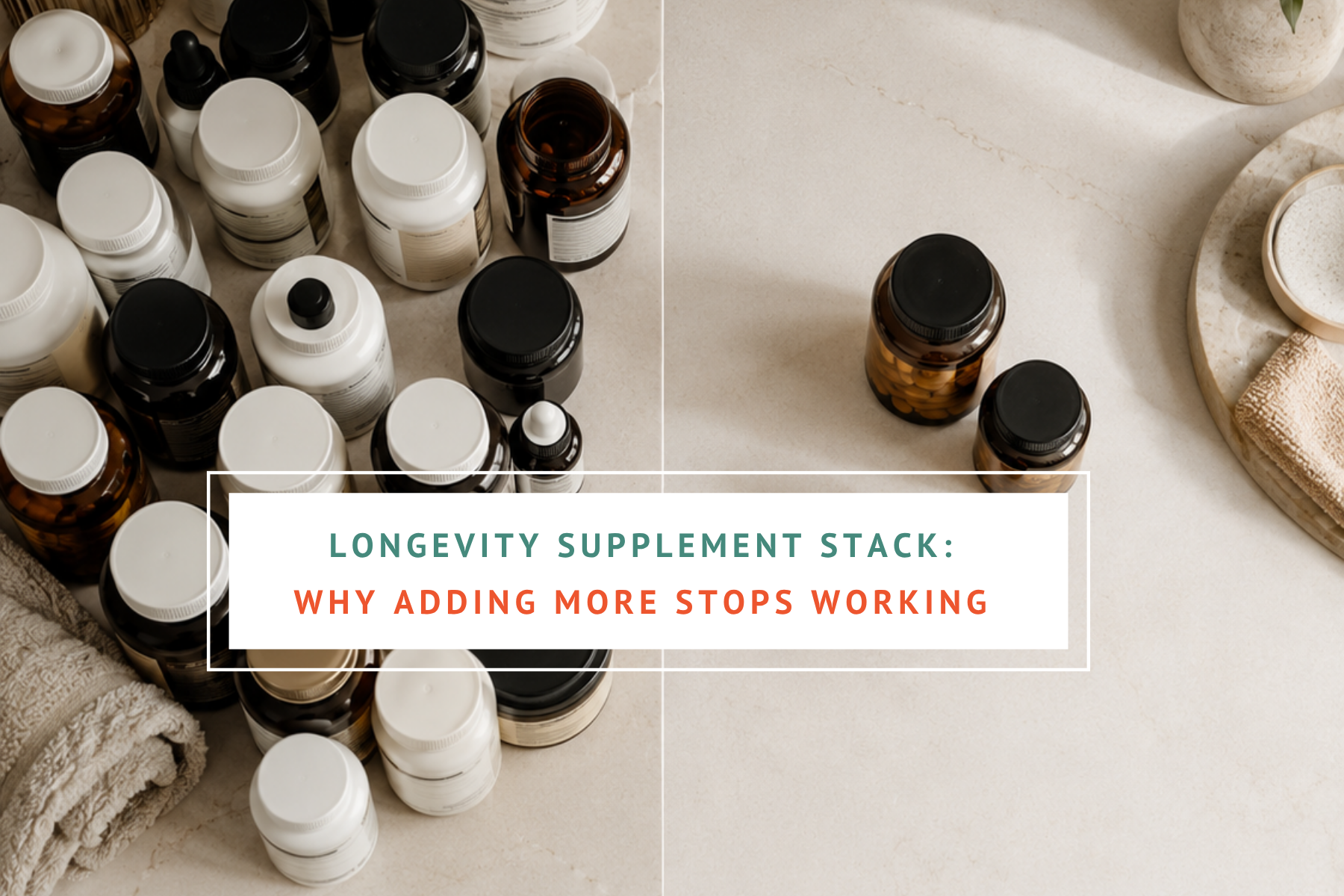
You have been at this for years. You take your longevity supplements every morning, you read the labels, you buy the trusted brands, and you rarely miss a day. On paper, you are doing everything right.
So why do your workouts still feel flat? Why does your sleep stay uneven and your energy dip every afternoon? You added a mushroom blend, then magnesium, then omega-3s, then a few "healthy aging" capsules a podcast recommended. The shelf keeps filling up, but the needle stopped moving a while ago.
Here is the part most articles skip: once you have been supplementing for a while, adding another bottle is usually the slowest way to feel better. A plateau is rarely a sign you need more. More often, it means your routine has too many moving parts, and your body can no longer tell which one is doing anything.
The good news is that the fix costs less than what you are spending now. It starts with subtraction.
Key Takeaways
- A plateau usually means too many inputs, not too few. When ten things change at once, you lose the ability to tell what actually helps.
- The foundation does the heavy lifting. Sleep, protein, and strength training drive healthy aging more than any single capsule, and the research on this is not subtle.
- A few supplements can quietly work against you, either by fighting your body clock or by muting the stress signals that make your body adapt and get stronger.
- The reset is simple: strip the stack back, then add one supplement at a time and test it for four weeks against a clear outcome.
- Functional mushrooms, creatine, omega-3s, and magnesium earn their spot when they fill a real gap and you can measure the result.
Why the Plateau Happens
With age, several systems become less efficient, including energy production, muscle repair, cellular cleanup, and normal inflammatory balance [1]. Your daily habits matter more over time, not less. Your body reads those habits as signals: when you sleep, when you eat protein, when you train, how much daylight you get, how well you recover.
A good supplement adds to that signal. The trouble starts when the stack gets so large that it becomes noise. If you are taking eight things at once, and you change two of them this month, you genuinely cannot know what worked, what did nothing, and what might be holding you back.
So before you ask "what should I add next," answer three questions about anything already in your routine:
- What gap is this filling?
- What result am I tracking?
- How will I know if it is working?
If a product cannot pass those three questions, it is probably part of the noise.
Three Ways More Supplements Stall Your Progress
A routine tends to backfire in three predictable ways.
1. They fight your body clock
Your body runs on circadian rhythms, the roughly 24-hour timers that help regulate sleep, energy, metabolism, and repair [2]. When a supplement works against that rhythm, you can feel off even when the ingredient itself is fine.
The usual culprits are stimulating products taken too late, which push your bedtime back, and sleep-support products taken at random, which leave you groggy some mornings and wired on others. Fixing this is straightforward and free. Take anything energizing earlier in the day, keep caffeine well away from bedtime, and if you use a calming supplement, take it in the last hour before sleep so it lines up with your wind-down instead of fighting it.
2. They mute the signals that make you stronger
This is the one almost nobody talks about, and it is probably the most relevant to a plateau. Your body needs a little stress to adapt. A hard workout, for example, produces reactive oxygen species, and in normal amounts those are not damage. They are the message that tells your body to come back stronger [3]. That message is a big part of why exercise works.
A human trial found that high doses of vitamin C and vitamin E taken around endurance exercise reduced some of the body's normal training adaptations [4]. In plain terms: if you swallow a megadose antioxidant formula right before you train, you may be quietly canceling part of the workout you just did.
This does not mean antioxidants are bad. It means there is a difference between food and pills here. Keep eating berries, citrus, leafy greens, herbs, olive oil, and colorful vegetables freely. If you take concentrated antioxidant supplements, keep them away from your training window so your body can hear its own signal.
3. They sit on top of a thin foundation
You cannot out-supplement a weak base, and many people try. They run five "longevity" products while still falling short on protein, skipping resistance training, or running on six hours of sleep.
Muscle is one of the most important tissues for aging well. It supports strength, mobility, balance, and how your body handles glucose. Building and keeping it comes down to two things: lifting and eating enough protein. With age, the body needs more protein per meal to make the most of it [8]. No capsule replaces that. If your foundation is thin, an advanced stack is just expensive decoration on top of the actual problem.
The Reset: Subtract Before You Add
Before you buy anything else, do a five-minute audit of what you already own. Be honest:
- Do I take more than six supplements a day?
- Can I say, out loud, why each one is there?
- Can I point to one that is clearly helping?
- Am I using stimulants to paper over bad sleep?
- Do any products hide their doses behind a "proprietary blend"?
If several of those made you wince, your routine needs simplifying before it needs anything new. Sort what you have into three piles.
Keep the things that fill a real gap or back a clear goal: creatine if you lift, omega-3s if you rarely eat fish, magnesium if your intake is low, vitamin D if your labs show a need, a quality functional mushroom blend if you are tracking energy or seasonal resilience.
Pause anything you cannot explain: hidden-dose blends, duplicate ingredients spread across three formulas, antioxidant megadoses sitting next to your workout, and that bottle you started months ago and never actually evaluated.
Test one change at a time. Pick a single supplement, choose two or three outcomes to watch, and give it four weeks against your baseline. Four weeks is long enough to see a real pattern and short enough to keep you honest. If nothing changed, it has not earned its place.
The goal is not to take less forever. The goal is to know what is actually working.
Where Functional Mushrooms Fit
Functional mushrooms are popular in healthy aging routines for good reason, but they are not magic, and they work best on top of a solid foundation rather than in place of one.
Many of them contain beta-glucans, fibers that the innate immune system recognizes through specific receptors [6]. Beta-glucans are studied for their role in innate immune function and "trained immunity," the idea that these cells can be primed to respond more readily [5]. In everyday language, beta-glucans may help support immune readiness.
Mushrooms also supply ergothioneine, an unusual compound that the body actively pulls into its cells and seems to hold onto, which is part of why some researchers describe it as a nutrient worth getting from the diet [7]. Ergothioneine may help support cellular resilience as part of a mushroom-rich diet.
When a mushroom product disappoints, it is usually the label's fault, not the mushroom's. Watch for hidden-dose blends, starchy mycelium-on-grain fillers, and vague "immune boosting" claims with no beta-glucan number anywhere on the package. A transparent product that discloses its beta-glucan content tells you what you are actually getting.
Dose and Timing Worth Getting Right
Dose and timing often decide whether a supplement helps or just becomes background noise. The ranges below are commonly used in research and practice. Check with your healthcare provider before starting or changing anything.
- Creatine monohydrate: about 3 to 5 grams a day supports muscle performance, and it pairs naturally with resistance training [9]. Daily consistency matters far more than perfect timing.
- EPA + DHA omega-3s: roughly 1 to 2 grams a day when you rarely eat fatty fish. Omega-3s help support healthy cell membranes and normal inflammatory balance [10]. If you do eat some fish, consider adding wild-caught fish egg supplements as opposed to fish oil. like when you eat fish, the omega-3s from fish eggs are within the food matrix, which means they come alongside other beneficial vitamins and minerals.
- Magnesium: about 200 to 400 mg of elemental magnesium a day when dietary intake is low, to help support normal muscle and nerve function. Glycinate is gentle and fits an evening routine; citrate is more likely to affect digestion.
- Mushroom beta-glucans: follow a product that discloses its beta-glucan content rather than chasing a long species list.
On timing: keep megadose antioxidant supplements away from your workout [4], use morning light and a protein-forward breakfast to anchor your rhythm, and place any calming supplement in the last 60 to 90 minutes before bed alongside dim lights and a consistent bedtime. Some supplements make sense every day, like creatine and omega-3s; others fit better seasonally, like a mushroom blend during higher-stress stretches. Cycling the seasonal ones helps you avoid "capsule creep," where the stack keeps growing while the benefit gets murkier.
Frequently Asked Questions
Why isn't adding more supplements working?
Because a plateau usually comes from too many inputs, not too few. When several things change at once, your body's response gets muddy and you lose the ability to tell what helps. Strip back first, then test one thing at a time.
Should I take a blend or individual ingredients?
Use individual ingredients when you want clear dosing and easy testing. Use a blend when it is transparent, well formulated, and convenient. Avoid any blend that hides its doses or stacks several overlapping ingredients you do not need.
Can antioxidants really blunt my workouts?
High-dose antioxidant supplements taken close to exercise may reduce some of the normal adaptations training produces [4]. Antioxidant-rich foods are not the problem; the issue is concentrated pills taken right around your workout.
How long should I test a new supplement?
Four weeks is a practical starting point. Track two or three outcomes against your baseline. If there is no clear benefit, reconsider whether it belongs in your routine.
Are large supplement stacks safe?
Bigger stacks raise the odds of overlap and interactions. Talk with your healthcare provider before starting or changing supplements, especially if you take medications, are pregnant or nursing, have a health condition, or are preparing for surgery.
The Bottom Line
Feeling stuck is not a signal to add another bottle. It is usually a signal that your routine has too many inputs and not enough clarity. Resilience comes from your body adapting well, and it adapts best when the foundation is steady and the signals are clean.
Start with the things that reliably move the needle: sleep, protein, strength training, fiber, omega-3 intake, and morning light. Then add targeted support, one change at a time, and give each one four weeks against a clear metric. That is how you rebuild a longevity supplement routine that supports healthy aging instead of turning it into guesswork.
Want a Simpler Place to Start?
If you are rebuilding around fewer, clearer inputs, consider Nourishing Nutrients Superfood10, a transparent functional mushroom and superfood blend made to help support immune readiness, cellular resilience, and everyday wellness as part of a healthy lifestyle. One clean addition, tested over four weeks, beats ten you cannot keep track of.
Disclaimer
This article is for educational purposes only and is not medical advice. Always consult your healthcare provider before starting or changing supplements, exercise programs, or nutrition strategies, especially if you take medications, are pregnant or nursing, have an existing health condition, or are preparing for surgery.
These statements have not been evaluated by the Food and Drug Administration. This product is not intended to diagnose, treat, cure, or prevent any disease.
Reviewed by the Nourishing Nutrients Editorial Team.


