

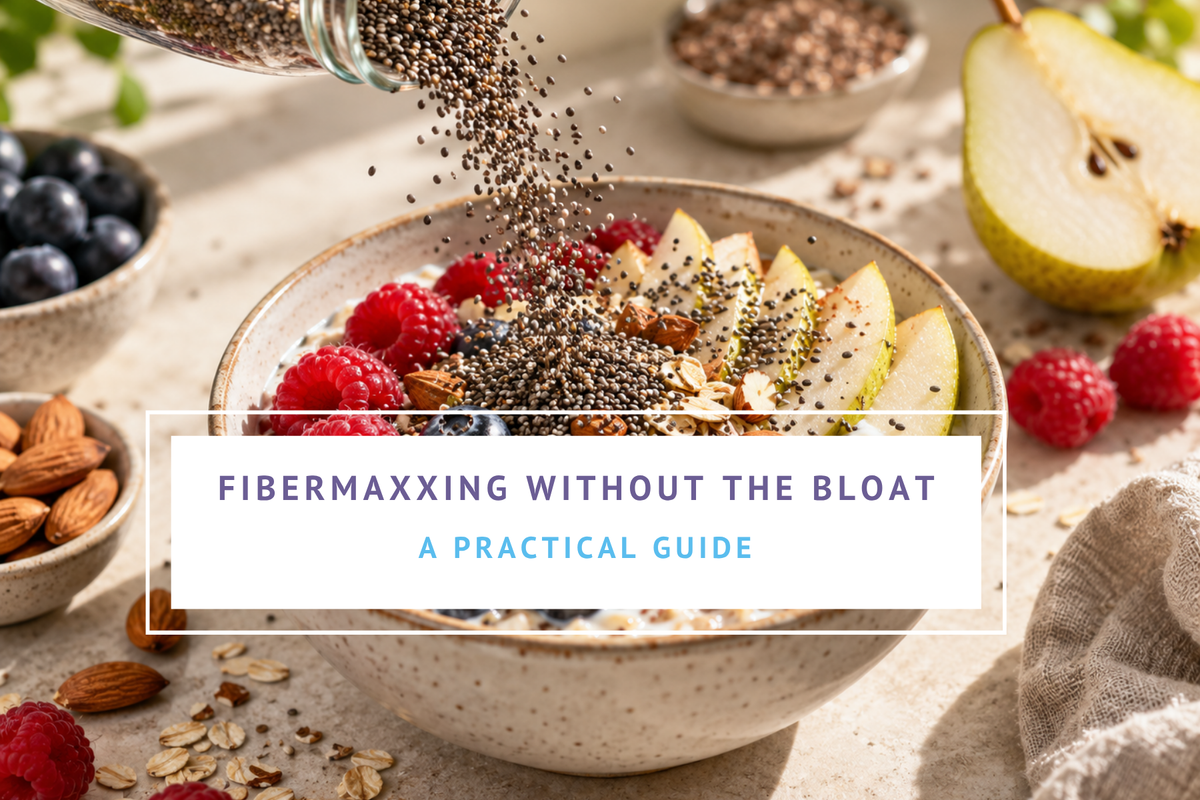
You saw the videos. Someone stirs chia seeds into yogurt, tops it with raspberries, and calls it their fibermaxxing breakfast. The comments are full of people saying they have never felt better.
Then you tried it. Three days later you were bloated, gassy, and wondering what went wrong.
Here is the thing: the idea behind the trend is solid. Most American adults really are falling short on fiber, and that gap has barely moved in nearly two decades of national survey data [9]. The problem is not fiber. The problem is how fast people are adding it.
This guide walks through what fibermaxxing actually is, what fiber does once it reaches your gut, what a realistic high-fiber day looks like, and the mistakes that turn a good idea into an uncomfortable week.
What Is Fibermaxxing?
Fibermaxxing is a social media term for deliberately building your meals around fiber. It is not a formal diet. There is no official rulebook and no single number everyone agrees on.
In practice, people who say they are fibermaxxing are usually doing some mix of these things:
- Adding chia seeds, ground flaxseed, or psyllium husk to meals they already eat
- Choosing beans, lentils, berries, and whole grains over lower-fiber swaps
- Eating vegetables at more than one meal a day
- Tracking daily fiber grams the way other people track protein
- Aiming for a target somewhere between 30 and 50 grams a day
The name is new. The advice underneath it is not. Fiber has been a nutrient of public health concern for years, and the FDA sets the Daily Value for dietary fiber at 28 grams per day, based on a 2,000-calorie diet [10].
Why the trend took off now
Protein had its moment. Fiber is having one now, partly because gut health became a mainstream topic and partly because a high-protein, low-carbohydrate eating pattern can quietly squeeze fiber out of the day.
What Fiber Actually Does in Your Body
Fiber is the part of plant food your small intestine cannot break down. It travels further than most nutrients, and that is exactly the point.
It feeds the bacteria in your large intestine
When prebiotic fiber reaches your colon, the bacteria living there ferment it. That process produces short-chain fatty acids such as butyrate, acetate, and propionate, which your body then uses [2]. This is the mechanism behind most of what people mean when they say fiber supports gut health.
It changes how food moves and how full you feel
Not all fiber behaves the same way, and this is the part most trend videos skip. Research on the physical behavior of fiber in the digestive tract makes a clear distinction [3]:
- Soluble fiber that forms a gel, like psyllium and beta-glucan from oats, holds onto water and thickens what is in your gut.
- Insoluble fiber that stays coarse, like wheat bran, adds bulk and helps move things along.
- Some soluble fibers, like inulin, dissolve without forming a gel and are fermented quickly instead.
That difference matters for comfort. A systematic review of randomized controlled trials found that the more viscous, gel-forming fibers were the ones most likely to affect appetite ratings in study participants [4].
It supports regularity when you drink enough with it
Fiber and fluid work as a pair. An analysis of national survey data found that low fiber intake together with low liquid intake was associated with irregularity in adults [8]. Adding fiber while staying dehydrated is working against yourself.
What the bigger research picture shows
A large series of systematic reviews and meta-analyses looked at fiber intake across many long-term studies. The strongest associations with better health markers showed up in people whose daily fiber intake fell between roughly 25 and 29 grams [1]. That is a helpful reference point. It also suggests that the very high targets floating around social media may be more than most people need.
Want This as a Plan Instead of an Article?
Our free 5-minute guide, Calm Your Gut Naturally, turns everything below into a gentle 7-day schedule.
Forget Grams for a Second. Count Plants.
Here is the shift that makes fibermaxxing click for most people. Instead of tracking grams, track how many different plants you eat in a week.
The reason is that your gut bacteria specialize. Different species prefer different fibers. Feeding your gut 40 grams from one source is a narrower diet, from your microbiome's point of view, than 28 grams from a dozen sources.
A large citizen science study of the gut microbiome found that people eating more than 30 different plant types per week had more diverse gut microbiomes than people eating fewer than 10 [11]. That study is observational, so it shows an association rather than proof of cause. Still, it is a useful and very practical way to aim.
What counts as a plant type?
More than you think. Types, not servings.
- Vegetables and fruit, including frozen
- Beans, lentils, and other legumes
- Whole grains, including oats, barley, and quinoa
- Nuts and seeds
- Herbs and spices, which absolutely count
Cinnamon on your oatmeal is a plant type. So is the basil on your pasta. Most people are surprised by their starting number, in both directions.
What a Healthy Day of Fibermaxxing Actually Looks Like
Here is a realistic day that lands around 40 grams without a single scoop of powder. Gram amounts are approximate and vary by brand and ripeness.
Breakfast: about 13 grams
- 1 cup cooked oatmeal, about 4 g
- 1 tablespoon chia seeds stirred in, about 5 g
- 1/2 cup raspberries, about 4 g
Morning snack: about 5 grams
- 1 medium pear, skin on, about 5 g
Lunch: about 14 grams
- 3/4 cup cooked lentils in a soup or grain bowl, about 11 g
- 1 cup mixed greens and raw vegetables, about 3 g
Afternoon snack: about 4 grams
- 1 ounce almonds, about 3.5 g
Dinner: about 7 grams
- 1 cup roasted broccoli, about 5 g
- 1/2 medium sweet potato, skin on, about 2 g
- Salmon or another protein of your choice
Daily total: roughly 40 grams. Notice what is not here. No single meal is carrying 25 grams on its own. The fiber is spread across five eating occasions, which is a big part of why a day like this feels fine.
Count the plant types in that day and you get oats, chia, raspberries, pear, lentils, salad greens, almonds, broccoli, and sweet potato. That is nine from one ordinary day. Three days like it, with a little variation, and you are near 30.
The Problems With Fibermaxxing, and How to Avoid Them
Most fibermaxxing side effects come down to a handful of avoidable mistakes.
Problem 1: Going from 12 grams to 45 grams overnight
This is the big one. Your gut bacteria adjust to what you feed them, and that adjustment takes time. Jump too fast and the fermentation produces more gas than you are used to.
How to avoid it: add about 5 grams per week and hold there until it feels normal. Getting from 15 grams to 35 grams should take about a month, not a weekend.
Problem 2: Taking a big dose of one fermentable fiber at once
Tolerance for inulin-type fibers is dose dependent. A double-blind, placebo-controlled, dose-ranging trial in healthy volunteers looked specifically at digestive tolerance of inulin-type fructans [5], and a separate trial in healthy adults measured gastrointestinal tolerance of agave inulin [6]. Broader reviews of nondigestible carbohydrate consumption report the same pattern: gas and bloating track with dose [7].
How to avoid it: split fiber across meals instead of front-loading it. Half a serving twice a day is usually easier than a full serving once.
Problem 3: Not drinking enough water
Gel-forming fibers need water to do what they do. Without it, you can end up feeling heavier and more backed up than you did before you started [8].
How to avoid it: pair every added fiber serving with a full glass of water, and keep fluids up through the day.
Problem 4: Treating powder as a shortcut to a plant-poor diet
A scoop of powder delivers one type of fiber. Whole plant foods deliver a mix, plus the vitamins, minerals, and polyphenols that come with them.
How to avoid it: use supplements to close a gap, not to replace produce. Food first, powder second.
Problem 5: Ignoring timing with medication and other supplements
Many fiber product labels advise separating the dose from medications, because fiber can affect how other things move through your gut.
How to avoid it: read your labels, leave a couple of hours between a fiber dose and your medications, and ask your pharmacist or healthcare provider if you are unsure.
Problem 6: Assuming more is always better
The research reference point is roughly 25 to 29 grams a day [1], and the FDA Daily Value is 28 grams [10]. Chasing 60 or 70 grams because a video suggested it is not supported by that evidence, and it is the fastest route to feeling miserable.
Who Should Check With a Provider First
If you are living with any digestive condition, have had abdominal surgery, are pregnant, or take daily medication, talk with your healthcare provider before making a large change to your fiber intake. This is general education, not personal advice.
Free 5-Minute Guide: Calm Your Gut Naturally
Every problem above comes down to one rule: fiber increases work better slowly. This guide is the gentle version, laid out day by day so you do not have to guess.
Inside the 7 pages:
- A 7-day plan that adds plants and water in the right order
- The 30 plant types a week method, with what counts
- A simple eat-more and eat-less list you can screenshot
- Why your gut lining and your joints belong in the same conversation
- Where supplements fit, and where they honestly do not
Enter your email and we will send it straight to your inbox. Unsubscribe anytime.
Get Calm Your Gut Naturally, free →
Key Takeaways
- Fibermaxxing means building meals around fiber on purpose. It is a trend name, not a formal diet.
- Fiber is fermented by gut bacteria into short-chain fatty acids your body uses [2].
- Fiber types are not interchangeable. Gel-forming, coarse, and rapidly fermented fibers behave differently [3].
- Research reviews point to roughly 25 to 29 grams a day as a sensible reference range [1]. The FDA Daily Value is 28 grams [10].
- Variety may matter as much as volume. Aim for about 30 different plant types a week [11].
- Spread fiber across the whole day rather than loading one meal.
- Increase slowly, about 5 grams per week, and drink water with every added serving [8].
Frequently Asked Questions
How much fiber per day is right for fibermaxxing?
There is no official fibermaxxing number. The FDA Daily Value for dietary fiber is 28 grams per day on a 2,000-calorie diet [10], and large research reviews found the strongest associations in the range of about 25 to 29 grams a day [1]. Most people are better served by reaching that range comfortably than by chasing a much higher target.
Why does fibermaxxing make me bloated?
Usually because the increase was too fast or the dose was too large at one sitting. Gut bacteria ferment fiber, and fermentation produces gas. Trials on inulin-type fibers show that tolerance depends heavily on dose [5][6][7]. Adding about 5 grams per week and splitting servings across meals gives your system time to adjust.
Is it better to count fiber grams or count plant types?
Both are useful, and plant types are easier to stick with. Grams tell you about volume. Plant types tell you about variety, and a study of more than 10,000 people found that those eating over 30 different plant types a week had more diverse gut microbiomes than those eating fewer than 10 [11]. It is an observational finding, so treat it as a helpful target rather than a proven rule.
Is it better to get fiber from food or a supplement?
Food first. Whole plants supply a mix of fiber types along with other nutrients, while a supplement typically supplies one. A fiber supplement is useful for closing a gap on busy days, not for replacing vegetables, beans, fruit, and whole grains.
Can I fibermaxx on a high-protein diet?
Yes. It usually means adding rather than removing. Lentils and beans bring both protein and fiber, and berries, chia seeds, and vegetables add fiber to meals you are already eating.
How long does it take to adjust to more fiber?
It varies from person to person. Many people find that gas and bloating settle within a few weeks of a gradual increase. If discomfort continues or gets worse, scale back and talk with your healthcare provider.
Does cooking change the fiber in vegetables?
Cooking softens plant structure and changes texture, but it does not remove the fiber. Peeling does reduce it, which is why leaving the skin on pears, apples, and sweet potatoes is an easy win.
Start Slow. We Will Send You the Plan.
Fibermaxxing works best when it is boring and consistent. Pick two meals, add one high-fiber food to each, drink water with them, and hold that pattern for a week before adding more.
If you would rather not build that schedule yourself, we already did. Calm Your Gut Naturally is our free 5-minute guide: a 7-day ramp, the 30-plant method, and a straight answer on where supplements actually fit. It takes about five minutes to read and a week to run.
Get Calm Your Gut Naturally, free →
Seven pages. No cost. Unsubscribe anytime.
References
- Carbohydrate quality and human health: a series of systematic reviews and meta-analyses. The Lancet, 2019. PMID 30638909. Read on PubMed
- From Dietary Fiber to Host Physiology: Short-Chain Fatty Acids as Key Bacterial Metabolites. Cell, 2016. PMID 27259147. Read on PubMed
- Understanding the Physics of Functional Fibers in the Gastrointestinal Tract: An Evidence-Based Approach to Resolving Enduring Misconceptions about Insoluble and Soluble Fiber. PMID 27863994. Read on PubMed
- Effects of dietary fibre on subjective appetite, energy intake and body weight: a systematic review of randomized controlled trials. PMID 21676152. Read on PubMed
- Digestive tolerance of inulin-type fructans: a double-blind, placebo-controlled, cross-over, dose-ranging, randomized study in healthy volunteers. PMID 18608562. Read on PubMed
- Gastrointestinal tolerance and utilization of agave inulin by healthy adults. PMID 24664349. Read on PubMed
- Gastrointestinal Effects and Tolerance of Nondigestible Carbohydrate Consumption. PMID 36041173. Read on PubMed
- Association of low dietary intake of fiber and liquids with constipation: evidence from the National Health and Nutrition Examination Survey. PMID 23567352. Read on PubMed
- Analysis of 1999-2017 NHANES Data: Minimal Increase and Racial Disparities in U.S. Fiber Consumption Over 18 Years. PMID 38351837. Read on PubMed
- U.S. Food and Drug Administration. Interactive Nutrition Facts Label: Dietary Fiber, October 2021. Read on FDA
- American Gut: an Open Platform for Citizen Science Microbiome Research. mSystems, 2018. PMID 29795809. Read on PubMed
This article is for educational purposes only and is not medical advice. Individual fiber needs and tolerances vary.


